Ex-Government Trade Official Sees Changes Under New Administration And Congress


David Spooner served as the Bush administration’s chief textile negotiator and assistant
secretary of commerce for import administration. In those positions, he was the administration’s
point man for textile negotiations in Central America, Latin America, Asia and the Middle East. As
he left government service and joined the global law firm of Squire, Sanders & Dempsey LLP,
Spooner shared his views on the outlook for textile trade with
Textile World’s Washington Correspondent Jim Morrissey.


David Spooner expects a pause in what was the Bush administration’s aggressive move toward
free trade as the Obama administration and the new Congress wrestle with ways to deal with the
worldwide economic recession. He sees the likelihood of a move toward greater protectionism, as has
happened in the past, but believes that is the wrong way to go.

“When companies run into tough times and start losing markets and jobs, the instinct is to
turn toward protectionism, and we saw that when that happened in the 1930s, it only exacerbated the
problem, and that is not the way to go,” Spooner said in a far-ranging interview assessing the
textile trade accomplishments of the Bush administration and the future outlook.

Spooner cites as major accomplishments the Bush administration’s success in making the
Western Hemisphere nations more competitive with Asia as a result of a number of free trade
agreements (FTAs). He also says the safeguard quotas agreed to between the United States and China
helped prevent disruption of apparel trade between the two countries and helped minimize
uncertainties in the marketplace.

Asked what, if any, disappointments he has with textile trade, Spooner said he wishes more
could have been done with more countries to strengthen trade in the Western Hemisphere, citing the
failure to create a free trade area of the Americas as one example. He also wishes there could have
been an agreement with Ecuador and that the Colombia FTA would have been approved by Congress. He
says it is important to link textile production in the United States with apparel manufacturing in
the hemisphere.

Spooner certainly does not see any moves toward trade liberalization “right now,” as both
Congress and the new administration are reassessing US trade policies.

With the textile import safeguards expiring, he said, “Everyone is holding their breath to
see if there is an import surge similar to what happened when most textile quotas were removed in
2005.” If a surge does occur, he believes there will be a demand for anti-dumping and
countervailing duty cases, or China could agree to some form of a monitoring system and
self-regulation. He noted that China has a monitoring program in effect with European nations, but
it is not very transparent, and as a result, it is unclear as to how it actually will work.

Spooner says the North America Free Trade Agreement, which was cited during the presidential
campaign as a problem that should be renegotiated, is not the cause of the US trade deficit, and
neither are other FTAs through which the United States in many cases enjoys trade surpluses. 
He says that 95 percent of the US trade deficit is with countries with which the United States does
not have trade agreements. He believes the United States is correct in addressing illegal export
subsidies in other countries, and that attacking them and negotiating the removal of trade barriers
would help US manufacturing.

With all of these factors to be considered, and many questions about how the Obama
administration and Congress will address them, Spooner believes there is a lot of uncertainty
surrounding textile trade in the future.

January 13, 2009
The Rupp Report: The (Cotton) Empire Strikes Back

The relative 50:50 equilibrium between natural and man-made fibers in global fiber consumption,
which existed for decades, is the object of constant change. At present, cotton only has some 37
percent of global fiber consumption; and wool, 3 percent. Improved fibers and still better fabrics
have steadily corrected the previous, negative image of man-made fibers. Experts predict that by
2010, man-made fibers will have a global market share of 72 percent; cotton, 26 percent; and wool,
2 percent.

International Year Of Natural Fibers

The United Nations General Assembly has declared 2009 to be the International Year of
Natural Fibers (IYNF). Natural Fiber industries provide employment to hundreds of millions across
almost all countries. Natural fibers are renewable, sustainable and economical; and provide
excellent performance characteristics for consumers. The International Cotton Advisory Committee
(ICAC) acknowledged the work of the Food and Agriculture Organization (FAO) of the United Nations
in coordinating the IYNF.

Completion Of Doha Round Needed

According to a recent Cotton Report, ICAC members acknowledged that the consequences of the
ongoing global financial crisis were having particularly adverse effects on the cotton sector.
Members hoped that an early and successful conclusion of the Doha Round would resolve the
outstanding issues of the cotton dossier in the Doha Development Agenda (DDA) and help to mitigate
the crisis in this sector. Members agreed that an ambitious and balanced outcome to the Doha Round
remains a strategic objective of ICAC. The ICAC members welcomed the leadership provided by the G20
Summit as expressed in the Declaration of the Summit on Financial Markets and the Global Economy,
on Nov. 15, 2008, in Washington.

The ICAC Members called on World Trade Organization (WTO) members to engage intensively to
achieve modalities this year. They reaffirmed the continued validity of the two-track treatment of
cotton in the DDA. They acknowledged the progress made on both the trade policy and the development
assistance aspects. They urged WTO members to act urgently to resolve the outstanding issue of the
treatment of the cotton dossier in the domestic support pillar of the agriculture negotiations and
to make faster progress on the implementation of the commitments on the development assistance
aspects.

African Cotton

The committee also observed that cotton has been an economic success story in sub-Saharan
Africa. Cotton is a major source of foreign exchange earnings in more than 15 countries of the
continent and is a crucial source of cash income for millions of smallholder farmers and their
families. At the same time, cotton is a source of major concern on the continent because of
declining production, compounded by unfavorable external factors such as exchange rates and market
distortions. The committee acknowledged the strenuous efforts of governments and the private sector
in African countries to ensure long-term competitiveness.

4 Cents A Pound

According to recent documents released by the US Department of Agriculture and the Commodity
Credit Corporation (CCC), a corporate agency of the US government, The Food, Conservation, and
Energy Act of 2008 and Upland Cotton Economic Adjustment Assistance Program presents interesting
opportunities for US users of eligible upland cotton.

For spinners, papermakers and nonwoven cotton product producers, the program will pay 4 cents
per pound for eligible cotton opened by the producer each year for the next four years. In year
five of the program, payments by the CCC will be reduced to 3 cents per pound.

With an estimated 4 million, 480-pound bale usage, the industry would consume 1.92 billion
pounds of cotton worth potential payments of $76.8 million per year for four years, totaling $307.2
million, with a fifth year worth an additional $57.6 million. Depending on usage and qualification
of cotton, product and users, the investable funds could reach $365 million over the course of five
years.

For details, see “
Cotton
Funding Promotes Investment
,” www.TextileWorld.com, Jan. 6, 2009.

January 13, 2009

NCSU Researchers Develop Process To Make World’s Strongest Polyester Fibers

A new fiber-making process developed at the North Carolina State University (NCSU) College of
Textiles, Raleigh, N.C., enables production of what researchers believe are the strongest polyester
fibers ever made using a process considered industrially acceptable. According to Dr. John A.
Cuculo and Dr. Richard Kotek, leaders of the NCSU research team, the process is based on two
established processes, taking them a step further with respect to controlling thread line dynamics,
and modifying the molecular architecture to offer  “exceptionally high-performance fiber
properties.”

The horizontal liquid isothermal bath (hLIB) process technology is a modified version of LIB
technology developed in the 1990s at NCSU for laboratory-scale production of high-tenacity
polyethylene terephthalate and polyethylene naphthalate fibers. The hLIB process is intended to
enable industrial-scale production of these fibers from conventional melt polymerized polymer,
using melt-spinning to form the fibers but allowing additional controllable variables to be used,
as in wet-spinning. As such, it hopefully could replace the traditional melt spin-draw process.

Compared with the currently used fiber-making processes, the new system is more
environmentally friendly and energy-efficient, is simpler to use, and requires less capital
equipment. For example, the multi-stage draw unit used in the traditional spin-draw process could
be eliminated, and the drawing or heat-setting could be part of a relatively simple one-step
continuous spin-draw process.

“We have shown some very marked property enhancement by this process on a single filament,”
Cuculo said. “The next step is to reproduce it in multifilament.”

Cuculo and Kotek have proposed a patent for their work and are seeking funding to help them
continue their research. Among their needs is a traversing high-speed winder that has processing
speeds of about 5,000 meters per minute.

January 13, 2009

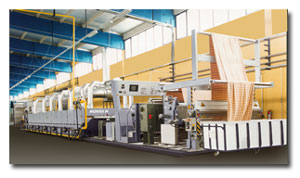
Monforts Unveils Montex JV

Germany-based A. Monforts Textilmaschinen GmbH & Co. KG has introduced the Montex JV, a tenter
designed and engineered in Germany, and produced in China at Monforts Fong’s Textile Machinery Ltd.
— a joint venture between Monforts and Hong Kong-based Fong’s Industries Co. Ltd.

montex

According to the company, the Montex JV is a competitively priced machine suitable for
standard finishing techniques on both woven and knitted fabrics and offers four to 10 treatment
chambers, operating speeds of between 5 and 100 meters per minute and working widths of between 60
and 240 centimeters. The machine is not equipped with all of the options available on the Montex
6500 and 7000 series machines, but it does come standard with Monforts’ TwinAir system, which
separately controls the top and bottom airflows to ensure reproducible results; a Golden Hercules
tentering chain, which can extend regreasing intervals to more than 12,000 hours depending on the
operating conditions; fully encapsulated bearings with a patented direct lubrication system; and
the fully programmable Mastermind programmable logic controller control system.

The new tenter will be marketed outside China through Monforts in Germany, and all service
and spare parts will be handled in Germany.

January 13, 2009

VTOF Debuts First Organic Washable Wool Fabrics

Middlebury, Vt.-based Vermont Organic Fiber Co. (VTOF), a provider of organic wool yarn, fabrics
and blankets, will launch its line of O-Wool® Washable fabrics at the Outdoor Retailer Winter
Market, to be held January 22-25 in Salt Lake City. According to the company, the fabrics, made
with organic Merino wool produced and certified to the US Department of Agriculture (USDA) organic
livestock standard, are the first such fabrics produced in the United States.

O-Wool is available in weights of 120-, 220- and 250-grams per square meter; and, according
to VTOF, will not shrink or felt during washing thanks to its 3e-WOOL® ecological, essential,
easy-care processing, which uses hydrogen peroxide and mechanical action to shrink the wool instead
of chlorine. The Oeko-Tex Standard 100-certified process also requires only one-third the amount of
water used by chlorine-based processes. VTOF reports its own testing also has shown that O-Wool is
superior to conventional washable wool with regard to anti-pilling properties.

“As the market for sustainable fibers grows, more and more companies were asking us for
washable wool fabrics made with organic wool, so we created a product that would have the least
environmental footprint and the best quality possible,” said Matthew Mole, president, VTOF.

O-Wool yarns and fabrics are spun, knit, woven and finished at plants in Massachusetts,
Pennsylvania, Rhode Island and South Carolina. Woolen spinning in the United States and worsted
spinning produced with partner mills in China are certified to the Global Organic Textile Standard.

January 13, 2009

Nilit Introduces Recycled Yarns

Israel-based Nilit Ltd. — a global manufacturer of nylon 6,6 fibers — has launched a line of
recycled yarns produced from a combination of Nilit® polymers and polymer waste. According to the
company, the development is a breakthrough in yarn engineering and production, as the process
involves shortened energy-consuming stages such as evaporation, reduces pollution, and does not
require autoclave use.

“With increasing demand for eco-friendly yarns and products, we decided to develop yarn spun
primarily from this recycled polymer,” said Alon Weiser, research, development and technical
service manager, Nilit. “We overcame the variability in efficiency and low-dye affinity by mixing
90 percent of the recycled polymer with 10 percent of our deep dye polymer to achieve a rich color.
The yarns have excellent uniformity and color depth, which makes them well suited for seamless
apparel, legwear and for other textile end-uses.”

Nilit recycles its yarn waste, re-melting it to produce polyamide chips. According to the
company, the process uses less energy compared to fiber spun from virgin polymers. Nilit also
captures energy from its facilities and reuses it in its manufacturing processes; has replaced
plant boilers with low-emission burners; and has reduced sulfur levels through the use of specially
designed systems.

“At the corporate level, we have a ‘zero waste’ policy,” said Fabio Kahn, Fibers Division
director, Nilit. “This development reinforces our company philosophy to respect and protect the
environment. Over the years we have consistently looked for ways to conserve water, reduce
emissions, recycle waste, and operate a cleaner enterprise.”

January 13, 2009

DSM Opens China Campus

The Netherlands-based Royal DSM NV, a life and materials sciences company that manufactures
Dyneema® high-performance polyethylene fiber and other products, recently opened the DSM China
Campus in the Zhangjiang Hi-Tech Park in Pudong New Area, Shanghai, which will serve as its
regional headquarters in China. The campus is DSM’s largest outside of Europe and the United States
and will focus on local research and development (R&D) for the Chinese market. All DSM Shanghai
offices, the DSM China R&D center and several other DSM business groups are located on the
campus.

“We know China not only as a market and a production base, but also as a strategic starting
point for research and development,” said Jan Zuidam, deputy chairman, DSM’s Managing Board. “In
DSM’s accelerated Vision 2010 with focus on Life Sciences and Materials Sciences, China plays an
important role regarding growth and innovation.”

The campus also is one of the first Leadership in Energy and Environmental Design (LEED)
Gold-certified buildings in China. The US Green Building Council, which developed the LEED
certification, promotes buildings that are healthy to live and work in and also are environmentally
responsible. DSM’s new campus can house more than 600 employees in 26,000 square meters of space.
From renewable and locally available building materials to transportation and water and energy
savings, the design and operation of DSM’s campus met the requirements of the LEED Gold
certification.

“As one of the most sustainable companies in our sector, we are committed to great
achievements in sustainable development,” said Dr. Jiang Weiming, president, DSM China. “The
environmental design standards we have adopted for the campus embody our consistent excellence in
sustainable development. We are responsible for providing a healthy and safe ‘green home’ for our
employees, and I believe it will be a new start for our contribution to sustainable development in
the fields of life sciences and materials sciences in China.”

January 13, 2009

Troy Corp Increases Polyphase® And Mergal® Biocides Prices

Florham Park, N.J.,-based Troy Corp. has increased the price of its Polyphase® biocides as follows:
Polyphase P100, 18 percent; Polyphase AF1, 14 percent; Polyphase AF3, 13 percent; and Polyphase
P20T, 10 percent. The company also has increased the price of its Mergal® 186 and Mergal 192
biocides by 5 percent.

Troy cites regulatory compliance and key raw materials cost increases that are not offset by
decreases in freight, petroleum-related raw materials and energy costs as the reason for the
increases.

January 13, 2006

The Rupp Report: Thanks For Your Feedback

Some of you may remember Watergate. The Watergate scandals were a series of American political
scandals during the presidency of Richard Nixon that resulted ultimately in his resignation on
August 9, 1974. Even the movie “All the President’s Men,” with Robert Redford and Dustin Hoffman,
has become a legend. But the issue for this report is not what happened, but how it was discovered:

Thanks To The Independent (Or Free) Press

The Washington Post revealed the immense scope of crimes and abuses, which included among
many others campaign fraud, political espionage, sabotage and illegal break-ins. Its writers, Bob
Woodward and Carl Bernstein, got the freedom from their editor-in-chief to follow-up the true story
and eventually published the whole story behind the curtains. With certainty of an impeachment in
the House of Representatives and of a conviction in the Senate, Nixon resigned, becoming the only
US president to have resigned from office.

The Link

So what is the link between Watergate and this report? There is quite a lot. The Rupp Report
has been “on the air” since mid-2007. In 2008,

Textile World
published 50 reports. The feedback from all over the world is sometimes pretty astonishing,
and, frankly speaking, very encouraging. Most of the feedback refers to the fact that the readers
appreciate the open expression — even if the reports are from time to time rather provocative, but
always honest. Like “Deep Throat” revealing the Watergate story, we often get our basic information
from readers to elaborate a new report.

Nothing’s For Free

However, even the independent press is not for free. Its work has to be paid for. I remember
years ago a rather intense discussion with the owner of a textile machinery company. He was very
well-known in the global trade press for sending out countless editorials without ever placing any
advertisements. He argued that the press as such must be happy to get a lot of articles to publish,
and that it is the duty of the media to do so. I replied and asked him how many machines he gives
away for free before charging his customers? Not one, he replied. You see, said I, you expect from
the press what you are not willing to do: a job free of charge. That’s not the same, he said. Of
course it is, I replied. You are producing machinery and we are producing magazines — or, in this
case, Rupp Reports. The consequence of the discussion was that he left in anger.

Your Positive Feedback

In personal encounters — mostly mill visits and exhibitions — people mention that it is good
to have at least the Rupp Report and Textile Industries Media Group’s magazines that write openly.
They appreciate our work and the freedom of expression. Readers often mention that they see a
declining of quality press; prefabricated articles are more and more in the foreground. “
Advertorial” is one of the key words. This is a blend of the words “editorial” and “advertising.”

However, to carry on with our job,

TW
needs your support. The year 2009 will be probably one of the toughest years in decades.
Every company, including in the textile industry, is saving money and spending their money only
where there’s value.

TW
will continue its support for the textile industry to publish true stories. We hope you don’t
forget us with your support.

In this spirit, for 2009 we wish you a strong will and the ability to carry on. As the new
president-elect from the United States says, “Yes, we can,” and we will. And don’t forget your
feedback to
jrupp@textileworld.com

January 6, 2009

Cotton Funding Promotes Investment


A
ccording to recent documents released by the US Department of Agriculture and the
Commodity Credit Corporation (CCC), a corporate agency of the US government, The Food,
Conservation, and Energy Act of  2008 and Upland Cotton Economic Adjustment Assistance Program
presents interesting opportunities for domestic users of eligible upland cotton.

For spinners, papermakers and nonwoven cotton product producers,  the program will pay 4
cents per pound for eligible cotton opened by the producer each year for the next four years. In
year five of the program, payments by the CCC will be reduced to 3 cents per pound. The payments,
intended to support the competitiveness of domestic users of eligible baled upland cotton
regardless of origin, must be reinvested in plant and equipment.

cottonbills


Use Of Payments


The application provided by CCC states: “The Agreement Holder must make capital expenditures
equal to, or greater than, any amounts paid by CCC within 18 months following the end of the
marketing year for which the payment was claimed. A marketing year [runs from] August 1 through
July 31.”

By example, the CCC states, “Payment received for all cotton consumed between August 1, 2008,
and July 31, 2009, (Marketing year 2008) must be spent on authorized expenditures by the end of
February 2011.”

Authorized expenditures include “costs incurred for purchases of land, or the acquisition,
construction, installation, modernization, development, conversion, or expansion of depreciable
fixed assets. Such capital expenditures must be directly attributable to the purpose of
manufacturing upland cotton into eligible cotton products in the United States.”


Big Numbers


In speaking with industry sources,

Textile World
was given the example of a 30,000-spindle spinning frame using approximately 370,000 pounds
of cotton per week. At 4 cents per pound, the spinner is reimbursed $14,800 per week for four years
and $11,100 per week for the fifth year, for a total reimbursement of close to $3.6 million through
the end of the five-year program. When considering a 10-year depreciation of machinery and the
reimbursement, there is the strong possibility of a significant investment opportunity.

The industry might also upgrade and diversify product lines. Adding novelties or specialties,
or increasing efficiencies certainly are possibilities. Spinners that have been eyeing the
nonwovens industry might be able to leverage their spinning operations to create an investment pool
for entering a new nonwovens business. Nonwovens manufacturers may extend their lines as well.

With an estimated 4 million, 480-pound bale usage, the industry would consume 1.92 billion
pounds of cotton worth potential payments of $76.8 million per year for four years, totaling $307.2
million, with a fifth year worth an additional $57.6 million. Depending on usage and qualification
of cotton, product and users, the investable funds could reach $365 million over the course of five
years.

Few might expect considerable investment in US textiles in 2009. The Upland Cotton Economic
Adjustment Assistance Program, however, could have significant beneficial  impact for years to
come.

January 6, 2009

Sponsors