The National Council Of Textile Organizations (NCTO) Applauds Trump Administration’s Move To Crack Down On Imported Counterfeits Sold Online

WASHINGTON — January 24, 2020 — The National Council of Textile Organizations (NCTO), representing the full spectrum of U.S. textiles from fiber through finished sewn products, issued a statement today on the Trump administration’s announced action plan to increase enforcement and penalties against counterfeit goods sold online and imported to the United States.

“This is a very important and long overdue move on the part of the administration to increase enforcement activity and penalties against counterfeit goods sold online and imported into the United States,” said NCTO President and CEO Kim Glas. “We commend the administration for making a commitment to bolster efforts to crack down on counterfeits, particularly in the textile and apparel sector, which has been hit hard by fake imported products for decades.”

Nearly two million shipments of goods are exported to the United States duty free each day — often from countries with poor labor, human rights and environmental track records — under a provision known as Section 321 de minimis. This provision allows goods valued below an $800 threshold to enter the U.S. duty free when imported directly to an individual on a single day.

“This massive increase in de minimis shipment trade poses significant security risks and threats to public health and safety, while incentivizing customs fraud and creating a loophole to our entire tariff structure,” Glas said. “Our concerns regarding the de minimis loophole are exacerbated by the belief that the domestic textile industry and other U.S. manufacturing interests are directly and negatively impacted, particularly since e-commerce sites like Amazon and others are using de minimis as a duty-free portal into the U.S. for products under $800.”

Furthermore, CBP’s own annual report on intellectual property seizures, including large volumes of counterfeits, revealed that U.S. authorities made seizures totaling $1.4 billion in fiscal 2018. Over 90 percent of all intellectual property (IPR) seizures occur in the international mail and express shipment environments, according to the report, which is a common method of shipping by e-commerce sites.

Chinese products accounted for 46% of all IPR seizures with a total Manufacturers Suggested Retail Price (MSRP) value of $761.1 million in FY 2018. Apparel and accessories were the top counterfeit products seized by U.S. authorities, accounting for 18% of all seizures in FY 2018 with an MRSP value of $115.2 million.

“We think this is an important step forward by the administration to deepen the analysis on de minimis products that are often not thoroughly examined and undercut our domestic manufacturing industries,” Glas said. “We don’t know what the products are, where they are coming from, whether they meet U.S. safety requirements, who is making them or the country of origin. We believe it is long past time for the administration to address the issue of de minimis shipments and counterfeiting head on.”

NCTO is a Washington, DC-based trade association that represents domestic textile manufacturers, including artificial and synthetic filament and fiber producers.

  • U.S. employment in the textile supply chain was 594,147 in 2018.
  • The value of shipments for U.S. textiles and apparel was $76.8 billion in 2018.
  • U.S. exports of fiber, textiles and apparel were $30.1 billion in 2018.
  • Capital expenditures for textile and apparel production totaled $2.0 billion in 2017, the last year for which data is available.

Posted January 24, 2020

Source:  The National Council of Textile Organizations (NCTO)
IFAI: Entries Open For 2020 Student Design Competition

ROSEVILLE, Minn. — January 24, 2020 — Industrial Fabrics Association International (IFAI) has announced that entries are open for the 2020 Student Design Competition. This competition offers any student currently enrolled in a school or university the opportunity to submit a project in one of two categories for the chance to win an award and prize package.

This year’s categories are in the areas of advanced textiles and fabric structures. To submit a project in the advanced textiles category, a student must design project for aerospace, medical, military, safety/protective or other wearable and non-wearable textile technology applications. In the fabric structures category, a student must design a fabric structure measuring 38-200 square meters that provides a shelter and architectural interest for an area on their school campus.

There will be two 1st place winners, one for each category. These winners will win a prize pack valued at over $6,000 which includes a trip to IFAI Expo 2020, the 100th anniversary of the show, in Indianapolis, Ind., Nov 4-6, 2020. The deadline for students to submit their projects is May 15, 2020.

For more information and to submit a project, please visit ifai.com/student-design-challenge.

Posted January 24, 2020

Source:  Industrial Fabrics Association International (IFAI)

Huntsman Textile Effects Partners With Xenon Arc To Form NaviColor

SINGAPORE — January 24, 2020 — Huntsman Textile Effects and Xenon arc today announced the formation of NaviColor, a dedicated marketing channel to service the unique needs of select customers in the United States textiles and apparel industry.

NaviColor features a dedicated team of professionals in a highly advanced technological environment to support customers utilizing Huntsman’s Textile Effects innovative chemicals, dyes and digital inks in the United States.

“NaviColor represents a significant investment in our customer experience and will help us enhance how we deliver value to our customers,” said Brook Swinston, Huntsman Textile Effects commercial director Americas. “Huntsman is a recognized global market leader and innovator in textile dyes, chemicals and digital inks. This approach enables us to be closer to our customers, deliver value and react with more agility.”

NaviColor is the latest deployment of Xenon arc’s innovative xa-Direct model that helps the world’s preeminent manufacturing companies reach, grow and more effectively service the needs of their customer bases. Leveraging its domain expertise of the marketplace, combined with extensive voice of the customer research and leading-edge technology platform, the xa-Direct model delivers enhanced customer intimacy, valuable insights and improved customer service levels.

“We are excited to partner with Huntsman Textile Effects,” commented Mica Zuniga, Vice President of Strategic Growth for Xenon arc. “Together, we have created a thoughtful and complete offering focused on delivering best-in-class service, and technical support to valued customers by representing Huntsman Textile Effects market-leading products.”

NaviColor will exclusively represent Huntsman Textile Effects product portfolio including:

  • Dyes;
  • Chemical Auxiliaries; and
  • Digital Inks.

Posted January 24, 2020

Source:  Huntsman Textile Effects

Hohenstein Advances Textile Sustainability With Microfiber Analysis

BÖNNIGHEIM, Germany — January 23, 2020 — Hohenstein has completed the development of its new method for analyzing microfiber shedding from textiles. Using dynamic image analysis, the method quantifies shedding behavior and reveals previously unattainable data with practical implications for material development throughout the supply chain.

The new method is the result of four years of research at Hohenstein, published in an article by lead researcher Jasmin Haap. The research team developed, refined and validated an analytical method that goes beyond current approaches of measuring the shedded mass to quantify fiber count, length, diameter and shape.

Further analysis can reveal the distribution of these attributes and even generate separate results for cellulosic fibers (e.g. cotton) and non-cellulosic fibers (e.g. polyester). This analysis is currently available exclusively through Hohenstein.

With this level of detail, researchers can now quantify in more detail which types of fiber and material constructions contribute most to microfiber release, leading to informed decisions in development of more sustainable textiles that shed less.

Synthetic microfibers are tiny pieces of plastic released into water during mechanical stress, particularly washing. Wastewater containing microfibers eventually flows through sewage into larger bodies of water. Along the way, synthetic microfibers attract harmful substances and pollutants from the environment, harming sea life and entering the food chains of larger fish and humans.

Dynamic image analysis of wastewater is non-destructive, allowing additional tests, such as filtration, to be performed for further analysis. Filtration, the most common method to date, involves filtering the wastewater from textile laundering, then weighing the remaining particles.

In November 2019, Hohenstein joined the Microfibre Consortium as a contributing research member.

Posted January 24, 2020

Source:  Hohenstein

Talking Sustainability With Monforts Denim Customers

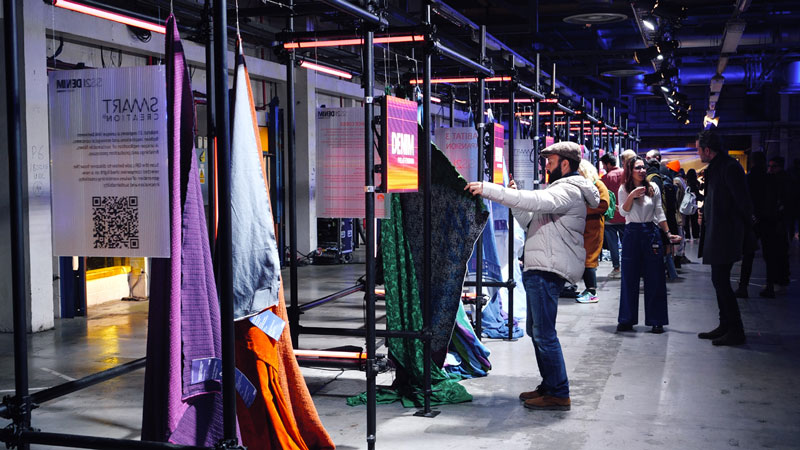
MÖNCHENGLADBACH, Germany — January 24, 2020 — In the latest short film released on the Monforts YouTube Channel — captured during the recent Denim Première Vision show in London — some of the leading global manufacturers discuss their initiatives for more sustainable denim production.

Cone Denim, based in Greensboro, N.C., for example, can lay claim to having put in place its first environmental control measures back in the 1940s when the company first started recycling its water.

“It was a method of efficiency even back then, eighty years ago,” says Gabriel Magopat, of the company’s England-based customer service center, “but producing high quality products is another method of being sustainable and of being efficient, and I think that’s what Cone stands for. We have an amazing history.”

Cone Denim is known for its signature S Gene® stretch denims which have traditionally incorporated polyester components to provide the stretch. It has now partnered with Intrinsic Advanced Materials of Gastonia, N.C., to introduce patent-pending CiCLO stretch polyester fibers into its denim collections.

While still being synthetic based, CiCLO polyester is able to biodegrade in marine environments, wastewater treatment plants and landfill conditions, at rates similar to natural fibers like wool.

This more sustainable solution for stretch is also being introduced to China for the first time by another leading denim supplier, Advance Denim.

“Advance Denim is spending its resources on being the most technologically advanced company in China, and also the most sustainable,” says Mark Ix, the company’s director of marketing. “We are investing heavily in our manufacturing to save both water and chemicals to create cleaner products.”

Monforts denim customer Berto is a family-owned company with its main denim mill in Bovolenta, a small rural town near to Padua in the north east of Italy, where respect for the environment has always been a must.

“The family has always been focused on respect for the environment,” says Berto’s Marketing Manager Francesca Palento. “In particular, we have a river next to the company from which we take our water for production and we then return it cleaner than it was before. We are also now producing GOTS and Global Recycling Standard jean produced with yarns made from our own internal waste production.”

Pakistan’s Soorty has recently received Cradle to Cradle Gold certification — the most stringent and exacting sustainable standard currently in existence — for its Pure D range of denims. These are produced using the company’s proprietary Zero Waste Water dyeing technology, in combination with the most advanced Monforts finishing machines.

“Our very latest collection is called Climate Jeans, because every single product we now produce draws attention to the climate emergency we are living through right now,” says Eda Dikman, Soorty’s marketing communications manager. “Sustainability is very important to us because we produce at scale and all of the actions we take reflect on the planet.”

The Monforts Denim PV film can be viewed by visiting the Monforts website at www.monforts.de/en/latest-news-media/

Posted January 24, 2020

Source:  A. Monforts Textilmaschinen GmbH & Co. KG

Eau Claire-Based Laundry Continues Certification For Hygienically Clean Food Safety

ALEXANDRIA, Va. — January 24, 2020 — Huebsch Services — provider of work uniforms, floor mats and cleaning supplies to business in western Wisconsin and the Minneapolis-Saint Paul area, —recently achieved recertification for Hygienically Clean Food Safety certification, reflecting its commitment to best management practices (BMPs) in laundering as verified by on-site inspection and its capability to produce hygienically clean textiles as quantified by ongoing microbial testing. Huebsch was first certified for the Hygienically Clean Food Safety certification in 2016.

The certification confirms the laundry’s dedication to compliance and processing garments and linens using BMPs as described in its quality assurance documentation, the focal point for inspectors’ evaluation of critical control points (CCPs) that minimize risk. The independent, third-party inspection must confirm essential evidence that:

  • Employees are properly trained and protected;
  • Managers understand legal requirements;
  • OSHA-compliant; and
  • Physical plant operates effectively.

To maintain their certification, laundry plants must pass quarterly testing of outcome-based microbial testing, indicating that their processes are producing Hygienically Clean garments and other reusable textiles with diminished presence of harmful bacteria.  Testing ensures that as laundry conditions change, such as water quality, textile fabric composition and wash chemistry, laundered product quality is consistently maintained. This process eliminates subjectivity by focusing on outcomes and results that verify textiles cleaned in these facilities meet appropriate hygienically clean standards and BMPs for animal processing, dairies, fruit/vegetable, bakeries, grain and other food and beverage industry segments.

Hazard Analysis and Critical Control Points (HACCP) practices are examined in the Hygienically Clean Food Safety inspection process, evaluating the plant’s techniques for:

  • Conducting hazard analysis;
  • Determining CCPs, monitoring their control, correcting them if not under control;
  • Validating and verifying HACCP system effectiveness; and
  • Documenting and record-keeping to show ongoing conformance.

On-site inspections also evaluate practices relevant to handling and processing textile products used in food manufacturing/processing establishments for adherence to U.S. Food and Drug Administration (FDA) and Centers for Disease Control and Prevention (CDC) directives. Introduced in 2014, Hygienically Clean Food Safety brought to North America the international cleanliness standards for laundering garments and other textile products for food manufacturing used worldwide by the Certification Association for Professional Textile Services and the European Committee for Standardization.

“Congratulations to Huebsch Services on their recertification,” said Joseph Ricci, TRSA president and CEO. “This achievement proves their laundry takes every step possible to prevent human illness.”

Posted January 24, 2020

Source:  TRSA

D3O Commits To Protecting Our Planet With New Recycled Impact Protection Material: D3O® Zero™

CROYDON, England — January 23, 2020 — Impact protection company D3O, today announced the launch of D3O® Zero™, which is created by recycling the surplus from D3O’s signature impact protection materials. Like those original D3O materials, D3O Zero will be incorporated into athletic headgear, padded gloves, and other products to offer maximum impact protection, while working towards zero waste.

“We are pleased to introduce D3O Zero, a material with the same great performance that we have always offered, but with more than 70 percent recycled components,” said Mostyn Thomas, general manager and chief marketing officer at D3O. “D3O is committed to social responsibility and as such, it is important that we find use for surplus D3O material to keep it out of landfills. D3O Zero is a product of our dedication to protecting not just people and products from impact, but also the environment.”

D3O Zero is compliant with the EU Registration, Evaluation, Authorization and Restriction of Chemicals (REACH) regulation and meets the Global Recycled Standard (GRS). The durable, flexible, and lightweight material is suitable for a number of applications, including shoe insoles, backpacks and luggage protection, knuckle and palm padding in gloves, head protection, and body protection.

To create the material, surplus D3O material from D3O factories is ground down and mixed with new foam, and the mixture is shaped into large cylindrical bales of D3O Zero. Next, D3O skives sheets in various thicknesses ranging from 2 to 10 millimeters for customers, which can then be die cut or thermoformed to suit various protective applications.

Posted January 23, 2020

Source:  D30

Starlinger: Production Monitoring And Optimization With Complete Software Solution GRAFiT 4.0

VIENNA, Austria — January 23, 2020 — Detecting machine downtimes before they happen: sounds like science-fiction. But this has long been possible with GRAFiT 4.0, a complete software solution for central production monitoring and digital process optimization. The software is used on Starlinger machinery and allows the operator to centrally monitor the complete machine park in real time — be it on a computer, via the smartView app, or on a monitor in the production hall.

Digitization, product tracking, iOT, artificial intelligence: in production, this involves using machine data to optimize and automate processes. Modern software solutions such as GRAFiT 4.0 present the data of all connected machines in a clear, accessible form, and thereby make it available to the operator for use and analysis. The data is displayed in real time — for example via the smartView app — which allows for early detection, analysis and correction of errors. The central monitoring of the entire machine park offers numerous advantages such as higher productivity, less production scrap and lower costs. The system is available for the complete Starlinger product range (e.g., machinery for the production of plastic fabric as well as plastics recycling machinery) and has been designed with this portfolio in mind, but machines of other manufacturers can be integrated as well by means of standardized interfaces. Worldwide, around 2,000 lines are currently connected to GRAFiT 4.0.

GRAFiT 4.0 – structure and features

GRAFiT 4.0 possesses a clear data structure; in the future, this structure will be geared towards machine learning, which means that the system can be trained to detect errors at an early stage. The resulting predictive maintenance of the machines leads to higher machine uptime, which in turn increases efficiency, reduces production scrap and lowers costs.

The smartView app features a user-friendly interface, which includes the option to individually adjust the menu bar. Popular features are push notifications, the storage of recipes, the export of data into a computer program or ERP system as well as limiting the access to machinery with an RFID lock. Online tutorials are available for operator training.

Smart solutions: GRAFiT 4.0 and rTRACK

Based on a solution that was developed by an IT service provider roughly 15 years ago, GRAFiT 4.0 is an elaborate system that was perfected in cooperation with customers of Starlinger. With the founding of the independent subsidiary GRAFiT in 2018, the Starlinger Group placed the product on a new platform which guarantees continuous development and comprehensive technical support. With the backing of a world market leader, GRAFiT was able to further expand its product range: In the previous year, rTRACK, a software for batch tracking in the entire recycling process, was added to the portfolio. On delivery, the goods are marked with a QR code which is scanned at each station that the goods pass through. The data is recorded by the system and gives information about the receipt, processing and delivery of materials. The system makes an important contribution to quality management in areas such as PET recycling; another area of application is a concept developed by Starlinger that focusses on a circular economy for big bags made from polypropylene fabric.

Posted January 23, 2020

Source:  Starlinger & Co. Ges.m.b.H.

Aid By Trade Foundation Presents First Standard For Sustainable Cashmere

HAMBURG, Germany — January 23, 2020 — The non-profit organization Aid by Trade Foundation (AbTF) has developed a new standard for sustainable cashmere. In view of the current discussion about the welfare of the cashmere goats, the increasing demand for transparency and corporate responsibility, the foundation is thus taking a timely and necessary step. The Good Cashmere Standard improves the cashmere production on many levels. It covers both the welfare of animals, the protection of nature and the working conditions of farmers and farm workers. It has been developed in close collaboration with animal-rights specialists and independent cashmere-production experts.

Farmers and buying stations for cashmere wool in Inner Mongolia are certified only if proven to be in compliance with the standard’s criteria. The cashmere farmers first complete a comprehensive series of questions on their livestock-keeping practices. Based on these results, independent third parties visit their farms to verify the proper implementation of the standard. The standard is starting off with 2,000 farmers in the region of Inner Mongolia in northern China, where cashmere goats are kept by settled farmers rather than roaming broad pastures with nomadic herders.

Tina Stridde, managing director of AbTF, said: “The Good Cashmere Standard provides a standard for the important resource cashmere. It meets increased consumer demand for sustainability, quality, and transparency. Many consumers want to be certain that the textiles they purchase were produced in accordance with social and environmental standards and that no animals were harmed in the process.”

The new standard now offers businesses their first opportunity to sell products made from certified, sustainable cashmere wool from Inner Mongolia. “The demand for The Good Cashmere Standard is correspondingly great. This sends an important signal to the entire textile and fashion sector,” continued Stridde.

A key stakeholder for The Good Cashmere Standard is the ERDOS Cashmere Group, one of the largest producers of cashmere and based in Inner Mongolia. ERDOS has been an important partner and supporter for the new standard from the beginning and they will offer and process certified cashmere wool already this year — in addition to four other producers.

On the demand side Peter Hahn, one of Germany’s leading cashmere retailers, has been the first retail partner of The Good Cashmere Standard. Patrizia Strupp, head of sustainability at Peter Hahn, says, “We are thrilled to be partnering with this new standard from the beginning. It meets our high standards of animal welfare and environmental protection and creates greater security for our customers and even more confidence in our company. With The Good Cashmere Standard, we can offer them products made of cashmere wool that meets the strict criteria of the standard for animal welfare and environmental protection.”

Peter Hahn has already been joined by additional fashion brands including BESTSELLER, H&M Group, J.Crew, Madewell, and Lacoste.

Posted January 23, 2020

Source:  Aid by Trade Foundation

Oerlikon Nonwoven Showcases Convincing Meltblown And Spunbond Technology

NEUMÜNSTER, Germany — January 23, 2020 — Oerlikon Nonwoven experts will be presenting efficient solutions and comprehensive technology know-how for challenging filtration tasks to an international trade audience at the FiltXPO 2020 in Chicago at stand #420, February 26-28, 2020.

Meltblown technology for filtration applications

Meltblown technology is one of the most efficient methods for producing very fine and highly-separating filter media made from manmade fibers. New, unique and highly-sophisticated filter media are easy to manufacture thanks to Oerlikon Nonwoven’s optimized meltblown technology. This process is characterized by its constant melt pressure distribution and consistent dwell time across the entire width of the spinning beam, Furthermore, the novel guidance and distribution of the process air outside the coat-hanger distributor offered by the Oerlikon Nonwoven technology prevents so-called hotspots, which overall ensures particularly homogeneous nonwoven properties and basis weights even in the case of delicate raw materials.

Electro-charging for superior filter separation performance

The filter efficiency can be considerably increased by means of so-called electro-charging — where the nonwovens are electrostatically charged. With its extreme flexibility when charging the most diverse nonwovens, the Oerlikon Nonwoven charging unit stands out against other concepts currently available on the market. Users can freely choose from a large number of variation possibilities and set the optimum charging method depending on the filter application, allowing the Oerlikon Nonwoven charging unit to also be used for the manufacture of EPA- and HEPA-class filter media.

Spunbond technology for filtration applications

And spunbonds are frequently also being deployed in liquid and air filtration. Here, the nonwovens are predominantly used as carrier materials in order to provide both filter stability and the necessary pleatability. Furthermore, they are also deployed as preliminary filters in automobile and HVAC applications (heating, ventilation, air conditioning).

It is in this area that Oerlikon Nonwoven stands out with its segmented spin packs, which guarantee even melt distribution and polymer dwell time. The new forming section ensures improved nonwoven formation evenness across the entire width, even in the case of high spinning speeds, special polymers and polymer combinations. In addition to this, the newly-designed system also ensures that nonwovens only require minimal edge trimming at the end of the production process. The newly-developed mixed-fiber technology enables the combining of various filament cross-sections and polymers, in order to set ideal filtering and pleating performances, for example.

Posted January 23, 2020

Source: Oerlikon

Sponsors