 EVANSTON, Ill. — November 4, 2026 — NylaNova, a chemical recycling company built on technology from Northwestern University, today announced a partnership with Nylene under which NylaNova will supply Nylene with green caprolactam recovered from post-consumer nylon-6 waste. Caprolactam is the raw material used to make nylon, and Nylene is an established nylon-6 producer with operations in the United States and Canada.
Nylene has been producing specialty nylon resins, copolymers, and compounds for decades, supplying the automotive, packaging, wire and cable, injection molding, roto molding, fiber, and carpet industries. The company is also long established in nylon recycling, operating a nylon-6 depolymerization process at its Arnprior, Ontario facility, one of only three such units in the world and the longest continuously running. Under the partnership, NylaNova’s green caprolactam becomes an additional supply source for their nylon-6 production. It is an important step as NylaNova builds a broader network of partners to bring recycled nylon-6 back into production.

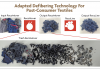
Nylon-6 is used across apparel, carpet, and industrial applications, and roughly 2.75 million tonnes of it are discarded worldwide each year. Almost none of that material is turned back into nylon, making it one of the most difficult plastics to return to the supply chain. At the same time, recycled-content requirements are tightening. Mandates are now law in California and New York, textile and carpet EPR bills are advancing in six more states, and EU textile EPR schemes must be in place by April 2028. NylaNova uses selective catalysts developed at, and exclusively licensed from, Northwestern University to depolymerize nylon-6 waste into high-purity caprolactam at yields above 90%. The process accepts mixed apparel, carpet, and industrial scrap with no pre-sorting, which has been a persistent barrier for existing recycling routes.
“The real test of a recycling technology is whether a producer will buy the material and put it into production,” said Yosi Kratish, Founder and CTO of NylaNova. “Nylene knows exactly what quality their customers will accept. Meeting that standard is what we set out to do.”
NylaNova has demonstrated its process at tonne scale on mixed plastic waste, running continuously on off-the-shelf equipment. An independent third-party life cycle assessment found the resulting green caprolactam produces 95% lower greenhouse gas emissions than the conventional virgin route. The material is offered at a virgin- competitive price, with no green premium.
“Our caprolactam has to meet the same specifications the nylon industry already runs on, with no changes to anyone’s process,” said Ananth Naman, President of NylaNova. “That is what we built the technology to do, and supplying Nylene is how we prove it.”
“We have been recycling nylon-6 at Arnprior since 1966, so we understand how much value there is in recovering this material,” said Scott Kuehl, Business Development and Product Manager at Nylene. “The mixed polymer post-consumer waste stream is not viable within our current operations, while NylaNova’s process is designed from inception for this underserved resource. We believe that more nylon should have a second life, and a third, and buying their green caprolactam is the next step in making that a reality.”
The work has also been backed by Apparel Impact Institute, which awarded NylaNova a grant in December 2025 through its Climate Solutions Portfolio (“CSP”) to vet the solution and propel it from the current stage of commercialization toward further scalability.
NylaNova is planning to open its first commercial manufacturing plant in 2028.
Posted: November 7, 2026
Source: NylaNova