Meridian Specialty Yarn Group Names Keith Horn Vice President Of Manufacturing
Valdese, N.C.-based Meridian Specialty Yarn Group Inc. has named Keith Horn vice president of manufacturing for its Ranlo Plant. Horn brings more than 30 years of worsted-wool spinning experience and will lead manufacturing operations, with emphasis on operational performance and consistent product quality.
Dugan
RefrigiWear Names Jim Dugan CEO
Dahlonega, Ga.-based RefrigiWear has appointed Jim Dugan CEO. Dugan brings more than 25 years of leadership experience, recently serving as chief revenue officer at Galls. He will lead RefrigiWear and its European brands: FlexiTog®, Fortdress®, Cold Tex®, Tessuto® and Goldfreeze®. Former CEO Ryan Silberman remains on RefrigiWear’s board.
Weiss
Marcia Weiss Appointed Dean At Thomas Jefferson University
Philadelphia-based Thomas Jefferson University has appointed Marcia Weiss, MFA, dean of its newly-formed College of Fashion and Textiles. Weiss previously served as interim dean and brings 19 years experience from Burlington Industries, as vice president of design for the House Fabrics Division.
Ryan
Schotex Global Names Jennifer Ryan Head Of Sales, North America
Hong Kong-based Schotex Global Co. Ltd. has appointed Jennifer Ryan head of sales for North America. Ryan brings 35 years textile-market experience, including more than 20 with Schoeller Textil AG. She will lead North American sales, active-lifestyle and fashion-apparel markets.
Champion Thread Appoints John GiordanoSenior Sales Director
Gastonia, N.C.-based Champion Thread Co. has appointed John Giordano senior sales director, a newly created role. Giordano brings more than 50 years of industrial sewing-thread sales and marketing experience, and will lead the company’s national-account and wholesale-distribution initiatives to expand market reach and strengthen customer partnerships.
Machado
Mario Jorge Machado Re-Elected EURATEX President
Brussels-based EURATEX has re-elected Mario Jorge Machado as president. Machado, who holds a degree in production polymer engineering from the University of Minho, will focus on improving textile-industry competitiveness, establishing a level playing field for products sold in Europe, and supporting companies through green and digital transitions. “Europe must decarbonize its industry, not deindustrialize it,” Machado said.
Taidi
bluesign Appoints Hanane Taidi CEO
Baar, Switzerland-based bluesign has appointed Hanane Taidi CEO. Taidi brings more than 20 years of global leadership in sustainability, public affairs and strategic communications and most recently served as director general of TIC Council. She will focus on expanding access to verified data, strengthening System Partner collaboration and translating evolving regulatory requirements into practical solutions for brands and manufacturers.
Enright
National Safety Apparel Appoints Michael Enright CEO
Cleveland-based National Safety Apparel has appointed Michael Enright CEO, succeeding Chuck Grossman Jr., who will become vice chairman after nearly 30 years leading the company. Enright brings more than 30 years of protective-clothing market experience and has served as NSA president for five years. Grossman will remain involved in mergers and acquisitions and strategic-growth initiatives.
Kasperkovitz
Lenzing Appoints Georg Kasperkovitz CEO
Lenzing, Austria-based Lenzing AG has appointed Georg Kasperkovitz CEO, effective June 1. Kasperkovitz will retain his role as chief operations officer and lead the company’s fiber production, sales, supply chain and human resources functions. A board member since June 2025, he succeeds to a three-year CEO mandate running through May 31, 2029.
Foshan United Medical, headquartered in Foshan, China, employs about 200 people. The purchase price was not disclosed. The sellers were UMT founder and CEO Dr. Xiaodong Wang and a private Chinese founding partner.
“Freudenberg Performance Materials and Foshan United Medical are a perfect strategic match,” said Dr. Andreas Raps, CEO of Freudenberg Performance Materials. “Going forward, the merger will enable us to offer a unique portfolio of technologies and products as an innovative full-service supplier in the market for advanced wound care.”
UMT’s capabilities span fiber manufacturing and functionalization, nonwoven production, final packaging, sterilization and marketing authorization. Its portfolio includes polyurethane foam dressings, silicone-coated dressings, antimicrobial dressings containing silver, alginate-based absorbent fibers, and chitosan- and CMC-based wound dressings.
“The innovative strength and high level of customer-orientation characteristics in both our companies make for an ideal fit,” Wang said.
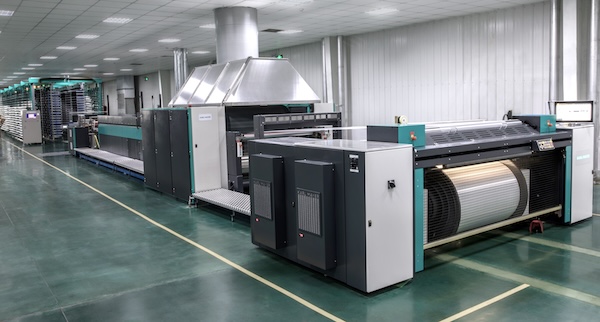
KARL MAYER FILSIZE-GObertshausen, Germany- based KARL MAYER reports growing demand for its warp-preparation technology as artificial intelligence infrastructure drives production of copper-clad laminates, the glass-fabric reinforced base material used in printed circuit boards.
“Currently, around four billion meters of glass fabric are produced worldwide each year,” said Enzo Paoli, president of KARL MAYER’s Warp Preparation Business Unit. “By 2028, another two billion meters will be added — a massive market in which we lead with a major market share.”
KARL MAYER’s FILSIZE-G sizing machine and AM-G assembling machine are designed to provide process reliability, efficiency and consistent warp quality for glass-fabric production. The company said it has supplied leading glass-fabric manufacturers for nearly 20 years, reaching a milestone of 100 electronic-glass machines sold in China in 2020.
AI data centers require increasingly complex printed circuit boards, with copper-clad laminate exceeding 24 layers, compared with six layers for standard electronics. KARL MAYER said precise yarn-tension control during warp preparation helps prevent fabric-density variation that can affect high-frequency signal transmission.
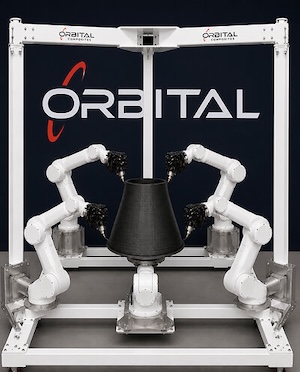
Orbital S – Multi-Robot Additive Manufacturing Platform for Advanced Composite Rocket NozzlesCampbell, Calif.-based Orbital Composites Inc. has received a $1.9 million Tactical Funding Increase contract from SpaceWERX, the U.S. Space Force’s innovation arm, to continue development of its robotic additive manufacturing platform for extreme-environment materials.
The platform is designed to manufacture components for conditions exceeding 3,000-degrees Celsius, high-velocity combustion gases and repeated thermal-shock cycles. “This work addresses a critical barrier to the rapid scaling of manufacturing for high-temperature rocket nozzles to serve the U.S. warfighter,” said Amolak Badesha, CEO of Orbital Composites. “Our initial goal is to eliminate the supply constraints on solid rocket motors that have long limited what the warfighter can field.”
Orbital combines robotics, advanced materials and physical AI to streamline manufacture of extreme-environment materials.
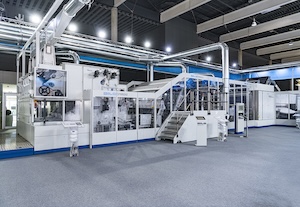
Dilo Nonwoven Production LineEberbach, Germany-based DiloGroup has received an order for a complete needling line for production of hygiene materials in the United States.
The line will cover all process stages, beginning with fiber opening. It includes a TEMAFA fiber-opening and filtration system designed to support stable operation, fiber preparation and dust and particle management.
The installation also features Dilo Spinnbau card feeding and carding equipment, as well as DiloMachines crosslapping and high-performance needlelooms supported by the CV1 system. The configuration is intended to provide controlled fiber processing, stable web formation and high throughput.
DiloGroup said the equipment is suited for hygiene-material applications requiring process stability, uniform web quality and consistent production parameters.
The order strengthens DiloGroup’s position in the U.S. hygiene sector and reflects continued demand for complete, high-performance nonwoven production systems.
Raleigh, N.C.-based NC State University will lead FutureTEX, a 10-year Department of War initiative to modernize U.S. textile manufacturing for defense and domestic applications. The award includes $36 million in its first year and has a $480 million ceiling over a decade.
FutureTEX will unite industry, government, university and nonprofit partners to advance textile manufacturing technology, workforce development, and facility and equipment modernization. Core partners include Drexel University, Gaston College, Georgia Tech, ISAIC and UMass Lowell.
“FutureTEX is focused on creating a cutting-edge national ecosystem for defense textiles that simply doesn’t exist today,” said David Hinks, FutureTEX chief strategic partnerships officer and dean of NC State’s Wilson College of Textiles.
NC State and Gaston College will establish a nonprofit to oversee the initiative, headquartered at Gaston College’s Kimbrell Campus in Belmont, North Carolina.
“North Carolina and Gaston County have deep roots in the textile industry,” said Gaston College President John Hauser. “We are uniquely positioned to propel this manufacturing innovation institute forward.”
Raleigh, N.C.-based Supreme Nonwoven Inc., a manufacturer of advanced nonwoven materials and products, will invest $25.8 million to establish its first U.S. manufacturing facility in Lexington, North Carolina.
The more than 200,000-square-foot facility will support technical collaboration and customized material development for North American customers in apparel, automotive, filtration and industrial markets.
“Our decision to establish this facility in North Carolina reflects a long-term commitment to serving the U.S. market with locally manufactured nonwoven materials,” said Amit Kavrie, managing director of Supreme Group, Supreme Nonwoven’s India-based parent company.
Average annual wages for the new positions will be $55,800, above Davidson County’s average of $54,395. The jobs could generate an annual regional payroll impact of $2.79 million.
Philadelphia-based Thomas Jefferson University established the College of Fashion and Textiles this summer as part of a restructuring of its Kanbar College of Design, Engineering and Commerce.
The new college will offer undergraduate and graduate programs in fashion design, fashion merchandising and management, textile design and textile technology, as well as a doctoral program in textile engineering and sciences. Students will remain in their current programs without changes to curriculum, faculty or advising.
“Rooted in our legacy as the nation’s first textile school and strengthened by our internationally recognized fashion programs, the College creates a dynamic, collaborative environment where creativity, innovation and purpose converge,” said Marcia Weiss, dean of the College of Fashion and Textiles.
Thomas Jefferson University also will create the College of Business and the College of Architecture, Design and Engineering.
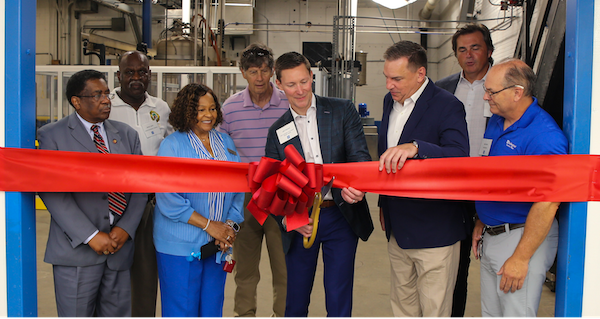
The commissioning ceremony (l to r): NC Rep Garland Pierce, County Commissioners Chairman James Leach, County Commissioner Mary Blue McCollum, Raeford Mayor John McNeill, Elevate CEO Jeffrey P Pritchett, US Rep Richard Hudson, Burlington President Guy Lucas, and Raeford Plant Manager Keith Mims.Charlotte, N.C.-based Burlington Industries, a U.S. manufacturer of advanced textile solutions, celebrated the commissioning of a modernized dyehouse at its Raeford, N.C. operation. The investment supports domestic textile production and the company’s military-uniform supply programs.
The Raeford facility produces specialized fabrics for military dress uniforms and is the only U.S. manufacturer producing those fabrics domestically. It supplies dress-uniform programs for the Air Force, Army, Coast Guard, Marine Corps, Navy and Space Force.
“Our dyehouse investment demonstrates our confidence in the Raeford operation, our employees and the critical role this facility plays in supporting those who protect our freedoms,” said Jeffrey P. Pritchett, CEO of Elevate Textiles, Burlington’s parent company.
Burlington President Guy Lucas said the modernized dyehouse equips employees with technology to sustain the site’s more than 70-year legacy. “This new state-of-the-art dyehouse is an investment in our future, but it is also an investment in our people,” Lucas said.
Reju opens its first U.S. Research & Development Center in Conshohocken, Pennsylvania, accelerating the path from circular innovation to industrial-scale textile regeneration.Paris-based Reju, a textile-to-textile materials regeneration company, has opened a research and development center in Conshohocken, Pennsylvania, its first dedicated North American research facility.
Located within Technip Energies’ Advanced Materials and Catalysts Research Center, the facility will support development and validation of recycling technologies for Reju’s future Regeneration Hubs. Its work will span polyester recycling, mixed-fabric solutions and new circular chemistry pathways, from early-stage feasibility through kilo-scale production.
The center also marks the relocation of Reju’s core research team from IBM’s Almaden Research Center in San Jose, California, where its VolCat depolymerization technology was developed. VolCat is a catalytic chemical recycling process that breaks polyester into reusable raw materials.
“I am excited to be joining such an innovative company and to be part of the team moving the technology toward industrialization,” said Gregory Breyta, Reju’s director of research and development.
Reju’s global infrastructure includes Regeneration Hub Zero in Frankfurt, Germany, and planned hubs in Sittard, Netherlands; Lacq, France; and Rochester, New York.