Textil Rossignolo Continues Upgrade With New Trützschler Cards

Textil Rossignolo Ltda, a Brazil-based cotton yarn supplier that specializes in production of Ne 8
denim yarns, has installed six new TC 03 cards from Germany-based Trützschler GmbH & Co. KG.
The installation is part of a company restructuring that began in 2003.

The new cards, which achieve outputs of between 165 and 180 kilograms per hour (kg/h) each,
were installed on one of Rossignolo’s two Trützschler blowroom lines, and replace eight DK 903
cards installed in 2004 that achieved outputs between 120 and 140 kg/h. The TC 03 cards feed
directly into six Schlafhorst Autocoros, having 360 rotors each.

Rossignolo expects to continue its restructuring with installation of a new Trützschler
Wasteomat fiber waste recovery installation unit that will enable blowroom and card waste to be
recovered and introduced back into the line.

November 27, 2007

Benninger Acquires Küsters Textile

Switzerland-based weaving preparation and wet finishing machinery producer Benninger AG has
acquired Germany-based wet finishing and dyeing machinery manufacturer Küsters Textile GmbH — a
deal that includes subsidiaries Küsters Far East Ltd., Hong Kong, and Küsters Shanghai Co. Ltd.,
and is retroactive to the beginning of 2007. The price of the transaction will not be disclosed and
is still subject to approval by antitrust agencies in Europe.

Benninger plans to integrate Küsters manufacturing activities into those of its own, and will
continue to operate the Küsters manufacturing facility in Zittau, Germany. In 2006, Küsters
employed 180 people and achieved a turnover of approximately 22 million euros (US$32.6 million).

“With this acquisition, we will attain an excellent market position, which will enable us to
further improve our efficiency towards our customers,” said Daniel Hirschi, CEO, Benninger. “The
synergies we will be able to exploit as a result will contribute to put Benninger in an even better
position regarding global competition.”


November 27, 2007

Clariant Ups Global Prices

Switzerland-based specialty chemicals manufacturer Clariant International Ltd. has announced a
global 5- to 12-percent price increase for its products. The company attributes the need to raise
prices to the rapid rate of raw material and energy cost increases.

“In order to meet the future needs of our customers, we have to remain a strong partner, who
is able to further invest in process and product innovations, as well as in availability, quality
and safety of our products,” said Clariant CEO Jan Secher in explaining the necessity for the price
hike.

November 27, 2007

Duro Textiles Launches Defense™ Protective Solutions

Fall River, Mass.-based Duro Textiles LLC, a provider of technical textile and sourcing solutions
to a range of industries, has launched the Defense™ line of protective fabric solutions for indoor,
outdoor, commercial and residential applications.

The new line consists of: Solar Defense, which imparts resistance of up to 2,000 hours to sun
exposure, depending on color, to printed fabrics; Nano Defense, which provides water repellency and
stain repellency from foods and beverages; Wear Defense, which provides optimal abrasion
resistance; Mildew Defense, which eliminates odors and provides resistance to mildew, bacterial and
fungal growth; and Breach Defense, which prevents liquids from penetrating fabrics.

The Defense product line utilizes a range of proprietary processes and techniques to achieve
their unique properties. Each product can be used alone or in combination with other Defense
products via a layering process. Duro Textiles combines all five solutions in its Ultimate Defense
product. The new solutions do not negatively affect industry fire-resistance tests for upholstery
and are safe for pets and families, according to Duro Textiles.


November 27, 2007

Rieter Launches I-BORO® Web-Based AV Customer Service Tool

rieteriboroSwitzerland-based
Rieter AG now offers a Web-based audio-visual (AV) communications system that allows the company to
provide virtual onsite, interactive customer service and support for its machinery in real time.

The I-BORO® system — developed by Rieter Automatik GmbH, a Germany-based subsidiary of Rieter
Textile Systems — consists of a safety helmet fitted with a camera, control display screen, mini-PC
and headset. When customer support is needed, the machine operator can put on the helmet and
contact Rieter over the network, using the camera to show a Rieter technician where a problem is
located. The technician then provides the operator with diagnostic steps and instructions for
resolving the problem. The new system also enables instant conferencing via links with other Rieter
specialists when additional troubleshooting is necessary.

According to the company, using the I-BORO system will minimize downtime and eliminate the
need for service technicians to travel to the problem site, resulting in significant cost savings.

November 27, 2007

Wellman Raises Fortrel® Fiber Prices

Effective December 15, Wellman Inc., Fort Mill, S.C., will increase the price of all Fortrel®
polyester staple fiber products by 4 cents per pound.

“The increase previously announced for December 1 has been insufficient to offset the
continued rapid acceleration in the cost of ethylene glycol, a primary raw material used in the
manufacture of polyester staple fiber,” said Steve Ates, vice president, sales and marketing.


November 27, 2007

Troubled ITMA Asia Exhibitors

After two consecutive ITMA Asias in Singapore in the years 2001 and 2005, China will host the
important textile machinery event for the first time, from July 27 to 31, 2008, at the Shanghai New
International Exhibition Centre (SNIEC).

As reported weeks ago, booth space is sold out, even with two more halls now being built
alongside the existing halls to provide total floor space of more than 120,000 square meters.
However, as the organizers report, there is still a waiting list for the exhibition. And it seems
they are still waiting for more registrations to come.

As mentioned in the official ITMA Asia press release of Oct. 29, 2007: “The whole world of
textile machinery will be in the spotlight in Shanghai next year for the ultimate textile machinery
show – ITMA ASIA + CITME 2008. For five days, from July 27 to 31, the city will host the perfect
blend in customer-supplier interaction, as the unique ITMA exhibition brand meets the largest and
most important textile sector.”

Difficult Communication

However, some clouds are showing up in the sky of the next ITMA Asia. Many exhibitors are
complaining about difficult communication with Shanghai. As some exhibitors mentioned to the Rupp
Report, the interaction with the organizers is more than difficult, not only because of language
problems; the whole timetable is already delayed.

Even more difficult is the fact that, for Nov. 1, 2007, allocations for booths were promised,
but not yet confirmed. This is – according to some exhibitors – more than late, because there are
only a few months left before to the show will open. It is vital for the logistics of the
exhibitors to know the exact situation of the booth layout. Many important questions aren’t
answered yet: How many square meters do we get after the rising demand for booth space? Where are
we located? How many walls do we have? Are there any pillars to cover?

Waiting For Clear Signals

Having in Singapore two perfect ITMA Asias in mind, exhibitors are asking many questions
about the realization of the ITMA Asia 2008. On top of that, most of the exhibitors are under the
pressure of showing at too many exhibitions, plus another important event later that year in India.
The exhibitors are very positive in their views of ITMA Asia. However, they expect in the next days
a clear signal from the organizers that the next show will be as efficient as the last ITMA Asia
and that final decisions will be made about their requested booth space. This and further steps in
the communication between organizers and exhibitors will help to make ITMA Asia 2008 as successful
as ITMA Asia 2005.


November 19, 2007

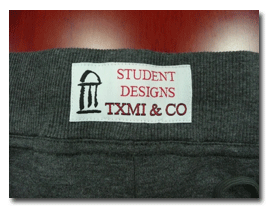
UGA Fashion Merchandising Students Design, Manufacture Apparel

Fashion merchandising students at the University of Georgia (UGA), Athens, Ga., have designed,
sourced and produced a line of T-shirts and sweatpants that are now available at the UGA bookstore.

Under the guidance of Charles Gilbert — Distinguished Professor of soft goods merchandising
and manufacturing in the College of Family and Consumer Sciences, and a consultant to the apparel
industry for more than 40 years — the students determined the details of each product, made
production arrangements and sought trademark permission from the UGA Athletic Department.

“I wanted the students to learn from start to finish what it means to make a product,”
Gilbert said. “The class that designed the T-shirt focused on domestic manufacturing, while the
other class worked with suppliers located in China.”

sweatpantugashirt

Students in Gilbert’s apparel manufacturing class chose Jefferson, Ga.-based Buhler
Quality Yarns Corp. to supply organic Pima cotton for the T-shirt. The cotton was then knit, cut
sewn, dyed and screen-printed by Fessler USA, Orwigsburg, Pa.

Students in Gilbert’s global sourcing class dealt with China-based Loudania for the
manufacture of the sweatpants. “The students get to see every tiny cost of production, especially
overseas,” said Gilbert. “They have to pay duty and quota costs along with air freight, all of
which add an additional $5.66 per garment to the wholesale price.”

The sweatpants retail at the UGA Bookstore for $40, while the T-shirt is $29. The college
will use the proceeds to buy materials and equipment necessary to keep the program going. Gilbert
anticipates next semester’s classes will produce new products.

“Most of these students will be merchandisers or buyers for the retail industry,” he added. “
These courses will make them better merchandisers and buyers with the knowledge they have gained on
design, production and sourcing; but it also gives them more avenues in their careers such as
apparel designers, suppliers and sourcing agents. 


November 19, 2007

Johns Manville Develops New Air Filter Media

Johns Manville Filtration — a division of the Denver-based Johns Manville Engineered Products Group
— has developed Assurance™ with SSP™, a new air filtration media with Self-Supporting Pleat™ (SSP)
technology. The new media — a nonwovens composite comprising natural and man-made fibers — is used
to produce MERV 6 to 8 mechanical air filters; as well as self-supporting air filters that reduce
cost, increase productivity and avoid safety liabilities related to incidents associated with
disposal and handling of sharp, expanded-metal filter structures.

Assurance with SSP, suitable for residential HVAC, industrial and commercial applications, is
available in customized roll widths and lengths, and offers low-pressure drop and consistent
filtration efficiency, according to Johns Manville.

“Our customers have identified that using expanded metal to support the filtration media is a
significant and volatile cost and it poses a huge potential liability for them in a number of ways;
we’ve addressed these needs,” said J.P. Blanchard, business manager, Johns Manville Filtration. “
Assurance’s Self-Supporting Pleat technology allows filtration manufacturers to reduce costs and
increase productivity by simplifying their manufacturing processes through eliminating the use of
expanded metal.”


November 19, 2007

Celanese To Raise Price Of PVOH

Effective Jan. 1, 2008, or as contracts permit, Celanese Corp., Dallas, will increase the price of
all polyvinyl alcohol (PVOH) grades. Low-viscosity PVOH will increase by 15 cents per pound in
North, Central and South America, and Asia; and by 250 euros per ton in Europe. Medium-viscosity
(PVOH) will increase by 20 cents per pound in North, Central and South America, and Asia; and by
325 euros per ton in Europe. High-viscosity PVOH will increase by 25 cents per pound in North,
Central and South America, and Asia; and by 400 euros per ton in Europe.


November 19, 2007

Sponsors