The Rupp Report: Lower Cotton Production And Higher Chinese Investments

According to the latest report from the Germany-based Bremen Cotton Exchange, the January US cotton
2008-09 supply and demand estimates include reduced production, domestic mill use and exports,
resulting in ending stocks of 6.9 million bales – slightly below the previous month’s estimate.

Lower Production

Production was lowered by 577,000 bales, mainly because of a reduction in Texas. Domestic
mill use was reduced by 100,000 bales to 4.2 million, reflecting lower activity in November. The
export forecast also was reduced by 250,000 bales to 12 million as a result of lower world import
demand. The forecast marketing year average price received by producers – 44 to 52 cents per pound
– was raised by 1 cent on the upper end and by 3 cents on the lower end of the range, as market
prices have improved during the past month.

The world cotton estimates for 2008-09 show lower production, consumption and trade compared
with the previous month. Beginning stocks were nearly 1 million bales higher as a result ot to
prior-year adjustments in China, India and Turkey. Production was reduced by 1.7 million bales,
mainly in India, the United States and Argentina. Consumption was lower in China, India, Pakistan
and the United States, reflecting a continued slowdown in global textile demand; but was higher in
Thailand.

Reduced Imports

World imports were sharply lower, according to the US Department of Agriculture, mainly
because of lower consumption and imports by China. Exports were reduced in several countries,
notably India, which accounts for more than half of the reduction in world exports. India’s
adoption of a minimum support price has resulted in sharply lower export commitments compared with
last season. World ending stocks were 1-percent higher than last month’s level.

In order to protect their farmers’ income, China and India have dramatically increased
government purchases to drive up domestic farm prices. These recent aggressive government purchases
add a new element of uncertainty and potential price volatility to global cotton markets. Although
there have been no official statements from either government regarding how these stocks will be
managed, their disposition will certainly affect US exports and prices. If significant portions of
stocks are held off the market, demand could shift to other suppliers, including the United States.
However, release of these stocks could further dampen demand, particularly for US cotton.

Heavy Investments In China

China and India are on track to acquire nearly 25 million bales of government-controlled
stocks in the next couple of months. Industry sources indicate that the Cotton Corp. of India (CCI)
has authorization to purchase up to 11.7 million bales – half the 2008 crop. CCI has bought about
3.6 million bales – 40 percent of the cotton sold by farmers to date. China already has purchased
more than 7.3 million bales of the 12.5 million it intends to buy. Continued weakening domestic
demand has offset some of the effect of the purchase,s and farm prices have responded only
moderately. According to industry sources, China already holds 4 million to 6 million bales of
state reserves carried over from the previous season. These policies raise the question of how many
government-stocks will be carried over into the next marketing year, and what impact the policies
will have on production in these countries in 2009.

… For Petrochemical And Textile Sectors

In general, China is planning multi-billion-dollar aid packages for its petrochemical and
textile sectors, as part of efforts to help key sectors through the global economic crisis. There
is a plan on the way that China will spend 100 billion renmimbi ($14.6 billion) by the end of 2010
to upgrade refineries to ma produce cleaner fuels, the China Business News reported, citing unnamed
sources. China will invest a further 400 billion renmimbi ($58.4 billion) on 20 new projects
related to the fuel-upgrading initiative, as well as on the overseas acquisition of oil and some
fertilizer assets.

The Chinese government also is drafting a stimulus package for the textile industry,
including preferential loans, to boost sales and create jobs, according to another source. The plan
has been submitted to the State Council and is expected to be issued soon, the source added without
giving further details. China’s textile industry had a hard year in 2008, with profits in the first
11 months falling by 1.8 percent – the first decline in a decade.

January 27, 2009
Treasury Chief Sees Chinese Currency Manipulation

At his confirmation hearing January 22, Secretary of the Treasury Timothy F. Geithner said
President Barack Obama believes China is manipulating its currency and that he will aggressively
use all diplomatic avenues open to him to correct the problem. Geithner’s comments signaled a much
stronger approach to addressing what textile manufacturers and others see as a major subsidy for
Chinese exports.

While the Bush administration had expressed its concerns about Chinese currency, it took a
much softer line in its approach to the problem, insisting that diplomacy was the better way to go.

About the time Geithner made his comments, the American Federation of Labor – Congress of
Industrial Organizations issued its recommendations for new approaches to a number of trade issues,
including currency manipulation, as it called for “cracking down on the Chinese government’s unfair
trade practices.” Kevin L. Kearns,  president of the US Business and Industrial Council, said
Geithner’s comments were a “welcome step forward,” adding that they send a clear signal to Congress
to send President Obama a strong currency manipulation bill during the first 100 days of his term
in office.

Legislation branding currency manipulation as an unfair trade practice that could be
addressed by US trade sanction laws was introduced in both houses of Congress last year, but it got
nowhere in the face of a threatened veto by then-President George W. Bush. That legislation would
have used US trade remedy laws, such as countervailing duties, to counteract a trade advantage
stemming from an undervalued Chinese yuan. This type of legislation in one form or another is
expected to be given new life under the new Obama administration and Congress.

January 27, 2009

WL Gore & Associates, Milliken & Company Make Fortune 100 Best Companies List

Fortune magazine has named Newark, Del.-based W.L. Gore & Associates Inc., manufacturer of
GORE-TEX® fabric, and Spartanburg-based textile and chemical manufacturer Milliken & Company to
its 2009 “100 Best Companies To Work For” list. Ranking and selection were based on opinions of
company employees and company responses to a Culture Audit questionnaire including both detailed
and open-ended questions.

W.L. Gore & Associates marked its 12th consecutive year on the list, with a number 15
ranking. “Gore is honored to once again earn recognition as one of the best workplaces in America,”
said Terri Kelly, president and CEO, W.L. Gore. “Thanks largely to the pioneering corporate culture
established by our founders more than 50 years ago, Gore is a place where innovation thrives and
where every individual has the ability to contribute to the success of the enterprise. I strongly
believe that our culture is our biggest competitive advantage. It directly contributes to our
business success and drives associate satisfaction.”

Milliken & Company achieved a spot on the list for the fifth time, ranking 64 overall,
and 17th for medium-sized companies. Once again, it is the only South Carolina-based company on the
list this year. “Making FORTUNE’s ‘100 Best Companies to Work for’ list for a fifth time is great
recognition for all our associates,” stated Joe Salley, president and CEO, Milliken. “Their
constant engagement and dedication to building a strong culture of integrity, innovation, and
excellence is truly what makes Milliken successful.”

In all, more than 81,000 employees from 353 companies participated in this year’s survey,
conducted by the San Francisco-based Great Place to Work Institute.


January 27, 2009

INDA Accepting Nominations For 2009 WOW Award

The Association of the Nonwoven Fabrics Industry (INDA), Cary, N.C., will be accepting nominations
February 2 through April 1 for the 2009 WOW Innovation Award. The award recognizes innovative
technology within the entire wipe value chain, including raw materials and ingredients, roll goods,
machinery, packaging, and finished products, among others. It will be presented during at the World
of Wipes (WOW) International Conference, to be held June 22-24, 2009, in Atlanta.

The process and criteria for the 2009 WOW Innovation Award are as follows:

1. The nominated product must be involved in some portion of the process and production of a
wipe product. All wipes are eligible, including nonwoven, woven, knit, foam and other wipe
technologies.

2. The product must have been introduced to the trade or to consumers in 2008-09.

3. Companies may nominate their own products. Although any number of products can be
nominated, only one product per company will be selected as a finalist.

Products may be nominated by e-mailing a short abstract of the nominated product to Michael
Jacobsen, WOW Innovation Award project coordinator,
mjacobsen@inda.org, and sending him a product sample at
INDA, 22 Paterson Ave., Midland Park, NJ, 07432.

January 27, 2009

Clariant Further Restructures In Response To Economic Downturn

Switzerland-based global specialty chemicals provider Clariant has announced it will restructure
its businesses in response to the leather and textile market downturn in the fourth quarter 2008,
combined with the uncertainty of market conditions for 2009.

Clariant already has adjusted plans for businesses experiencing a decreased demand by slowing
or shutting down production, releasing temporary employees, and reducing overtime, among other
actions. Further restructuring moves include downsizing and reducing expenditures, particularly in
its selling, general and administrative (SG&A) expenses.

Clariant plans to eliminate 1,000 jobs, mainly in the SG&A area, in addition to the
approximately 2,200-employee reduction announced in 2006 that it is still carrying out. The company
is focusing on cash generation in 2009, and in line with this, the Board of Directors will propose
to Clariant’s 14th Assembly, to be held April 2, 2009, that dividends, grants and other shareholder
payouts for 2008 be cancelled.

The company announced global sales in 2008 totaled 8.1 billion Swiss francs – a 1-percent
growth in local currency, but a 5-percent decline in Swiss francs. The downturn in the leather and
textile markets led to an impairment of approximately 180 million Swiss francs in the fourth
quarter 2008.


January 27, 2009

Halston Selects RLM’s FashionManager™ ERP Software

New York City-based luxury fashion label Halston has implemented sales, order and shipping
components of Fairfield, N.J.-based end-to-end business software solutions designer RLM Apparel
Software Systems Inc.’s FashionManager™ Web-based enterprise resource planning (ERP) software at
its headquarters. Working in a modular manner, the company eventually will apply the software to
its entire design-to-delivery business process.

“As a fast-growing global distributor of apparel, footwear and accessories, we wanted a
business solution that could quickly give us full functionality right out of the box,” said Jeff
Green, vice president, finance, Halston. “In addition to the requirements associated with multiple
product types, such as footwear pre-packs and size runs, the ability to manage multi-currency was
very important to us. RLM offered all of that in a system that required no hardware purchases,
minimal IT support, and a very low upfront investment.”

“The roll-out has gone very quickly. We were up and shipping in 45 to 60 days,” Green
continued. “Our first priority was to use the system to accomplish sales, order, costing and
shipping activities. Now we are setting up raw materials so that we can track our piece goods for
the spring line. Going forward, we plan to go online with the financials components, warehousing,
and the product development pieces.”

January 27, 2009

Cranston Print Works Closes Webster Facility

Cranston – the textile printing, finishing and engraving division of Cranston Print Works Co.,
Cranston, R.I. – has announced it will close its Webster, Mass.-based manufacturing facility in
favor of outsourcing production. The mill currently produces 75 percent of the company’s goods, but
plans are to outsource 100 percent of production by June 1 this year. The company also will phase
out its light packaging operation at its Cranston, R.I.-based facility, with most of those
functions being absorbed by the Webster location.

The closure will affect approximately 75 employees. Fifty people will remain employed at the
Webster location in administration, customer service, sales, marketing, supply chain/global
sourcing, put-up/packaging and distribution. The company will maintain its design, sales and
executive offices in New York City.

 “Our traditional over-the-counter fabric market continues to be highly competitive and
over supplied,” said Andrew F. Sylvia, president, Cranston. “The marketplace has become more
customized and less volume driven, causing excess capacity and increased costs. Moreover, as we
have successfully launched new product categories to expand our business, many of these products
cannot be produced in Webster. All of these factors coupled with the dire economic environment made
it necessary to change our business model.

 “This was a very difficult and emotional decision,” Sylvia continued. “Most employees
are veterans of this company, with many over 30 years of service. The Webster plant is a premier
cotton print plant known throughout the world for its quality and cutting edge technology. This
reputation was built through the dedication and commitment of all the many employees who worked
here over the years and gave their best everyday. I have never been associated with a finer group
of people.”

Sylvia said the company will continue to offer quality products and services because of its
knowledge and proficiency in global sourcing developed over the past 10 years. “Our manufacturing
expertise in printing and finishing will remain in our global sourcing capabilities,” he said. “We
will continue to provide innovation and creativity through our V.I.P., Quilting Treasures and
Cranston Home brands.”

January 27, 2009

Bush Signs US-Peru Free Trade Agreement

In one of his final acts as president, George W. Bush has signed a proclamation activating the
US-Peru Free Trade Agreement (FTA) in a move that US trade officials believe will significantly
increase trade between the two nations. The US textile industry supports the agreement because it
has a yarn-forward rule of origin and does not include tariff preference levels or cumulation,
which textile manufacturers see as loopholes. It also, for the first time, includes enhanced labor
and environmental standards for trade agreements, standards to which the Bush administration and
Congress agreed to in May 2007.

In December 2007, Congress gave final approval to the US-Peru Trade Promotion Agreement, but
President Bush held up signing a proclamation implementing the agreement until now in view of some
congressional concerns that had to be resolved.

US Trade Representative Susan C. Schwab said: “The agreement marks an important milestone in
our relationship with Peru, one of our strongest allies in Latin America. For the first time in
history, American exporters will be able to sell the vast majority of their products into the
Peruvian market duty-free.” Schwab said that when the agreement enters force, 80 percent of US
industrial and consumer goods and more than two-thirds of current US farm exports will be
duty-free.

With the signing of the Peru agreement, the United States now has 11 FTAs with nations in
North and South America, Central America, Africa, the Far East, the Middle East and Australia.

January 20, 2009

The Rupp Report: Trend Shop Heimtextil

Heimtextil, a major international trade fair for home textiles and contract business, took place
January 14-17 in Frankfurt. Despite bad forecasts from the markets, exhibitors and visitors were
both satisfied with the show’s result.

Better Than Expected

A total of 2,721 exhibitors from 64 countries attended the show, some 10 percent fewer than
in 2008. In spite of unfavorable initial indications, both exhibitors and visitors were pleased
with the results, especially in the wallpaper and wall covering, bed linen, and contract business
sectors.

The degree of internationality dropped by one point to 63 percent, which was better than
expected in this particular economic situation. According to the organizer, Messe Frankfurt GmbH,
more than 74,000 visitors from 121 countries attended the show — less than in the previous year.
Germany remained, as it has traditionally, the strongest nation, with some 27,000 visitors and 440
exhibiting companies. The top 10 visitor nations were Germany, Italy, United Kingdom, Netherlands,
Spain, France, Belgium, Turkey, Poland, Greece and the United States.

Exhibitors were particularly pleased with the good frequency and top quality of the visitors.
Apart from the traditional visitor groups such as interior design and the textile industry, more
visitors were welcomed from sectors such as architecture, hotel and hospital.

Visitors appreciated the quality of the exhibitors’ product novelties and marketing
incentives for the coming season. Detlef Braun, managing director of Messe Frankfurt, said, “
Heimtextil has managed to give the exhibitors and the visitors an orientation with new design
impulses, innovative entrepreneurial approaches regarding sustainability principle and modern sales
possibilities.”

heimtextil
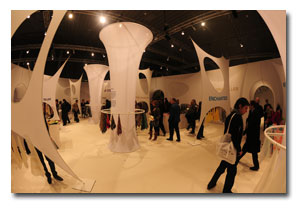
Heimtextil’s Trend Show presented six trend themes under the motto “Expect the Unexpected,”
providing an overview and a preview of current home textile trends that reconsider and reinterpret
established concepts for today’s market.

Contract Business

As always, the contract business was prominently featured at Heimtextil. More than 350
exhibitors from different sectors participated in the “Contract Creations” marketing initiative,
which provided easier access to new textile products for people working in the areas of
architecture, interior design and planning.

Heimtextil 2009 also was a success for the visitors. According to show organizers, 91 percent
of all surveyed people from all around the world were very satisfied with new ways of doing
business. The results of the survey confirmed trends from previous years: Positive business factors
and purchasing criteria for consumers this year are sustainability and new products.
Quality-assurance protection and transparency for sustainable procedures in production and the
supply chain are important steps for the market.

Cotton Very Prominent

Not only Heimtextil has highlighted the trend towards nature and natural fibers.
Organizations such as Cary, N.C.-based Cotton Incorporated and Washington-based Cotton Council
International are putting a lot of emphasis on cotton, with various actions and support throughout
the year (See “
The
Rupp Report: The [Cotton] Empire Strikes Back
,” www.TextileWorld.com, Jan. 13, 2009). In a
media orientation, both organizations provided information in general about their news about green
cotton issues; and in particular about progress and opportunities, resource scarcity and scientific
developments, as well as consumer and trade perceptions.

Heimtextil Trend Show

The Trend Show — always a highlight at Heimtextil — was held in the Forum level 0, and was
probably better than ever. The Trend Show gives trade visitors an overview and a preview of how
current trends can be applied in the daily textile business. This year, the Stijlinstituut
Amsterdam was responsible for planning and organizing the Trend Show. It’s no wonder that this
year, the trend forum attracted more visitors than in the years before. Congratulations on this
exceptional job.

The motto of this year’s Heimtextil trends — “Expect the Unexpected” — stood for current
trends that reconsider and reinterpret tried and tested ideas and, in doing so, encounter
unexpected ideas. The six trend themes — “Illusionist,” “Time Traveller,” “Fortune Teller,” “
Alchemist,” “Witchcraft” and “Enchanted” — emerged from the Trend Table’s consideration of the
various inspirations and influences.

The next Heimtextil will take place January 13-16, 2010.

January 20, 2009

Concept III Textiles Celebrates 25 Years

Red Bank, N.J.-based Concept III Textiles — a developer, producer and sourcer of fabric-based
finished products for outdoor and activewear markets — is celebrating 25 years in business. The
company was founded by David Parkes and Bob Wilson to sell pile fabrics to the outerwear and ski
industries. Parkes now operates the business in partnership with his son, Chris, and daughter,
Helen — a business that has grown into a complete product development company from fabric
development to garment production.

The company chooses its partners carefully, selecting mills with high-quality production and
environmental standards as well as five-star research and design capabilities.

Wilson coined the company’s name. The “III” represents service, styling and sales — something
the company believes still holds true.

Concept III has worked with many widely known apparel brands in its 25 years in business.
Parkes believes textile innovation drives apparel sales. “Only those with exciting new products are
the ones that survive,” he said.


January 20, 2009

Sponsors