UniFirst Introduces New Armorex® COOL Flame Resistant (FR) Workwear

WILMINGTON, Mass. — January 28, 2013 — UniFirst has expanded its proprietary line of flame
resistant (FR) workwear with its new Armorex® COOL work shirts and coveralls. These new safety
garments are made of an innovative, lighter weight, tri-blended FR fabric that helps keep workers
who are exposed to flame risks safe and more comfortable on the job.

“In wear tests, it was confirmed that our new Armorex® COOL work apparel is more comfortable
and cooler to wear than competitive products touting maximum comfort,” said Adam Soreff, Director
of Marketing at UniFirst. “We expect these new safety products to become a favorite with employers
and workers seeking FR clothing that’s cooler and drier in warm or hot environments.”

Ideally suited for such workers as those in the oil and gas industries, as well in
environments that produce combustible dust, the Armorex® COOL work shirts and coveralls are made
from a new Tecasafe® Plus 580 fabric by TenCate. The cellulosic tri-blend FR fabric features a
lighter weight that weighs just 5.8 oz./sq. yard and touts outstanding moisture wicking and air
permeability characteristics. UL Classified® and tested in accordance with ASTM F1959, Armorex®
COOL is NFPA 2112 and NFPA 70E compliant (ATPV 6.5; HRC 1) for protection against flash fires and
electric arcs. And because the new Tecasafe fabric is inherently flame resistant, the protective
qualities can never wash out.

Like all garments in the Armorex® FR family brand, Armorex® COOL is designed specifically for
maximum comfort, greater ease of movement, and a more professional appearance. In fact, the
Armorex® COOL work shirt features distinctive “dress shirt” construction that provides a crisper,
more polished business image when compared to competitive FR garments.

Under its Armorex® FR brand, UniFirst offers a wide range of work shirts, pants, and
outerwear to meet the protective clothing needs of workers exposed to flammability risks, all
available for “rent” or purchase.  In addition to Tecasafe® Plus FR fabric options, 
UniFirst manufactures its Armorex® FR safety line using such innovative and proven flame resistant
fabrics as UniFirst “88/12 FR” fabric, UltraSoft®, CXP® (Next Generation Nomex), and Nomex® IIIA.


Posted on February 5, 2013

Source: UniFirst/PR Newswire

M&G Signs A US$ 1 Billion EPC Contract With Sinopec Engineering (Group) Co., Ltd. For The Construction Of Its Corpus Christi PET/PTA Plants

HOUSTON — January 11, 2013 — The M&G Group (“M&G”), one of the three leading producers in
the Americas of PET for packaging applications, announced today that it has signed a US$ 1 billion
engineering, procurement and construction contract (“EPC Contract”) with Sinopec Engineering
(Group) Co., Ltd. (“SEG”) for the turnkey construction in Corpus Christi (Texas, US) of the world’s
largest single line PET plant with a capacity of 1 million tons per year (2.2 billion pounds),
integrated with the largest western world’s single line PTA plant with a capacity of 1.2 million
tons per year (2.6 billion pounds).

M&G’s engineering arms, Chemtex Global S.a r.l. and M&G Finanziaria S.r.l., will
provide critical equipment and services on a subcontracting basis to turnkey contractor SEG.

The completion of construction of the plants, including the time required to obtain necessary
permits, is expected to occur within 36 months.

Industrial and Commercial Bank of China (“ICBC”, the world’s largest bank by market
capitalization) and Banco Inbursa (a leading Mexican bank) are expected to provide the bank
financing for the project.

M&G will be the sole owner of the plants and solely responsible for their operation.

“This is the largest PET investment ever in the western world and probably one of the largest
investments recently announced in the US in the private sector. It is the celebration of
excellence. It combines the excellence of the Corpus Christi (Texas, US) site, the excellence of
state of the art technologies, and the excellence of geographical heterogeneous project
participants in their respective fields of competence being production of PET/PTA, engineering and
construction of chemical plants or banking and financials services. It shows that good projects
attract the very best even in the current economic downturn. I am very proud of this achievement,”
said Marco Ghisolfi, CEO of M&G’s Polymers Business Unit.

“The awarding of this important contract to SEG is a big milestone for entering the North
America EPC market, which is a part of SEG business strategy to diversify from coal chemicals to
polymers,” said Yan Shaochun, President & CEO of SINOPEC Engineering Group.

Posted on February 5, 2013

Source: M&G Group/PR Newswire

Södra Cell Reaches 100,000 Tonnes Of Textile Pulp

Växjö, Sweden — February 1, 2013 — Södra Cell has sold 100,000 tonnes of textile pulp since
production began at its Mörrum mill in December 2011. This milestone has been reached sooner than
planned.

“We had budgeted to produce 50,000 tonnes in 2012. That we have now reached 100,000 tonnes in
January of 2013 is a fantastic result,” said Dag Benestad, Business Area Manager Dissolving Pulp.
It took 12 months to convert line 1 at Mörrum to textile pulp and the company is now looking at
converting an additional line to softwood-based textile pulp, primarily for customers in Europe and
Asia.

Posted on February 5, 2013

Source: Södra Cell International


Dude Wipes From Dude Products Receives 2013 Visionary Award

CARY, N.C. — February 5, 2013 — Incorporating social packaging and humorous, niche-driven branding,
Dude Wipes from Dude Products was named the recipient of the prestigious 2013 Visionary Award,
presented at the VISION 2013 Consumer Products Conference in Orlando, Florida. The Visionary Award
is given to the most innovative new consumer product that utilizes nonwoven fabrics in its final
form. 

Dude Wipes was selected over four other finalists by the attendees at the 12th annual VISION
Conference, which was held from January 28-31, 2013 at the Rosen Centre Hotel in Orlando. 

Celebrating its 12th consecutive year as the most important conference bringing together the
worlds of consumer products and nonwovens, the VISION Consumer Products Conference, organized by
INDA, Association of the Nonwoven Fabrics Industry, attracted over 325 attendees from around the
world. Through presentations and workshops by industry experts, the event once again focused
attention on the growing role of nonwovens in consumer products.

The five finalists made presentations during VISION 2013 and conference attendees voted for
the recipient of the 2013 Visionary Award.

Dude Wipes utilizes its novel packaging and humorous branding in its goal to change male
hygiene routines and behavior. The product is wallet-sized, flushable and biodegradable and
contains vitamin E and aloe.

“Dude Wipes is a superb example of innovating through clever positioning, packaging and
marketing to meet the needs of a specific target market,” says Dave Rousse, President of INDA.
“There were five outstanding products representing many aspects of consumer products and they were
all winners by being selected as finalists in the 2013 competition.”

The other four 2013 Visionary Award finalists were:

* DiversiTech Merv 8+ and Merv 9+, DiversiTech Corporation. A pleated filter that has a full
frame but takes up half a much storage space as a conventional cardboard filter because it is
nestable when stacked. 

* Poise® Panty Fresheners, Kimberly-Clark. These feminine fresheners are equipped with a
clean and fresh scent that lasts up to four hours. 

* Winged Fiber™ Facial Mask, Allasso Industries. Cosmetic facial mask made using a nylon
Winged Fiber™ spunbond is loaded with essential moisturizing and rejuvenating oils and creams.

* VitaFlex Soft-Stretch Hood™, VitaFlex LLC. Utilizes a latex-free elastic nonwoven fabric to
provide greener and less expensive primary head protection.


Posted on February 5, 2013

Source: INDA

Kraig Biocraft Laboratories’ Monster Silk™ Pilot Production Program Enters Second Stage Ahead Of Schedule

LANSING, Mich — February 4, 2013 — Kraig Biocraft Laboratories, Inc. (KBLB) (the “Company” or
“Kraig”) announced today that it is accelerating its pilot production program, as a result of
positive initial data from the first stage of the trial.

The acceleration to the second phase of the program is designed to increase production
capacity of Monster Silk™, the Company’s recombinant spider silk, by more than tenfold over the
first stage.  Kraig’s strategy calls on further accelerating the production program by
initiating a third stage, if the program continues to meet its targets.

The first phase of the pilot production program for Monster Silk™ is continuing, even as
phase two is being launched.  The purpose of the program is to verify scalability and
favorable production economics of Monster Silk™, to significantly increase production, and to form
the basis of large scale commercial production of the Company’s recombinant spider silks.

“The initial success of the first stage has given us the confidence to accelerate the
program,” said Kraig founder and CEO, Kim Thompson.  “We are now well ahead of the schedule
that we envisioned even a few weeks ago.  This is a critical step forward in the
commercializing of our laboratory discoveries.  The launching of stage two, which I view as
the heart of the pilot production program, is the most exciting and momentous event in the
Company’s history, second only to our invention of Monster Silk™.”


Posted on February 5, 2013

Source: Kraig Biocraft Laboratories Inc.

Colombiatex De Las Américas Marks 25 Years With 2013 Show

The 25th edition of Colombiatex de las Américas — an annual trade show produced and organized by
the Institute for Export and Fashion (Inexmoda), Medellín, Colombia — was held Jan. 22-24, 2013, at
Plaza Mayor in Medellín. The exhibition, which is focused on fashion systems and apparel production
including technology, materials and machinery, also included a program of 22 related educational
seminars and presentations held at Plaza Mayor’s Knowledge Pavilion.

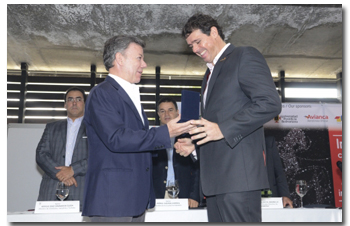
The exhibition was officially installed by Colombia’s President, Juan Manuel Santos Calderón.
Santos presented the Order of Merit in the category of Industrial Grand Officer  to Inexmoda
to honor the institute’s contributions in promoting and strengthening Colombia’s fashion system and
its success in making Colombiatex and its sister show, Colombiamoda — held annually in July to
present finished apparel, among the most important textile trade fairs in Latin America. Inexmoda
President Carlos Eduardo Botero Hoyos accepted the award on behalf of the institute.

Botero, in turn, challenged all those involved in Colombia’s apparel and textile industry to
look forward to the next 25 years. He also recognized the European Union, Colombia’s newest free
trade partner, which was the designated guest of honor at Colombiatex 2013. In addition, Botero
acknowledged the 60 founders of Inexmoda and presented awards to members of the institute’s first
Board of Directors — including Guillermo Valencia Jaramillo, Carlos Vargas González, Gonzalo
Restrepo López, Álvaro Lafuarie Restrepo, Alejandro Ceballos Zuluaga and Alberto Uribe Maya — as
well as to Inexmoda’s former Executive Director, Roque Ospina Duque, who served from 1987 to 2008.

colombiatex

Colombian President Juan Manuel Santos Calderón (left) presents the Order of Merit in the
category of Industrial Grand Officer to Inexmoda President Carlos Eduardo Botero Hoyos, who accepts
the award on behalf of the institute.


Organizers reported that Colombiatex 2013 generated US$152.5 million in negotiated sales,
representing a 26-percent increase over the $120.5 million generated in 2012. The show attracted
475 exhibitors to fill 9,900 square meters (m2) of exhibition space — 14 percent more exhibitors
and 19 percent more floor space than at Colombiatex 2012, when 416 exhibitors showed their products
and services in 8,300 m2 of floor space. It also exceeded expectations in terms of visitor numbers,
with 32,429 people attending – an increase of 2.75 percent over the 2012 total. Visitors included
1,699 international buyers from more than 40 countries worldwide, many of whom attended with
support from Proexport Colombia, an agency that promotes exports, foreign investment and tourism in
Colombia. In addition, the programs at the Knowledge Pavilion were attended by 15,600 people, and
11,700 people from 22 countries accessed the programs online.


January 29, 2013

The Rupp Report: Making Spinning More Economical By Using The Appropriate Lighting

When it comes to investments, a serious investment plan has to take various cost factors into
consideration. However, not only must price, delivery times and other factors be considered.
Because of rising energy and labor expenses, energy and maintenance costs play more and more a very
important role.

But before even thinking of buying new machinery, one should be clear about the level of the
equipment to be purchased. High-quality machines have a much better trade-in value than less
sophisticated machinery. It’s just about the same situation when you, dear reader, replace your
car.

Some weeks ago, the Rupp Report met Hermann Selker, head of marketing of Germany-based
Trützschler GmbH & Co. KG. Talking about savings in production, Selker started a very
interesting discussion about the ways and possibilities for a spinning mill to save money by using
different electric lighting.

LEDs

Selker mentioned that he visited a big spinning mill in Pakistan that has about 6,000 square
meters of production space. And the halls were lit using light-emitting diode (LED) systems. “I’ve
never seen this before,” he said. “Of course, we all know the advantages of LEDs versus traditional
lights: approximately 85 percent less energy consumption and three-to-five-times-higher life cycles
than other lights. However, the plant manager explained to me some other reasons why he has
invested in this expensive technology.”

Advantages

The answer was stunning, Selker said: “He said that the availability of electricity
in Pakistan is limited. So if the consumption of energy for lighting is lower than with other light
sources, he can use more power for production in the spinning mill, which makes it much more
economical. The maintenance costs are virtually zero, and there is no need to change neon tubes all
the time. Even without these factors, the return on investment (ROI) is about seven to eight years.
And if the power costs further increase, the ROI will be reached even sooner.”


Full Calculation Is Needed


The Rupp Report wanted to know why Selker is putting so much emphasis on this story.

Selker: Well, it is because investment decisions for new machinery and equipment
are based sometimes on similar arguments: Over and over again in the textile industry, only the
pure investment costs are considered. On the other hand, energy costs become more important. Often,
the impact of the total costs during the service life of machines and equipment — the life cycle
costs (LCC) — are not reflected enough.

RR: What does that mean?

Selker: Only when all the costs are predictable and known during the service life
can one decide on planned investments properly. By the way, the pure investment costs in the
textile industry sometimes are only about 10 to 20 percent of the LCC.

RR: Do you have an example, most probably in spinning?

Selker: Yes. In spinning, the production costs of a plant are somewhat equal to
the capital costs. That means for the economy of the whole plant, low energy costs are as important
as low investment costs.

RR: Are there other savings?

Selker: Many more. For example, machinery from Germany tends to use engines of the
highest energy-efficiency classes. But the electric bill is not the end of the story. There are
other important factors to be considered in spinning.

Other Important Factors

RR: Which ones?

Selker: Firstly, maintenance and repair costs are ongoing for each plant. Machines
can be very demanding in maintenance — or maybe not. The absence of mechanical gears, the
application of belts instead of chains, the use of maintenance-free motors and the use of
high-quality bearings are just a few examples of how to reduce maintenance costs year after year.

Secondly, compressed air, filters and air conditioning must be considered. Compressed air is
very expensive. By taking intelligent measures, the consumption of compressed air can be reduced
considerably. The size of the filter system is reflected in the investment and operation costs. The
aerodynamic optimization of the exhaust systems reduces the filtering requirements.

Thirdly, there are waste costs. In spinning, the costs of waste are very high. However, there
are a lot of possible savings. This point is much neglected, and yet, it is the most important if
one is looking at the LCC. Half a percent more or less waste often determines the profitability of
a spinning mill. The Pakistani mill manager said that with high-tech equipment from Germany,
savings are possible in the amount of US$50,000 to $100,000 and even more.


A Good Value For The Money


RR: But how do you handle the equipment if the machines are getting old and are
outdated?

Selker: Well, you know that in most of the sectors, high-quality equipment can be
sold second-hand for a much better price; let’s take the example of cars. Investments in the
textile machinery are just the same: At the end of their life cycle, maybe after 10 or 12 years,
the high-tech machinery can still have a good value, while less sophisticated equipment only has
scrap value.

RR: Therefore, the consideration of the LCC is rather important for a serious
investment plan?

Selker: Definitely: although it’s not only the higher economical profit but also
an environmental benefit. Lower energy costs, less waste and so on are the cornerstones of a
sustainable investment strategy. That’s why one should think about all these aspects before an
investment decision is made. The German textile machinery manufacturers take the aspects of a
positive LCC very much into consideration when they develop a new product.

Before making any investment decision, one should ask dealers of secondhand textile
machinery: Which brands still have a certain value when their first life cycle is over?

It makes quite a huge difference in the LCC whether older machinery should be scrapped or
will bring up to 30 percent of its original value on the used machinery market. An investment in
which the price is the only top priority may be very expensive a few years later.

January 29, 2013

OPHI Acquires Kenactiv, Changes Name To Kenactiv Innovations

Organic Plant Health Inc. (OPHI) — a Charlotte-based manufacturer of organic-based and hybrid turf
and garden care products for residential and commercial markets — has acquired Kenactiv Innovations
Inc., Scottsdale, Ariz. — a manufacturer of kenaf-based products for applications including
nonwovens and other textiles, automotive parts, packaging, plastic composites, agriculture,
environmental management and oil drilling.

Under a Share Exchange Agreement, Kenactiv has issued 50 million shares of its common stock
to OPHI, and OPHI has issued 54 million shares of its common stock to Kenactiv. Going forward, the
combined companies will do business under the name Kenactiv Innovations and will be headquartered
in Scottsdale. Kenactiv Chairman and CEO Christopher E. Galvin now serves as chairman, president
and CEO of Kenactive Innovations. Kenactiv’s David Querciagrossa and Michael J. Sinnwell Jr. have
been named CFO and COO, respectively, of Kenactiv Innovations. OPHI Co-founder and President Billy
Styles now serves as president of Kenactiv Innovations’ Lawn and Garden division, which remains in
Charlotte; and OPHI Co-founder Alan Talbert has been named vice president of operations, Lawn and
Garden division.

“The demand for our natural fiber solutions from the automotive, energy and consumer products
sectors has ramped up significantly over the past year,” Galvin said. “We intend to rapidly scale
production to support expansion of our revenue base through our DrillWall™, FiberZorb™ and other
natural fiber solutions. Our two companies share important synergies and OPHI’s portfolio of
sustainable lawn and garden products is a great complement to our retail platform.”

“The potential impact of kenaf in growing our specialty turf, garden and agricultural
management products is tremendous,” Styles said. “It will be very gratifying to help drive the
improved sustainability of other industries through the use of natural fibers. Having access to
Kenactiv’s operational, financial and management expertise will also be a great asset to us as we
build on our regional success bringing authentically sustainable solutions for responsible turf and
garden care to a broader market.”

Kenactiv owns and operates a 160,000-square-foot manufacturing plant in Snow Hill, N.C. The
facility is able to process 2 million square meters per month of nonwoven natural fiber felts, as
well as 2 million pounds per month of raw kenaf for various textile and non-textile products, and 1
million pounds per month of products such as sorbents derived from the inner core of the kenaf
plant, according to Margaret Skriloff, vice president marketing and communications, Kenactiv.

January 29, 2013

Huntsman Textile Effects Adds Specialty Synthesis Unit At Mahachai Facility

Singapore-based dye and chemical provider Huntsman Textile Effects (HTE) has added a specialty
synthesis unit at its state-of-the-art reactive dye facility in Mahachai, Thailand.

The newly installed unit — which specializes in the production of HTE’s reactive dyes,
including those incorporating Huntsman’s fluorotriazine (CF3) chemistries — expands HTE’s service
capabilities, particularly in key Asian markets such as India, China and Indonesia, and also will
help ensure that the Mahachai facility remains important globally as a supplier reactive dyes.

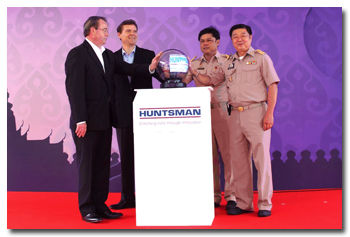
“The inauguration of the Mahachai Specialty Synthesis Unit is a demonstration of our
commitment to Thailand as well as our confidence in the growth of the textile industry in the Asia
Pacific region,” said Paul Hulme, president, HTE. “This synthesis unit is the only one in its class
in terms of scale and quality of output which underpins our drive to be a leader in technological
innovation in our industry.”

Hunstman

HTE President Paul Hulme and Huntsman Corp. President and CEO Peter Huntsman with Chatree
Phoob, mayor of Bangpla Municipality, and Chaiyasit Worakhamheang, head of Sumatsakorn Provincial
Industrial Authority, at the inauguration ceremony of the specialty synthesis unit in Mahachai,
Thailand

Huntsman has invested a total of $17.5 million over the past five years to upgrade the
Mahachai facility, which, according to the company, features state-of-the-art proprietary
technology that boosts production capacity and efficiency and exceeds strict global environmental
and safety standards. A Formulation Distribution Center also is located at the Mahachai site.

January 29, 2013

Trützschler Switzerland Receives Order For Carpet Yarn Spinning System

Trützschler Switzerland AG — a provider of spinning components and plants for processing bulked
continuous filament (BCF) and industrial yarns; and a part of Germany-based Trützschler Group’s
Trützschler Man-made Fibers business — reports it has received an order for a symTTex carpet yarn
spinning system from a long-time customer of the former SwissTex Winterthur AG.

Last year, Trützschler Group acquired the BCF and industrial yarns business — including
personnel and intellectual property — of Switzerland-based SwissTex Winterthur, which has been
renamed Trützschler Switzerland AG
(see ”
Trützschler
Acquires SwissTex BCF And Industrial Yarns Business
,”
TextileWorld.com, October 16, 2012)
. Trützschler will deliver the system to
the company, which is based in China, in the second half of 2013.

January 29, 2013

Sponsors