A Conversation With AATCC’s Gregg Woodcock: From Curious Textile Student To Executive Director

Gregg Woodcock

The American Association of Textile Chemists and Colorists’ (AATCC’s) Executive Director Gregg Woodcock discusses his personal textile journey, industry relationships and new leadership role at AATCC.

By James M. Borneman, Editor In Chief

In response to the World War I blockade of Germany, when the export of European dyes to the United states halted, 140 men gathered at the Engineer’s Club in Boston in 1921 and established the American Association of Textile Chemists and Colorists (AATCC). Its critical mission at that time was to develop standards for producing dye products consistently — which was urgently needed — and in doing so, the groundwork was laid for further development of test methods, evaluation procedures and literature that brought a semblance of order to the expanding dyeing and finishing industry.

For many in the textile industry, AATCC is a trusted resource for standardized textile test methods, training, publications, and engagement with like-minded industry professionals. AATCC standards became the arbiter for how textile manufacturers met the specifications of products ordered by their clients. Imagine the newfound ability for client and manufacturer to converse, compare competitive sources, and have a “standard”by which to evaluate order fulfillment.

Even today, when textile products are at the end of production, prior to shipping, or received by the next client downstream in the supply chain, AATCC standardized test methods provide a baseline that, technically and systematically, represent the product’s characteristics.

Late last year, AATCC named Gregg Woodcock executive director of the association — an organization that has played a significant role in his life-long career in textiles. Woodcock’s experience ranges from earning his textile engineering degree in 1985 to his most recent role as senior manager, Product Quality/Safety at Hanesbrands Inc.

Woodcock recently sat down with Textile World to share some of the challenges and insights gained throughout his textile career and how those experiences prepared him for his current responsibilities as AATCC executive director.

TW: What attracted you to the textile industry?

Woodcock: My father, Dr. Harry W. Woodcock, is a theoretical physicist who spent his entire career teaching at the Philadelphia College of Textiles and Science (PCT&S) which is now Thomas Jefferson University. As the dependent of a college professor, I had the opportunity to not pay tuition to attend the college.

As a curious student, following my junior year of high school I participated in a week-long summer textile camp at PCT&S, and I was hooked. The combination of zero tuition and the new-found interest in textiles led me to major in textile engineering.

TW: How did your academic background — a degree in textile engineering as well as a master’s degree from the Institute of Textile Technology —impact your career in textiles?

Woodcock: As with most college students, I thought I knew everything after receiving my undergraduate degree. I quickly learned in graduate school that I didn’t know what I didn’t know. I’ve carried that lesson with me throughout my career in industry, and now at AATCC.

Even after 60 years of living and learning, I learn new things every day. I spent the first decade of my career largely working in dyeing and finishing mills. My education made the work lessons easier to comprehend and work taught me a depth of knowledge that you can’t get from textbooks.

The degrees also taught me the language of textiles. Having the language and the engineering perspective allowed me to problem solve with a larger group of coworkers than if I had studied something other than textiles.

Since its inception, AATCC has published test methods, evaluation procedures and other literature.

TW: What was your early career path like in textiles?

Woodcock: Probably the most significant detail of my early career was change. Over the first 11 years, I built three houses across North Carolina, moving multiple times.
A key lesson was to never burn bridges; you never know what the future holds. I left a particular dyeing and finishing mill, was gone for three years, and then came back in a higher-level position.

By leaving the first time with the right attitude, I was welcomed back. And one of the people that worked with me at that mill today works at AATCC.

TW: During your career, what impact did AATCC have on you, your work and your personal growth?

Woodcock: Back in college, AATCC was a legendary organization; there was a real mystique about it. There were so many critically important test methods that came from AATCC. For a large chunk of my career, I was responsible for product quality, including testing; it was during this stage that my relationship with AATCC really took off.
I joined AATCC as a member and became involved with multiple research committees
and eventually became chair of RA88, Home Laundering Technology, which then led
me to be a member of ECR — the Executive Committee on Research.

These were excellent experiences that broadened my personal knowledge, benefited the company that I worked for, and helped me make new connections across the industry.

Not long after my term on ECR ended, I became interested in growing my relationship with AATCC, examining different paths. Before anything concrete happened, the executive director role at AATCC opened up and here I am.

TW: When you came on board as AATCC’s executive director, what surprised you the most about the association and was there anything you learned about AATCC that you didn’t know?

Woodcock: Having been an active member for more than a dozen years, I knew about the comradery among the members. But I wasn’t fully aware of the staff at the AATCC Technical Center. They are an incredible group of people that do a tremendous amount of work for the association, often behind the scenes. They are highly talented and dedicated professionals. They feel like a “work family.”

I “knew”of the AATCC Foundation, but I wasn’t fully aware of it. It’s an incredible part of AATCC that just does one thing: it gives money to students in pursuit of textile education.

Each year, the foundation gives up to $132,000 in scholarships, fellowships, and research grants. Signing the checks for these gifts is the highlight of my year.

I’m tremendously grateful for the generous members that have built the foundation, including Charles E. Gavin III, who was instrumental in founding the scholarship program and gave the first financial gift to the foundation.

TW: Anything interesting that people may not know about AATCC?

Woodcock: I know this might sound funny, but AATCC 1993 Standard Reference Detergent, WOB – without optical brightener, is not made by the same company that makes the number one selling laundry detergent in the United States. I feel like I’ve been given the formula to Coca-Cola or Colonel Sander’s 11 herbs and spices.

What really differentiates AATCC detergent is its consistency — it doesn’t change with the times. The same is NOT true for detergents sold at retail. Lab testing demands consistency over time and AATCC detergent delivers consistency.
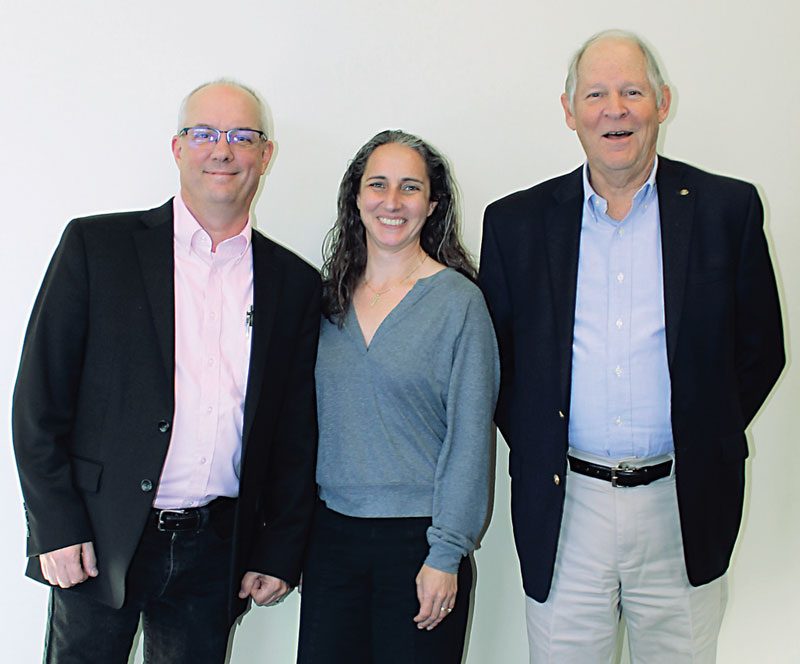
(left to right): AATCC Executive Director Gregg Woodcock; former executive vice president Diana Wyman, and John “Jack” Daniels, who was previously executive vice president for more than 20 years.

TW: When you are asked,“What is the AATCC?” what is your response?

Woodcock: I asked myself that question shortly after I arrived. I put a one-page document together to help me fully understand. Key points are:

  • A professional association of members, including professionals, students, and corporations;
  • Founded in 1921 to serve the global textile industry;
  • A 501(c)(6) nonprofit organization;
  • Focuses on textile testing methods, standards, and education for the textile, apparel, and related industries;
  • Publishes the AATCC Technical Manual
    (Manual of International Test Methods and Procedures), which includes test methods widely used for textile quality control;
  • Publishes the AATCC Journal of Research, a peer-reviewed scholarly journal. The journal’s aim is to advance and disseminate knowledge in all areas pertinent to textile research;
  • Provides training, conferences, and networking opportunities for professionals in the field; and
  • Includes the AATCC Foundation, a 501(c)(3) nonprofit organization that provides scholar-ships, fellowships, and research grants to undergraduate and graduate students studying textiles in the United States.

TW: AATCC has always been a gold standard for test methods and communication by way of the standards. What is the process like for developing standards, and how does AATCC understand the need for a new standard and develop a method to support it?

Woodcock: From my earliest days at PCT&S, to today, AATCC really has been the gold standard for textile test methods. And the secret sauce to the process of developing new standards and supporting existing standards is our members.

AATCC is made up a very diverse group of individuals that represent all facets of the textile supply chain. We have people that span the entire vertical, from fiber formation to textile manufacturing through cut/sew, to brands and retailers. Then there are academics and suppliers, who are absolutely critical to the long-term success of AATCC and the standards development process.

AATCC has dozens of research committees, all made up of members. The research committees meet twice a year — in May and November —and work on new test methods and update existing test methods.

Committee members are welcome to propose new test methods that will benefit the industry. Each committee is chaired by a member — not by AATCC staff — and each committee is made up of volunteer members of the association.

And the best part is that the committee meetings are free-of-charge to attend, and — thanks to COVID — offer a hybrid option.

TW: Education has always been an important part of AATCC, how has that evolved from when you were a student? How do you see it changing with the shifts in the textile industry?

Woodcock: The biggest change in textile education over the last few decades has been the reduction in the number of colleges dedicated to textiles in the country. There are still plenty of schools to obtain a degree in textiles but only one school/college of textiles remains.

Along with this change, the most common degrees have changed as well. There used to be a lot more textile chemists, textile engineers and textile technologists. Today, it’s textile/apparel design, textile/fashion merchandising, fashion management, and fashion and apparel studies, for example.

This changes some of the scholarships that the AATCC Foundation offers; two of the more recent scholarships added to the annual offering are a Textile Design Scholarship and a Textile Merchandising Scholarship.

A changing industry also impacts the educational classes that AATCC conducts; we now include a Mastering Textile Specifications workshop that is less technical than traditional offerings, but appeals more to designers, merchandisers, and product developers.

Though we have “chemists and colorists” in our name, we are adapting to the changes in industry and academia.

TW: Industry events and meetings have always been a large part of the organization. How are they structured today? Are certain types of meetings, conferences or digital options shifting in importance?

Woodcock: Industry associations are an important part of every industry. Since COVID, corporate travel budgets have been under more pressure than ever. Remote options have a real place that should not be abandoned, but so does face-to-face human interaction.
The relationships and camaraderie are enhanced by participating in industry events. Because of the stress on travel budgets, a collective of textile industry associations has been organized to help all the associations thrive. It’s called the Alphabet Soup Collective. It now includes 12 different organizations that meet regularly to discuss shared issues and seek out opportunities for collaboration.

To further the collaboration, AATCC and SEAMS — the Association and Voice of the U.S. Sewn Products Industry — are jointly hosting a fall meeting we are calling
“Fabricating the Future. ”It will be held in Savannah, Ga., October 5-7, 2025. There is a tremendous amount of content packed into the event that will appeal to both textile and apparel experts, plus plenty of opportunity to network and expand horizons.

TW: As executive director, what is your vision for AATCC and how is the vision impacted by the global textile industry?

Woodcock: For more than 100 years, AATCC has been a consistent beacon of service to the textile industry. Though founded in the United States and knowing that the first word in our name is “American”, we have become and will continue to be more international.

The AATCC Technical Manual is now the AATCC Manual of International Test Methods and Procedures.

In January 2025, I signed a Memorandum of Understanding with the Textile Association
of India (TAI).

In August, I will participate in a signing ceremony for a Mutual Recognition Agreement with CTES, the China Textile Engineering Society.

Today, the largest AATCC student chapter is in Pakistan — NED University in Karachi.
AATCC represents the American textile industry, but definitely has a global focus. The textile industry today is global in scope and so is AATCC.

Over time, things will change. People might say “that’s not your father’s AATCC;”and when that happens, I’ll know I’ve been successful.

2025 Quarterly Issue III
Cal Poly Ponoma Assistant Professor To Design PPE For Agricultural Workers

Cindy Cordoba, assistant professor of apparel and merchandising management at Pomona, Calif.-based California State Polytechnic University Pomona has received a $398,926 state grant to co-design, produce and distribute the first 100 Heat-Shield garments for agricultural workers in Southern California. Farmworkers will participate in the design process, including fabric selection, prototypes and field trials. The garments aim
to reduce occupational health risks, as agricultural workers are significantly more likely to die from heat exposure than workers in other sectors. The grant was awarded from the Extreme Heat and Community Resilience Program as part of the Governor’s Office of Land Use and Climate Innovation.

“According to a 2021 research study, extreme heat exposure for outdoor workers could triple by mid-century, putting $39.3 billion in annual earnings at risk,” Cordoba said. “These facts, along with what I’ve seen and learned from workers firsthand, have motivated me to pursue a solution that is both equitable and sustainable. I believe that through circular, user-centered design, we can create protective clothing that addresses the realities of climate vulnerability and uplifts those who are too often left out of the conversation.”

2025 Quarterly Issue III

Andritz Supplies neXline Spunlace Line To Gesalife

Hubei Gesalife Industry Co. Ltd., China, has successfully commissioned its first crosslapped configuration neXline spunlace production line from Austria-based ANDRITZ. Operational since late 2024, the line produces up to 1,000 kilograms per hour of spunlace roll goods, with crosslapper speeds of 130 meters per minute. The installation supports Gesalife’s expansion in wipes and hygiene product converting, aligning spunlace output with its existing capabilities. The company manufactures hygiene products, disposable medical
supplies and protective equipment.

Li Jun, chairman of Gesalife, said: “This new spunlace production line and the cooperation with Andritz marks a major leap forward for Gesalife. We look forward to leveraging this technology to support future innovation and growth.”

2025 Quarterly Issue III

ALMA Installs New Dilo Systems Needling Line

To expand its polypropylene fiber production Italy-based ALMA S.p.A., a floor coverings specialist, has installed a new nonwoven needling line from Germany-based Dilo Systems GmbH. The line serves ALMA’s markets in exhibition carpet, artificial grass, automotive interiors and domestic applications. The system includes DiloTemafa fiber blending and filtration system, DiloSpinnbau card feeding, state-of-the-art carding, high-speed crosslapping from DiloMachines, and 6-meter-wide needling with DI-LOOP for high-speed structuring, in addition to Industry 4.0 DI-Connect controls.

According to ALMA, the line has been installed and started up in a smooth, straightforward way, synchronizing DILO’s team with ALMA’s operating and maintenance department. The launch provided a quick start-up and full production capacity.

2025 Quarterly Issue III

CCI Obtains U.S. Air Force Funding For CF3D® Technology

Continuous Composites (CCI), Coeur D’Alene, Idaho, has secured multi-million-dollar funding from the U.S. Air Force to advance high-temperature materials using its CF3D® technology. The first funding phase will establish baseline material properties for CF3D-produced components, while the second phase will expand to full-scale production and flight testing. CF3D enables automated manufacturing of continuous fiber composites in near-net shapes, offering precise control and scalability for high-performance applications.

According to CCI, by integrating advanced materials fiber steering and automated manufacturing, CF3D enables the production of lightweight, high-performance structures with unmatched precision and scalability.

2025 Quarterly Issue III

Nonwovenn Invests In MediTech Division

England-based Nonwovenn has invested in its MediTech division, adding a new medical manufacturing suite at its headquarters location. The facility includes a Class 8 standard performing cleanroom and supports the company’s three-year plan to drive 14 percent annual growth through innovation, partnerships and expansion. Recent product developments include x-ray detectable materials for surgical safety, reinforced CMC hydrofiber for wound care, and a translucent dressing scaffold that enables incision site inspection without removal.

John Birkett, medical business director at Nonwovenn, said: “The investment reflects our commitment to quality, innovation and continuing to serve the evolving needs of our partners in the sector across the UK, Europe and Middle East.”

2025 Quarterly Issue III

Absorbent Hygiene Products In The Spotlight

INDA’s annual Hygienix™ event will gather in Orlando for the 2025 edition.

TW Special Report

Hygienix™, an annual event focused on the absorbent hygiene products (AHP) industry organized by the Cary, N.C.-based Association of the Nonwoven Fabrics Industry (INDA), will be held in Orlando, Fla., November 17-20, 2025, at the Omni Orlando Championsgate hotel.

Hygienix brings conference sessions, workshops, tabletop exhibits and product showcases, networking, and the Hygienix Innovation Award™ together in a single event for industry leaders, innovators and professionals from the AHP industry.

First up, on November 17, are three workshops designed to provide hands-on learning and insights. James Robinson, principal, Absorbent Hygiene Insights LLC, is hosting a workshop titled “Fundamentals of Absorption Systems and Opportunities in Adult Incontinence.” Crown Abbey CEO Heidi Beatty will lead a workshop on “Innovations in Menstrual Care.” A third workshop named “Baby and Infant Care Market Dynamics” will be conducted by Natalia Richer, director of business development, Diaper Testing International.

Conference Topics

As of TW’s press time, INDA was still finalizing the speakers and the presentation titles for the conference. But, this year’s conference program will focus on key areas that are trending in the AHP industry:

  • Sustainability and Circularity — including biobased materials, natural fibers, packaging innovations, end-of-life solutions and safe operating limits;
  • Consumer and Market Insights — including private label product growth, regional market outlooks and skin health;
  • Product Innovation — including strategies to manage hurdles when bringing period care products to market; and
  • Regulations and Standards — including regulatory updates and testing methods.

In 2025, Hygienix offers participating companies two opportunities to share information, and demonstrate products and services to attendees who may be potential partners or future clients — tabletop exhibits; and fast-paced, five minute Lightning Talks. The talks will take place November 18 and 19 in the afternoon. INDA also is hosting extended networking with three receptions — the official welcome reception on November 17, as well as receptions and the chance to view the exhibits at the end of the day on November 18 and 19.

Innovation Awards

Finalists for the Hygienix Innovation Award will give presentations about their nominated products to event attendees on November 18. At the close of the event on November 20, the winner will be announced. As of TW’s press time, the finalists had not been determined, but the products always cover breakthrough ideas in technology and product solutions. Last year’s winner was HIRO Technologies, a start-up out of Austin, Texas, awarded for its biodegradable MycoDigestable™ Diapers.

“Having attended every Hygienix since its inception, what I always found valuable was the ability to connect with both my suppliers and customers at the same event,” said Dr. Matt O’Sickey, director of Education & Technical Affairs, INDA. “Having both my technical and commercial team members with me in those meetings allowed us to take quick decisions that accelerated programs and ultimately enhanced our speed to market, elevated our hit rate and improved our overall ROI. Now with INDA, I appreciate the efforts made to provide actionable market and technical content and facilitate the supply chain connectivity that was so critical for my success in the corporate world. Hygienix is an exhausting week in the very best possible way.”


For more information about Hygienix™ — including the full conference schedule, speakers and topics — please visit hygienix.org.


2025 Quarterly Issue III

RISE® 2025: Where Research Meets Real-World Innovation

The 15th annual RISE® conference will bring industry and academia together in a forum for science, innovation and collaboration in engineered fabrics.

TW Special Report

The 15th RISE™ — Research Innovation & Science for Engineered Fabrics — conference is set to take place October 14-15, 2025. The two-day event, co-organized by the Cary, N.C.-based Association of the Nonwoven Fabrics Industry (INDA) and The Nonwovens Institute, will take place at the McKimmon Conference and Training Center on the NC State campus, Raleigh, N.C.

RISE focuses on emerging technologies and ideas with the aim of connecting innovations with real-world applications for professionals in the nonwoven/engineered fabrics industry.
Speakers included experienced industry, government and academic personnel.

While the event is created by a nonwovens organization, topics and focus areas stretch beyond nonwovens with a large focus on materials science. There definitely are reasons to attend for those who do not work exclusively in the nonwovens industry.

Key topics covered at RISE include:

  • Recycling methods, raw materials alternatives and circular economy;
  • Biobased/hybrid fibers and natu-ral-synthetic blends;
  • Innovations in coatings, additives and adhesives; and
  • Enzyme technology and the biodegradation processes. Speakers from Nova Institute,

Total Corbion, Fibroline, Gottlieb Binder, CJ Biopolymers, Bast Fibers, Keel Labs, Hills Inc. and INDA, among other companies are commit-ted to speak during this year’s event. Please visit the RISE website for the full conference lineup and schedule.

On Monday, October 13, a day ahead of the conference, there is a golf tournament starting at noon at the Lonnie Poole Golf Course on the NC State campus. The conference also is offering tours of NWI from 3-5 p.m. at the conclusion of the conference proceedings on October 15.

RISE® Innovation Award, Research Posters

Nominations have already concluded for the RISE® Innovation Award, which honors innovation in nonwovens that solve problems and meet unmet needs. The top three nominations as selected by an INDA Technical Advisory Board (TAB) will present their technologies during the RISE conference. The winner is determined by votes cast by TAB, the affiliated Conference Committee and attendees at RISE, with each group’s votes carrying equal weight. All votes are tallied during the conference and the winner is presented with the award before the end of RISE. Last year’s winner was Hempitecture Inc. for its PlantPanel™ product (See “From Hemp Farm To House Frame: The Hempitecture Story,” TW,, this issue).

An evening reception, to be held from 5-6 p.m. on October 14, will allow attendees to view current research work of graduate students who are enrolled in a variety of non-woven, textile and fiber programs as well as corporate research posters.

Pre-RISE® Webinar

On Thursday, October 2, INDA will host a preconference webinar on the topic “Enhancing Softness and Loft in Nonwoven Fabrics.” The presentation — featuring ExxonMobil Technology & Engineering Co.’s Dr. Paul E. Rollin Jr., senior principal scientist – Global Hygiene, and Thomas Cugnon, Hygiene Market Development Lead, Europe — will explore the role of ExxonMobil’s Vistamaxx™ performance polymers in softness including approaches to achieving a high-loft feel.

“What I’ve really come to enjoy about RISE is that it is one of the few places where you can find a blend of scalable academic and independent lab research side-by-side with fresh to the market industrial innovations,” said Dr. Matt O’Sickey, director of Education & Technical Affairs, INDA. “Observing how this mix fosters cross-pollination and synergies in the fiber, engineered fabrics, and nonwoven space is invigorating.”

Make plans to attend this year’s RISE conference and participate in this unique forum where research, innovation and commercialization really do intersect. The conference showcases what’s next, but also fosters collaboration and helps accelerate ideas.


For more information about RISE®, please visit riseconf.net.


2025 Quarterly Issue III

AT Expo 2025: A Hub For Textile Leaders And Innovators

The Advanced Textile Association’s (ATA’s) annual conference will take place in Indianapolis in November.

TW Special Report

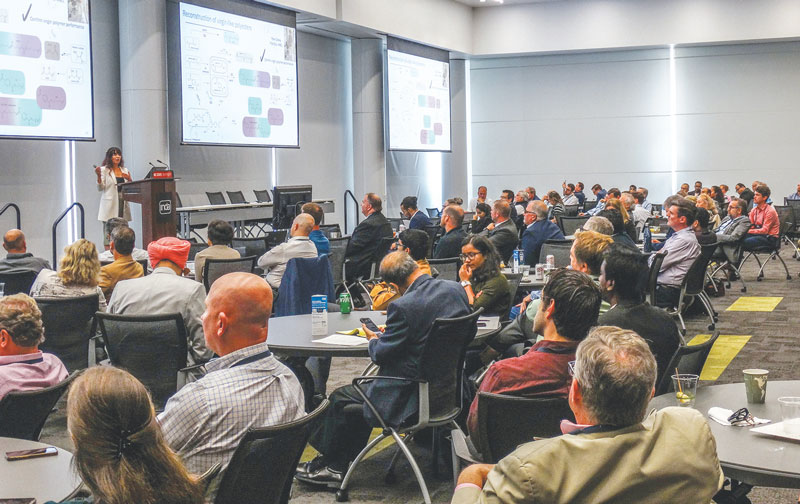
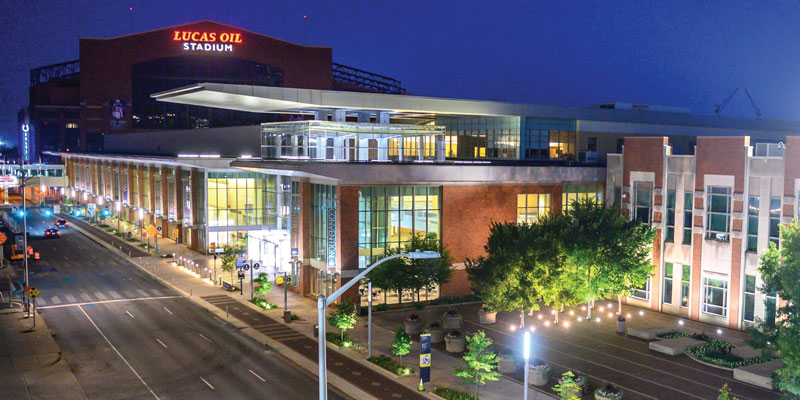
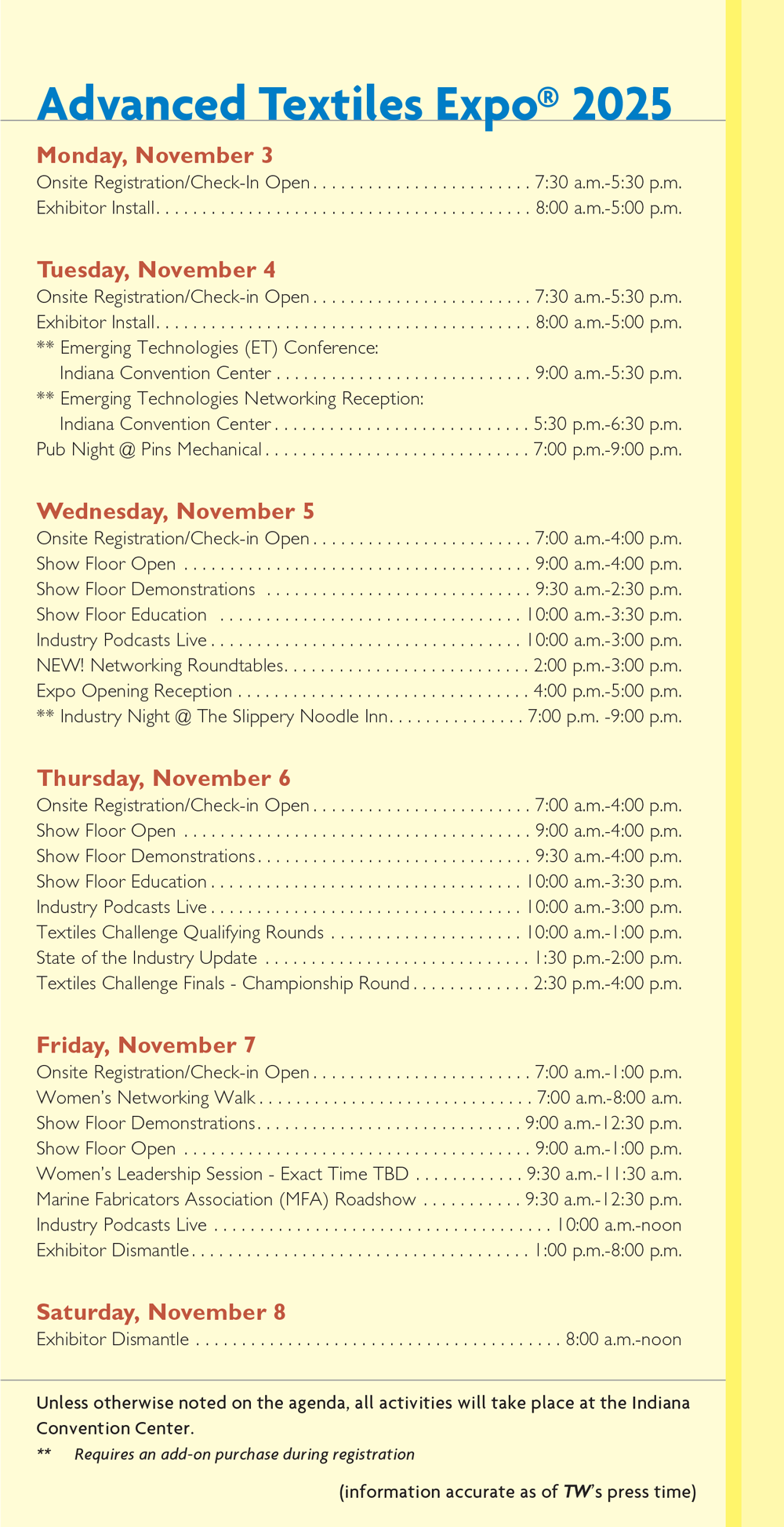
The COVID pandemic halted the Advanced Textiles Association’s (ATA’s) plans to host its annual trade show in Indianapolis, Ind. The year 2020 was the association’s 100th anniversary and it was looking forward to a standout event to mark the occasion. While COVID had other ideas, ATA is excited to host the 2025 edition of the AT Expo at the Indiana Convention Center in downtown Indianapolis. Education sessions begin on November 4 and the show floor is open November 5-7, 2025.

What To Expect

The show will again be collocated with Messe Stuttgart’s Sun Shading Expo North America. According to ATA, the collocation of the events for these two complementary industries offers value in terms of connecting with customers, suppliers, end-product manufacturers, and industry counterparts, as well as providing growth opportunities. Attendees have access to both events including the combined show floor, show floor education and networking receptions. The only exceptions are AT Expo’s Emerging Technologies (ET) conference, which is only open to AT Expo registrants; and Sun Shading Expo classroom education, which is only open to Sun Shading Expo registrants.

The show floor will feature the ATA Hub, which is a great place to learn more about ATA or join a member division open meeting.

Education

For an add-on charge, attendees can arrive one day early to kick off their expo week at the ET Conference. On Tuesday, November 4, a full day of presentations will conclude with the ET Networking Reception from 5:30-6:30 p.m.

Topics will cover a variety of subjects from medical textiles and bio-materials to space innovations and artificial intelligence. A full lineup of speakers and topics is available on the AT Expo website.

Education continues on the show floor stage beginning Wednesday morning. These more informal, 30-minute sessions are designed to be interactive and digestible.

New In 2025

ATA has planned several new features for attendees at the upcoming expo. Networking Roundtables will allow fabricators and suppliers to engage in topic-driven and candid conversations. It’s free to attend these peer-to-peer sessions that will cover topics such as tariffs, workforce development and overcoming sales objections, among other topics.
ATA also will present a State of the Industry Update, which highlights findings from its annual State of the Industry survey. This session, to be held on the show floor, is open to all expo attendees. In addition to the economic outlook, growth markets and industry trends content, the presentation will include testimonials about ATA programming and how it helps support member success.

“Talking Textiles” — a daily live podcast — will be recorded on the show floor. According to ATA, visitors will be able to hear “textile leaders, innovators and changemakers” as they are interviewed on subjects such as trends, challenges and industry stories for the podcast. ATA will publish a full schedule of hosts and guests as the expo date draws closer.

Other Notable Events

Returning to AT Expo is the Marine Fabricators Association (MFA) Roadshow. Julie Tinsman from Strataglass, Jeff Newkirk from Precision Custom Canvas and Kyle Van Damme from Marine Tops Unlimited, will host sessions on marine fabric selection, traditional patterning techniques and U-Zips. The roadshow is free to attend, but registration is required to save a seat.

ATA is again giving women a chance to meet and network during the expo. On Friday, November 7, before the show floor opens, the Women’s Networking Walk will take place. Later the same morning, women also can participate in the Women’s Leadership Empowerment session. Under the title “Balancing Priorities for Success,” the session will impart advice and ideas on managing work and life while building a career.

Nighttime Social Events

To kick things off, the Professional Awning Manufacturers Association (PAMA), ATA Canada and the Fabric Structures Association (FSA) are hosting Pub Night at Pins Mechanical Tuesday, November 4, from 7-9 p.m. Members of PAMA, ATA Canada and FSA are welcome to connect with peers and network in a relaxed atmosphere. The event is sponsored by Herculite®, Trivantage® and Sunbrella®.

On Wednesday, November 5, AT Expo will host the official opening reception at 4 p.m. The reception is included with all registration types to give all participants the chance to mix and mingle to wrap up the first full day. The reception is sponsored by Herculite.

Attendees who opt to purchase a separate ticket during registration can move from the opening reception to Industry Night at 7 p.m., which this year will be held at the Slippery Noodle Inn in downtown Indianapolis. As always, live music will be provided by ATA member band Hangin’ by a Thread. Event sponsors are Herculite, Sunbrella, TVF and Weathermax®.


For more information about Advanced Textiles Expo — including the full conference schedule with speakers — as well as to register, please visit advancedtextiles expo.com.


2025 Quarterly Issue III

From Hemp Farm To House Frame: The Hempitecture Story

Hempitecture’s HempWool® is a 90-percent hemp fiber batt insulation material designed to replace mineral wool and fiberglass in insulation applications. It can be installed in wood or metal framing systems.

Hempitecture is bringing natural fibers, hemp  in particular, to the  forefront of sustainable building design.

By Rachael S. Davis, Executive Editor

Not every textile entrepreneur begins their journey in the textile space. Some arrive by way of a completely different path — driven by a problem they can’t ignore and a vision for change. For Matthew “Mattie” Mead, co-founder and CEO of Jerome, Idaho-based Hempitecture Inc., that moment came while studying architecture, environmental science, and entrepreneurship at Hobart College in Geneva, New York.

As Mead became immersed in the world of sustainable design and materials, “I saw a big problem,” Mead said. “Buildings and their operations are responsible for nearly 40 percent of our carbon footprint. In seeking to understand how to solve that issue, I became enamored with the idea of using plant-based, sustainable fibers.”

He was inspired to use hemp as a carbon-storing, high-performance material, and what started as a vision, quickly became Mead’s mission.

Leveraging Hemp

In 2013, Mead co-founded Hempitecture — a company he touts as a “Public Benefit Corporation with a mission to benefit both people and planet through carbon capturing mate-rials.” Mead works with Co-Founder and Chief Innovation Officer Tommy Gibbons to develop Hempitecture’s biobased construction materials.

The company primarily uses decorticated and cleaned industrial hemp fiber to create its products, along with some cotton and thermoplastic fibers including polyethylene and polyester biocomponent bonding fibers. Depending on the use case, the company may also create products using polylactic acid (PLA) fibers.

“Hemp is our cornerstone because it’s fast-growing, regenerative, and has ideal insulation properties,” Mead said. “We like to consider it our carbon capturing engine behind our product portfolio. We blend the hemp with other fibers, depending on the performance characteristics we are seeking to achieve.”

Hempitecture’s facility is in Jerome, Idaho, in the heartland of agricultural industrial hemp fiber production.

Jerome, Idaho, was selected for the company’s headquarters and manufacturing location because it’s in the heartland of agricultural industrial hemp fiber production, according to Mead. “From a logistical standpoint, it’s centrally located to where hemp is grown, but our factory is located right on Interstate 84, allowing efficient distribution of our finished nonwovens,” Mead shared. “In Idaho, we’ve found great team members, we’ve received support from the Idaho Department of Commerce, and we’re proud to sup-port this agricultural opportunity in Idaho, an agriculturally aligned state.

“Agriculture is at the heart of what we do,” Mead emphasized. “By sourcing fibers like hemp from American farmers, we’re creating new markets for regenerative crops. We’re turning farms into supply chains and putting rural communities at the center of climate solutions.”
Hempitecture also operates five distribution centers around the country.

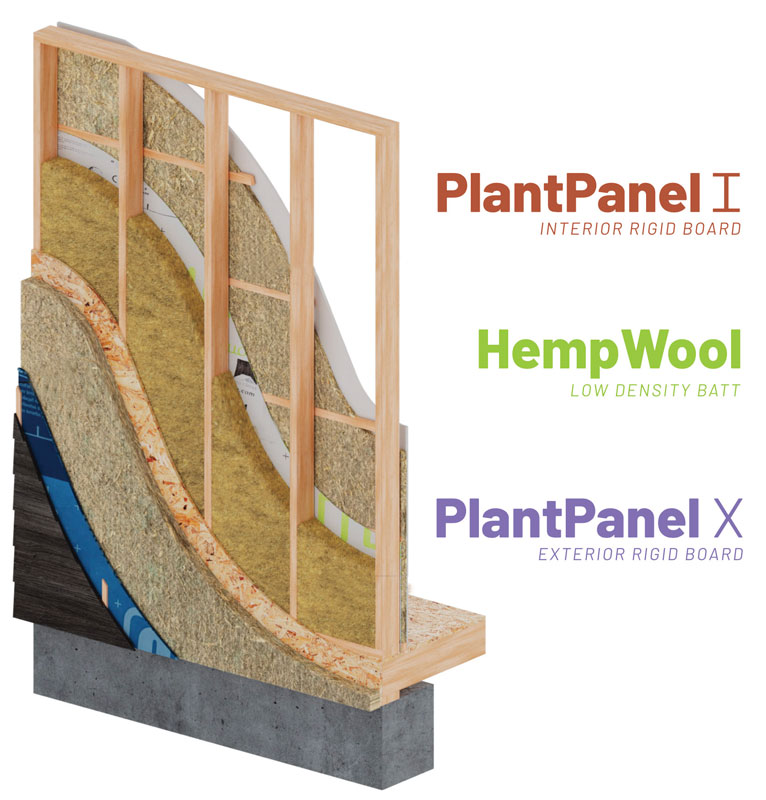
Hempitecture’s product portfolio includes PlantPanel™ — a continuous insulation panel made from biobased fibers for exterior or interior wall assemblies —as well as HempWool™ fiber batt insulation.

First Introduction: HempWool®

Hempitecture’s first innovation was HempWool®. This natural fiber batt insulation material contains hemp, but no wool as the name may suggest. The wool portion of the name arises from the fact that HempWool was designed to replace mineral wool and fiberglass products traditionally used in the construction business. HempWool comprises 90-percent hemp and 10-percent binder fiber.

“We initially collaborated with Europe-based OEMs and other manufacturers who had experience in natural fiber insulation and nonwovens,” Mead said. “That helped us under-stand the machinery and process requirements. With their support, we developed a unique configuration of nonwoven machinery with modifications so it can handle natural fibers like hemp, which behave differently than synthetic fibers.”

Eventually, Hempitecture brought the technology stateside and made it their own, modifying, improving, and ultimately scaling it into a domestic operation.

Hempitecture began development of HempWool in its production facility in 2022, and after working with academic and industry partners, launched the product for sale in the U.S. market.

HempWool currently is used primarily in residential construction, but Hempitecture is working on expanding its reach into other markets including industrial and commercial for wall, roof, and floor assemblies.

“Current capabilities include fiber opening and cleaning, fiber treatment, airlay and thermal bonding, and nonwoven cutting,” Mead shared. “We also can offer custom formulations for partners across industries and are always open to collaborating on nonwoven projects.”

Hempitecture is focused on healthier and more sustainable alternative construction materials for the whole building including insulation and acoustic products.

Whole Home Solutions

Once HempWool hit the market, Hempitecture looked for other areas where its natural fiber technology could make an impact. The company is building a portfolio of whole home thermal and acoustic insulation solutions, but is not limiting itself to building products.
“Manufacturing is about continuous improvement, and we continue to develop our manufacturing technologies and capabilities to advance our product portfolio,” Mead said. “While we started with HempWool, it’s an evolving product as we continue to advance our fiber compositions, our treatment technologies and our operational efficiency.”

PlantPanel™ — a continuous thermo-acoustic insulation panel made from biobased fibers for exterior or interior wall assemblies —and FiberFill™ — a blowable loose-fill insulation material ideal for retrofits and attics — became the next two products offered by Hempitecture. In addition, it offers a carpet underlay named FiberPad, and an eco-friendly building material called Hempcrete.

“We also entered the cold-chain packaging sector, developing a high-performing hemp-based liner for shipping food and pharmaceuticals,” Mead said. Hempitecture utilizes cotton shoddy fiber for the cold-chain packaging products, which helps divert landfill bound textiles into new materials.

“While hemp and building materials are our core focus, we also produce products for a variety of industries needing nonwoven materials using a range of different fibers,” Mead noted.

Hempitecture Advantage

According to Mead, Hempitecture’s products compete head-to-head on thermal performance. The company has completed ASTM C518 thermal testing, ASTM E84 testing and ISO-based lifecycle assessments to back up its claims. “From an R-value perspective, we’re competitive with mineral wool and fiberglass, but our product phase shift resistance is improved over these conventional products,” Mead noted. “Hemp fiber insulation has incredible phase shift resistance — storing heat and then releasing it as temperature shifts from hot to cool, reducing heating and cooling loads,” Mead said. “It’s also highly dimensionally stable so it won’t sag or slump over time.

“From an embodied carbon and health standpoint, we’re significantly better. We’re continually optimizing our products and we’re advancing our fire-resistance ratings to better align with commercial and industrial standards.”

HempWool®can be handled and cut without special tools or protective gear.

Mead notes however that there is a lot more to insulation than just R-value. In addition to making the grade on thermal performance, Hempitecture products offer other significant advantages. They are non-toxic, vapor open, carbon-storing and safe to touch. HempWool can be handled, cut and installed all without wearing gloves. Hemp also confers a natural mold- and pest-resistance.

Properties can be further enhanced with the company’s proprietary fiber fortification line that can increase fiber consistency, and improve flame and pest resistance. “We also
enhance our fibers with our fiber treatment technology, which is typically borate-based chemistries — a naturally occurring mineral with a long safety record,” Mead added.

In addition, Hempitecture products are landfill-safe and mostly biodegradable. “Unlike traditional insulation, which can persist for decades releasing harmful substances as it degrades, our materials break down safely,” Mead said. “Because our products are airlay thermal bonded, we do use small amounts of polymers, but are always monitoring the world of biobased bonding fibers.”

Wide-Scale Adoption

Response to Hempitecture products has been incredibly positive, especially among architects, builders and homeowners who prioritize health and sustainability. “The biggest hurdle is awareness, and people don’t always know that better alternatives exist,” Mead reflected. “We also face typical industry barriers like code compliance and cost competitiveness at scale.”

Mattie Mead (center) accepted the RISE® Innovation Award from the Association of the Nonwoven Fabrics Industry (INDA) for PlantPanel™.

In 2024, Hempitecture’s Plant-Panel received the Association of the Nonwoven Fabrics Industry’s RISE® Innovation Award. Being recognized by the nonwovens industry helped raise awareness for Hempitecture. “Winning the RISE Innovation Award put us on the radar of some major players in the nonwoven and building material industries,” Mead said. “It validated our work and opened doors for collaboration, funding and visibility in sectors we hadn’t yet tapped. We are excited about the opportunity to collaborate with mainstream players in the nonwovens and textiles industries to help custom build nonwoven solutions using our technology and capacity.”

A Better Future

The Hempitecture team is small, but growing. The company is eyeing an expansion in Tennessee that would be enabled in part by Department of Energy funding.

Mead considers material innovation, sustainability leadership and the company’s supply chain as its biggest strengths. “We partner with companies who produce fibers to our specification, which gives us flexibility and resilience,” Mead said. “Our team also brings together architectural knowledge, manufacturing experience and startup experience, which is a rare combination.

“Our culture is mission-driven, entrepreneurial, and rooted in the belief that materials can be a force for good,” Mead offered. “We value transparency, sustainability, health and performance, as well as American manufacturing.”

PlanetPanel™ X exterior rigid board thermo-acoustic insulation panels.

Long-term, Hempitecture envisions a world where natural fibers are a cornerstone of the built environment from walls to packaging and beyond. “We’re building a platform for biobased building materials,” Mead said. Our technology can be extended to new product categories including acoustic panels, molded composites and prefab building systems.”

Summing up, Mead said: “The materials we build with matter. They shape our health, our climate and our economy. I believe we have a responsibility, as well as a huge opportunity, to reimagine those materials for a better future.”

From an idea born in a college thesis to a growing company reshaping how buildings are made, Hempitecture has proven that natural fibers can compete with — and perhaps surpass — conventional materials. By pairing agricultural innovation with advanced manufacturing, the company is carving out new markets for regenerative crops while delivering healthier, more sustainable products for builders, homeowners, and industries beyond construction. As awareness grows and collaborations expand, Mead sees Hempitecture not just as a manufacturer, but as a catalyst for change — proof that the materials we choose can protect our planet, strengthen communities and inspire a better future.

2025 Quarterly Issue III

Sponsors