Keeping Products Moving With Swedish Automation At FILTECH 2026

STOCKHOLM, Sweden — June 8, 2026 — At FILTECH 2026, taking place in Cologne from June 30th to July 2nd, members of TMAS – the Swedish textile machinery association – will highlight how the country’s engineering expertise is enabling filtration manufacturers to increase productivity, improve traceability and reduce dependence on labour-intensive manual processes.

Technical woven and nonwoven fabrics are used in a wide variety of products in filtration systems for air, gas and liquid filtration, touching on almost every facet of life in the 21st Century. They are crucial to aerospace and road transportation and a vast range of industrial processes and to be found in every home, hotel and institutional building in air conditioning systems and household appliances such as washing machines and vacuum cleaners.

Interfil produces a staggering range of over 15,000 filter media variants.

At its Skjåk manufacturing plant in Norway, for example, Interfil manufactures an annual 230,000 air filter units from a staggering range of some 15,000 variants, with 9,000 products moving continuously through the differing stages of the plant at any time each day, and a daily finished output of 1,100 products.

It’s a similar situation at the US plant of Filtration System Products (FSP) in Farmington, St Louis, which now has a daily production of over 2,200 filter hoses and media.

Material handling

Both Interfil and FSP rely on the automated material handling expertise of TMAS member Eton Systems in Sweden.

The individually addressable product carriers of Eton Systems are designed to eliminate manual transportation and minimise handling throughout a manufacturing plant, ensuring each individual product arrives at its correct position precisely when required for each separate process step.

Eton Systems automation at Interfil consists of a 50-metre overhead UPS conveyor system designed and installed to link the company’s two production halls at the Skjåk plant, eliminating the need for manual handling and truck transport between the facilities. This has resolved the challenge of having semi-finished products made far from the final assembly area, not only improving efficiency, quality control and component traceability across all parts of production, but also increasing on-site safety due to the need for fewer trucks.

Eton Systems automation at FSP in St Louis.

FSP has meanwhile calculated that since installing an Eton System in 2023, it has increased its production output by 60%, using the same number of operators and the same working hours as with the previous manual system. An inbuilt quality system also ensures that only 100% perfect products are unloaded from the system, allowing for a much more efficient quality control process. In addition, Eton’s compact method of moving single units through the production process has saved floor space and created a safer and more ergonomic work environment.

“FSP wasn’t sure if it was possible to find an automated production system that could handle the varying demands of filtration media production, due to the many style variations, but our system enables all carriers to be tracked in real-time and proved to be the perfect solution,” says Eton Systems CEO Jan Molin.

Filter bag production

A fully automated micro factory to produce fully finished filter bags has meanwhile been developed by TMAS member ACG Kinna Automatic.

Until now, woven or nonwoven needlefelt filter bags have been assembled and finished in laborious and time-consuming cut and sew operations by third party suppliers.

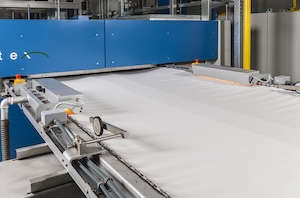
ACG has developed a microfactory for filter bag production.

“The automation of these essential steps eliminates the need for the many hours of labour-intensive manual work that has previously been necessary,” says ACG Kinna Automatic Marketing and Sales Manager Tomas Aspenkog. “The output is 120 finished filter bags per hour, and the entire configuration is guided by precise automatic steering and alignment, with quality control handled by the latest high-definition vision cameras. This type of automation is the way forward, not just for filter bags, but for many industries who heavily rely on such consumables in their operations.”

The ACG microfactory’s configuration is based on two separate interconnecting modules – the Automatic Filter Tube Line (KA-156) and the Automatic Filter Bag Production Line (KA-177).

The Automatic Filter Tube Line handles the fabric feeding from rolls and its folding prior to seam construction, which can either be by automatic sewing, welding or with sewing and taping, depending on specifications. Very rapid changeover of the modular seaming methods can be achieved during product changes. The specific size of the now fully tubular fabric is then precisely cut to size for each individual unit and further folded ready to be fed into the Automatic Filter Bag Production Line.

The Automatic Filter Bag Production Line then automatically attaches the reinforcement, bottom and snap rings onto the filter tube with a second Juki sewing head on a robotic arm, to form the fully finished filter bag ready for packaging.

“The innovations coming from our companies are far-ranging and characterised by an advanced grasp of automation techniques and the need for more sustainable processing methods that is being demanded by their customers,” says TMAS Secretary General Therese Premler-Andersson. “At FILTECH 2026 TMAS members will demonstrate why limiting manual transportation and minimising handling is essential for textile manufacturers, especially across Europe and the United States, in providing competitive advantages.”

Posted: June 8, 2026

Source: TMAS – The Swedish Textile Machinery Association

Registration And Exhibit Reservations Are Open For Hygienix™ 2026

CARY, N.C. — June 8, 2026 — INDA, the Association of the Nonwoven Fabrics Industry, has announced that registration and exhibit reservations for Hygienix™ 2026 are now open. Hygienix will take place Nov. 16-19 at the Hyatt Regency Houston in Houston, Texas.

Hygienix will bring together industry leaders, innovators, and business professionals from across the absorbent hygiene products (AHP) industry for expert-led conference sessions, product showcases, networking opportunities, Lifetime Service Awards, and the presentation of the Hygienix Innovation Award™.

Hygienix Program Highlights

Attendees will gain valuable insights across key areas driving the future of hygiene:

  • Industry collaboration or “coopertition”
  • Market intelligence and global economics
  • Regulatory and trade environment
  • Innovation in products, materials, and processes
  • Sustainability and end-of-life solutions
  • Consumer and end-user insights
  • Startups, entrepreneurs, and emerging technologies

Business Opportunities and Networking

The Exhibits will showcase the latest innovations in the absorbent hygiene industry, offering a platform for companies to demonstrate their products and services to potential partners and clients.

Hygienix 2026 will once again feature Lightning Talks—a series of fast-paced, five-minute presentations by nearly 20 companies scheduled for Nov. 17-18 in the afternoon.

Hygienix Innovation Award™

Recognizing breakthrough products, technologies, and solutions that are making a significant impact in the hygiene sector, the Hygienix Innovation Award will be awarded at the event.

Nominations will be accepted until Sept. 14th. Finalists will present their products on Nov. 17, and the winner will be announced on Nov. 19 to close the event. Last year’s winner was Confitex Technology for their Washable Nonwoven Sanitary Pads, the world’s first washable nonwoven sanitary pads designed for sustainability and scalability without the need for SAPs.

Lifetime Service Award Recipients

Carl Cucuzza and Pricie Hanna are receiving the Lifetime Service Awards. Both industry veterans are being recognized for their key contributions to the advancement of the nonwovens industry and INDA. Cucuzza and Hanna will accept their awards Tuesday, November 17th at 4:30 pm.

For registration and exhibit reservations, visit www.hygienix.org

Posted: June 8, 2026

Source: INDA, the Association of the Nonwoven Fabrics Industry


Source Guatemala: Explore Sourcing Opportunities In The Western Hemisphere

MOUNT PLEASANT, S.C. — June 4, 2026 — Americas Apparel Producers’ Network (AAPN) and The Apparel and Textile Association of Guatemala (VESTEX) have partnered to launch Source Guatemala, a sponsored sourcing experience designed exclusively for brand and retailer sourcing leaders.

Taking place August 19–20, 2026, in conjunction with the Guatemala Apparel Show, the program offers participants a firsthand look at Guatemala’s textile and apparel supply chain through a combination of factory tours, networking, and supplier engagement.

The experience includes:

  • Access to the Guatemala Apparel Show
  • Executive networking reception
  • Factory tours of Indiana Knitwear, Apparel & Textile Sourcing/Palin, and Texpasa
  • Up to three hotel nights
  • Up to a $500 travel stipend for approved participants

Designed for sourcing and supply chain leaders who influence sourcing strategy and supplier selection, Source Guatemala provides an efficient way to evaluate regional capabilities, strengthen supplier relationships, and explore opportunities in the Western Hemisphere.

Participation is limited to qualified brand and retailer professionals. Space is limited and attendance is subject to approval.

For additional information and to request an invitation, visit Source Guatemala:

https://www.aapnetwork.net/guatemala

Posted: June 5, 2026

Source: Americas Apparel Producers’ Network (AAPN)

U.S. Textile Industry Applauds House Committee NDAA Passage, Stronger Berry Amendment Enforcement Requirements

WASHINGTON, D.C. — June 5, 2026 — The National Council of Textile Organizations (NCTO), spanning the entire spectrum of U.S. textiles from fiber to finished sewn products, issued a statement today commending the House Armed Services Committee (HASC) for passing the Fiscal Year 2027 National Defense Authorization Act (NDAA), which contains reporting requirements aimed at strengthening the Berry Amendment’s 100 percent Made in America rules.

The House NDAA bill, which authorizes funding levels and provides authorities for the U.S. military, includes several important reporting requirements directing divisions within the Department of Defense (DOD) to strengthen compliance with the Berry Amendment and Buy American requirements for textiles and apparel. The Berry Amendment requires the DOD to purchase 100% U.S.-made textiles and clothing.

In the legislation, the committee directs the DOD to fulfill the following reporting requirements: an assessment of waiver usage under the Berry Amendment, evaluation of supplier verification and auditing practices and actions to align contracting strategies with the long-term health of the domestic defense textile industrial base; an assessment of the feasibility of narrowing the exception for Berry Amendment small purchases from $150,000 to $20,000, broadly and specifically for textiles; an examination of  flame-resistant textile production capacity and resilience; and an examination of potential non-Berry compliant Army service uniforms.

NCTO President and CEO Kim Glas

NCTO President and CEO Kim Glas:

“We applaud the HASC for passing the FY 2027 NDAA and including provisions that, if enacted, will lead to increased government purchases of more Made in America textiles and bolster domestic manufacturing and meet the mission-critical needs of our Armed Forces. We appreciate the leadership of Congressman Don Davis (D-NC) and Congressman Pat Harrigan (R-NC), co-chairs of the House Berry Amendment Caucus, who led efforts to strengthen Berry in the House this year.

“These provisions reinforce a simple but vital principle: America’s military should be equipped with American-made products whenever possible. Strong enforcement of the Berry Amendment helps ensure our armed forces have access to reliable, high-quality textile products while sustaining the domestic manufacturing base that supports military readiness and national security.

“The U.S. textile industry supplies approximately $1.8 billion in advanced textile materials and components to our military each year. These reporting requirements send an important signal that Congress recognizes the strategic value of maintaining a strong domestic textile supply chain and is committed to protecting it.

“NCTO looks forward to working with House and Senate lawmakers to ensure these provisions are included in the final FY 2027 NDAA and to advance policies that strengthen the domestic textile industrial base.”

Posted: June 5, 2026

Source: The National Council of Textile Organizations (NCTO),

Hexcel, NIAR Break Ground On New Hexcel Applications Center At Wichita State University

WICHITA, Kan. — May 28, 2026 — Hexcel Corporation, a global supplier of advanced composite materials, today announced the groundbreaking of the Hexcel Applications Center at Wichita State University’s National Institute for Aviation Research (NIAR). The new center marks a significant expansion of Hexcel’s long‑standing collaboration with NIAR and reflects a shared commitment to advancing composite materials, automated processing, and aerospace manufacturing innovation.

“This investment represents a pivotal step in how we support aerospace and defense customers, from material innovation through advanced manufacturing and structural realization,” said Tom Gentile, Chairman, Chief Executive Officer & President, Hexcel Corporation. “By combining Hexcel’s materials science and application development expertise with NIAR’s world‑class automated processing capabilities, we are creating a powerful ecosystem that accelerates innovation and delivers practical, manufacturable solutions for our customers.”

The Hexcel Applications Center at NIAR’s Advanced Technologies Lab for Aerospace Systems (ATLAS) further strengthens Kansas’ position as a global hub for aerospace research, design, and manufacturing, while highlighting the importance of collaboration between industry, academia, and government.

“Wichita has long been a hub for innovation and a leader in global aerospace and defense manufacturing,” said U.S. Sen. Jerry Moran. “The groundbreaking for the new Hexcel Applications Center at Wichita State University is an important milestone that further solidifies Wichita as the Air Capital of the World. I appreciate Hexcel’s decision to collaborate with NIAR and invest in our workforce, underscoring the significant role that Kansans play in shaping the future of aerospace and national security.”

Hexcel’s collaboration with NIAR is grounded in complementary strengths. NIAR is widely recognized for its leadership in advanced manufacturing and automated composite processing, and advanced materials properties characterization, while Hexcel brings deep expertise in materials science and application development. The Hexcel Applications Center will enable close day‑to‑day collaboration between Hexcel and NIAR engineers and specialists, providing customers access to an integrated development environment unlike any other in the industry.

“The Hexcel Applications Center at NIAR will bring together world‑class expertise, capability, and technology in one collaborative environment,” said John Tomblin, WSU Executive Vice President of Research and Industry and Defense Programs and NIAR Executive Director. “This collaboration will significantly enhance the resources available to our aerospace and defense customers, enabling them to develop, scale, and validate advanced composite solutions using next generation manufacturing technology.”

Hexcel’s collaboration with NIAR is designed to deliver a seamless, end‑to‑end composite development pathway for customers. Early‑stage material innovation and application development are driven by Hexcel’s Applications Lab in Salt Lake City, Utah, where teams focus on materials science, process development, and non‑automated composite activities. This work will feed directly into the Hexcel Applications Center in Wichita, Kansas, where customers gain access to a broad range of automated composite manufacturing equipment and processing expertise within NIAR’s ecosystem. Final structural build and validation activities are supported by Hexcel’s Kent, Washington facility, which brings deep expertise in composite structures and the ability to produce and evaluate full‑scale articles.

Together, this coordinated approach will connect materials development, advanced automation, and structural realization, enabling Hexcel and NIAR to help customers move efficiently from concept to manufacturable solutions.

Posted: June 2, 2026

Source: Hexcel Corporation

Milliken Adopts IAFF PPE Manufacturer Code Of Conduct

SPARTANBURG, S.C. — June 2, 2026 — Milliken & Company announced today they have become the first textile manufacturer to sign the International Association of Fire Fighter’s (IAFF) new PPE Manufacturer Code of Conduct for Fire Fighter Protective Clothing and Equipment, reinforcing the company’s longstanding commitment to firefighter safety.

IAFF General President Edward Kelly and Milliken Apparel EVP Marcio Manique sign the IAFF Code of Conduct at Milliken’s headquarters in Spartanburg, South Carolina on May 20, 2026. Milliken is the first fabric manufacturer to adopt the IAFF code. Photo courtesy of Milliken & Company.

The IAFF Code of Conduct outlines expectations for manufacturers serving the fire service industry, including safe and compliant product design, truthful representation, proactive hazard assessment, and timely communication of potential issues. At signing, Milliken became the first fabric manufacturer to adopt the IAFF Code.

“It’s important for firefighters that we have clean gear and that we’re not introducing toxic chemicals into personal protective equipment,” said Edward Kelly, general president of the International Association of Fire Fighters. “That’s why the IAFF Code of Conduct is so important. It ensures manufacturers share the same ethical and moral commitment to protecting our members and keeping harmful chemicals out of this gear.”

Milliken has not used PFAS in fabrics developed for the fire service industry since 2021. Today, the company is the only manufacturer providing non-PFAS options across all three layers of turnout gear fabric supporting departments seeking complete system solutions. Milliken has been the technical unlock for many recent department transitions to non-PFAS solutions, including the San Francisco Fire Department and Horry Country Fire Rescue.

“We recognize the responsibility that comes with supplying fabrics used in life-saving protective gear and for decades have gone above what’s required to keep firefighters safe on-the-job,” said Marcio Manique, EVP and Managing Director for Milliken’s apparel business. “Signing this Code reflects how we operate as a company – with integrity, rigorous manufacturing standards, and a clear commitment to the firefighters who depend on these materials.”

Milliken works with every major turnout gear manufacturer in the United States and continues to invest in research, testing, and manufacturing processes that advance protective performance while supporting evolving health and environmental priorities within the fire service.

Recently, the company announced it underwent voluntary third-party testing through Forever Analytical. That testing confirmed that Milliken fabrics used in the manufacturing of firefighter turnout gear contain no detectable PFAS.

Posted: June 2, 2026

Source Milliken & Company

Sensormatic Solutions Expands Options For Sewn-In RFID Source Tagging Strategies

NEUHAUSEN, Switzerland— June 2, 2026 — Sensormatic Solutions, the leading global retail solutions portfolio of Johnson Controls, now offers two discreet radio-frequency identification (RFID) tagging alternatives for clothing, apparel and accessory for brands and retailers seeking deep insights without compromising garments’ look and feel. Its new RFID Seam Tag and RFID Brand Label—which are now available to retailers worldwide—can be sewn directly into garments without altering fit, function or impact on branding. This approach can extend the life of RFID investments, helping brands to help verify authenticity, help deter theft and remove friction to help enable a seamless shopper journey. Both will be on display at NRF Protect, Booth #1116, June 8-10, 2026 in Grapevine, TX.

“These tagging solutions turn inventory intelligence into comprehensive brand protection,” said Tony D’Onofrio, president of Sensormatic Solutions. “They represent the next era of omnichannel retail intelligence tools, pairing full product visibility and protection in a discreet package. They’re designed to be permanent and tamper-resistant, providing retailers with information needed to address total retail loss from the source through their supply chains and sales floors, and beyond. This helps enhance shopper experiences, preserve revenue, and control shrink.”

These small and discrete RFID tagging solutions are highly durable and built to last, helping retailers expand the value of their RFID and inventory intelligence investments:

  • Fast, seamless integration into apparel production
    RFID Seam Tag and RFID Brand Label are designed with the natural feel of fabric and the needs of versatile, fast production environments. The RFID Seam Tag’s narrow and flexible design allows it to be embedded in the seam of apparel and accessories whereas the RFID Brand Label is sewn-into the garment according to the retailer’s brand discretion. As such, retailers can protect merchandise without damaging or compromising merchandise while also reducing the labor needed to execute enterprise-wide tagging.
  • Extend and support RFID-based intelligence throughout the supply chain
    The RFID Seam Tag and RFID Brand Label are designed to stay with the item for the product sales cycle. It’s applied at the source and built to be an all-in-one solution for inventory visibility and management throughout enterprise operations and through the sales cycle. Each tag can become a unique and long-lasting digital fingerprint, providing item-level identity from factory to store and beyond to enable inventory and omnichannel accuracy.
  • Harden targets while improving shopper experiences
    RFID tagging solutions should be perceived as a part of the product rather than a traditional security addition, intended to add defeat resistant friction for thieves while streamlining self-checkout and return processes for paying customers. Their design is intended to curb counterfeiting and unauthorized resales to enhance satisfaction. Further, adding RFID Seam Tag or RFID Brand Label at the source can bolster shrink analytics systems with additional context, helping retailers refine their practices to preserve shopper satisfaction and revenue alike.
  • Protect brands at scale
    They can help validate that the product is authentic and are designed so that they cannot be easily removed without damaging the merchandise, thus enabling identifiers that allow retailers to validate origin, help verify authenticity and protect against counterfeiting, grey-market sales and return fraud on scale.

These RFID tagging solutions are compatible with retailers’ existing RFID ecosystems and are available as part of Sensormatic Solutions expanding source tagging services. The brand operates RFID Service Bureaus around the world bringing the capabilities closer to retailers anytime, anywhere. To learn more, visit the RFID Seam Tag or the RFID Brand Label pages on sensormatic.com.

To schedule a meeting or a demonstration at NRF Protect (June 8-10), Booth #1116, click here: Meet us at NRF Protect 2026.

Posted: June 2, 2026

Source: Sensormatic Solutions

Eton’s AI-Driven Sorting System Targets Growing Resale Market

STOCKHOLM, Sweden — May 28, 2026 — At the recent Texprocess exhibition in Frankfurt, Eton Systems – a member of TMAS, the Swedish textile machinery association – demonstrated its new aUPS module for the rapid sorting of used garments.

The aUPS in action at the Frankfurt show.

Based on Eton’s well-proven UPS transport system for material handling and powered by the company’s ETONingenious Factory 4.0 software, the aUPS exploits the latest AI to instantly grade individual garments by colour, size, style, and where possible manufacturer. It also instantaneously analyses and highlights any damage to the garment and makes recommendations for possible repairs, while calculating a resell price.

“The collected information is fed into a calculation model that, based on market data, makes suggestions for a sales price,” explained Eton Sales and Marketing Manager Sven Sørbo in Frankfurt. “At the same time, the garment is photographed for marketing and then transported to a warehouse to await sale.”

The potential of the aUPS module has already been recognised by several prominent retail brands who are currently trialling it. It was developed as part of the Microfactories System Innovation project which has also involved specialists at the Swedish School of Textiles in Borås, the Automation Region innovation cluster at Mälardalen University and the iHubs Sweden national collaboration platform.

The project builds on previous work that had mainly focused on developing small-scale, local and needs-based production. Now the focus is on the growing market for reuse.

Pictured at Texprocess 2026 are Ellen Flybäck, Sven Sørbo and Jan Johansson.

“The online resale segment alone is huge and forecast to double over the next five years and volumes are now so large that handling has to be automated for it to work,” said Ellen Flybäck, a consultant affiliated with the Swedish School of Textiles in Borås. “The new EU regulations requiring the separate collection of textiles are without doubt having an impact, but we are also seeing an increasingly positive attitude towards reuse and greater awareness of the textile industry’s environmental footprint.”

“Collaboration with universities and innovation environments helps us to be at the forefront,” added Eton’s sales and marketing director Jan Johansson. “We can participate in freer and more visionary development, without having to take on all the work ourselves. But above all, it is about contributing to a more circular industry, where materials can be used for longer and in a smarter way.”

Many TMAS member companies are now developing technologies that support the textile industry’s shift towards more circular and resource-efficient business models.

“Eton’s development clearly illustrates how Swedish innovation is moving beyond traditional production efficiency towards enabling entirely new value chains based on reuse, automation and AI,” said TMAS Secretary General Therese Premler-Andersson in conclusion.

Posted: June 2, 2026

Source: TMAS, The Swedish Textile Machinery Association

Easy Care For Fresher Air: New Pur-Ease Technology On Smartstrand Styles Is Asthma & Allergy Friendly® Certified

CALHOUN, GA  — May 31, 2026 — Mohawk is setting a new standard for carpet in homes where allergy and asthma concerns are top of mind.

The company announced today that its SmartStrand carpet styles are the first treated carpet products to earn the Asthma & Allergy Friendly® Certification, made possible by an innovative built-in technology that helps control and reduce indoor allergens.

New Pur-Ease™ technology uses natural probiotics integrated into the carpet to reduce common household allergens — such as pet dander, pollen, and dust mite allergen — by up to 75% compared with untreated carpet, with continued allergen reduction over time, even after deep cleanings.

The SmartStrand portfolio, now enhanced with Pur-Ease, strengthens Mohawk’s longstanding commitment to innovation and builds on more than two decades of proven performance. These

advancements reaffirm SmartStrand’s position as the softest, most durable and easiest to clean

carpet available, now with the added benefit of built-in allergen reduction.

The Asthma & Allergy Friendly® Certification, an independent, science-driven program, verifies

that carpet with Pur-Ease meets rigorous standards for allergen reduction and indoor air quality.

This Certification proves, through strict scientific testing, that carpet treated with Pur-Ease

meaningfully reduces exposure to household allergens and irritants, making the carpet better

suited for people with asthma and allergies.

“Innova>on has always been at the core of who we are at Mohawk,” said Joe Semaan, president, residential carpet, Mohawk Flooring. “Achieving the Asthma & Allergy Friendly® Certification for carpet with Pur-Ease reinforces that commitment and brings real, meaningful benefits to the homes of our consumers.”

The Asthma & Allergy Friendly® Certification Program is a unique, groundbreaking collaboration between the Asthma and Allergy Foundation of America (AAFA) and Allergy Standards Limited (ASL). The program tests and certifies products against strict standards to prove their suitability for people with asthma and allergies. Products passing these tests earn the Asthma & Allergy Friendly® Certification Mark. The Certification Program works with retailers and manufacturers to offer consumers products for a healthier home.

For more information on the Asthma & Allergy Friendly® Certification and the Asthma and Allergy Foundation of America, visit aafa.org/Certified. To learn more about Mohawk’s innovations in flooring, visit mohawkflooring.com.

Posted: June 2, 2026

Source: Mohawk Industries

Lenzing AG Appoints Georg Kasperkovitz As Chief Executive Officer

LENZING, Austria — May 31, 2026 — The Supervisory Board of Lenzing AG has appointed Georg Kasperkovitz, Member of the Management Board and Chief Operations Officer, as Chief Executive Officer (CEO) of Lenzing AG with effect from June 1, 2026.

Georg Kasperkovitz

Kasperkovitz will assume this role in addition to his current function as Chief Operations Officer (COO). Kasperkovitz has been a member of the Management Board of Lenzing AG as Chief Operations Officer since June 2025. In this role, he has most recently led the Fiber Division (sales, production, and supply chain) as well as the further development and execution of the performance program. He has achieved significant progress in operational excellence and the profitability of the fiber production sites.

As CEO, in addition to overseeing the company-wide fiber production sites, he will also assume global responsibility for fiber sales, supply chain, and human resources. Kasperkovitz’s mandate as CEO runs for three years until May 31, 2029.

Supervisory Board emphasizes continuity and performance

Patrick Lackenbucher, Chairman of the Supervisory Board of Lenzing AG, commented: “Over the past months, the Supervisory Board has intensively addressed the appointment of the CEO position and evaluated both internal and external candidates. It became clear that the current Management Board works very effectively together and that Georg Kasperkovitz manages his areas of responsibility extremely successfully. He has achieved measurable progress in operational performance and profitability. His appointment as CEO is therefore a logical step that ensures stability and execution strength, particularly in challenging market environments.

The Management Board will continue to consistently focus on structural profitability and strengthening competitiveness, with the aim of further expanding Lenzing’s position as a leading integrated premium supplier of regenerated cellulose fibers.”

Focus on transformation, profitability, and growth

Georg Kasperkovitz said: “I would like to thank the Supervisory Board for their trust and for appointing me as CEO, and I am very much looking forward to actively shaping Lenzing’s future. A clearly prioritized strategy focused on premium products, the consistent execution of our performance program, and a strong leadership team are key drivers of Lenzing’s continued transformation.

We will drive sustainable growth in high-margin market segments, such as nonwovens applications in hygiene and filtration, while further advancing next-generation technologies such as Tree-to-Textile.

At the same time, we will consistently implement measures to further strengthen our cost position and global competitiveness. Our goal is to unlock the company’s full value-creation potential.”

Management Board structure remains unchanged

The composition of the Management Board remains unchanged and continues to consist of Georg Kasperkovitz (CEO), Mathias Breuer (CFO), and Christian Skilich (CPO/CTO).

The extended Executive Committee, consisting of six members, also remains unchanged.

About Georg Kasperkovitz

Georg Kasperkovitz holds a PhD in Mechanical Engineering (Vienna University of Technology) and an MBA from Harvard Business School. He has more than 15 years of international management experience across Europe, North America, Asia, and China—Lenzing’s key production regions and markets. Prior to joining Lenzing, he served as Business Unit CEO at the international packaging and paper company Mondi plc (2016–2019) and as CEO of Rail Cargo Austria AG (2012–2016). He previously worked as a partner at the global consulting firm McKinsey & Company.

Posted: June 2, 2026

Source: Lenzing Aktiengesellschaft

Sponsors