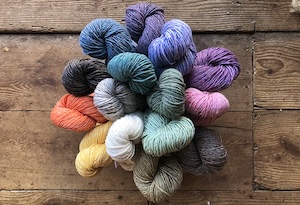
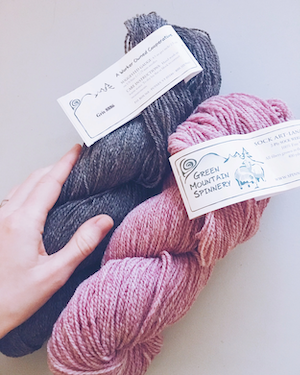
 PUTNEY, VT — September 30, 2026 — Nestled near the banks of the Connecticut River, Green Mountain Spinnery’s colorful yarn covers the entrance to its historic woolen mill headquarters in Putney, Vermont, a cheerful welcome to fiber artists and crafters alike. Green Mountain meticulously transforms raw wool into exquisite, finished skeins through a time-honored process.
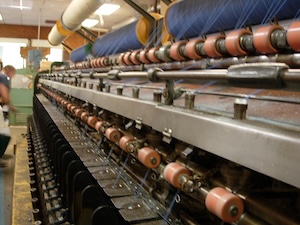 But that process is dependent on something else time-honored: A five-foot Davis & Furber-Whitin carding machine that is over a century old. Built right here in New England between 1908 and 1918, the carding machine sits alongside other machines dating back to the mid-1940s and early-1950s.
About 10,000 pounds of wool goes through the mill a year. Imagine this machine made by two iconic Massachusetts companies has seen almost 1.1 million pounds of wool in its lifetime, and you can guess what kind of work it takes to maintain.
Keeping that antique machinery running smoothly is the job of Scott Matthews, carding operator and a nine-year veteran. For Matthews, machine maintenance and fine tuning is almost a daily devotional. And perhaps the most important part of that routine is lubrication.
Going Green in the Green Mountains
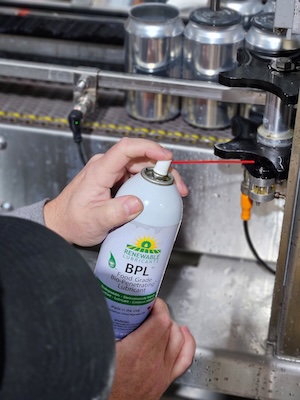 About a decade ago the spinnery transitioned away from traditional petroleum-based products seeking a cleaner footprint. They tried various eco-friendly solutions before finally settling on Renewable Lubricants, which exceeds performance standards. Today, the shop utilizes 1-gallon containers of Bio-Slide Way™ Lubricant—an ISO 68 lubricant—for transfer cases, sliding parts, and other moving surfaces. They also purchase 11-ounce aerosol cans of Bio-Penetrating Lubricant™—an NSF H1 food grade penetrant and light lubricant—for bearing shafts, and hard to reach spots. Bio-High Temp™ 180 E.P. Grease—a biodegradable lithium complex grease designed for high-temperatures, extreme pressures, and heavy duty applications—rounds out the products that the Spinnery purchases directly from the Renewable Lubricants website. This is used for bearings and wherever there are Zerk fittings.
“We use the lubricating oils on almost everything in our shop. We’re an old mill,” Matthews says. “We only have to oil the card every couple of days, and it lasts long enough. So, we’re not using this any more than we did with the petroleum-based oil, which is good.”
That can be a departure from the daily reapplication required of other green solutions. Throughout his intricate, single-shift 8-hour workflow, reliability is Matthews’ focus.
Efficient and Effective
Another place that applies is in replacement components. Original manufacturer parts are hard to come by after 100 years. With a combination mill drill press and lathe, the team handles its own custom fabrication to keep the vintage shop operational. They machine spares ahead of time to have on hand and rarely need to outsource solutions, Matthews says. That saves on shipping emissions and reduces their environmental impact for parts that can be heavy and unwieldy.
 Yarn-making is, in many ways, a green industry. It’s entirely mechanical, relying on zero computer chips, and revolves around natural and organic materials. Customers ship or drop off raw wool, which is carefully sorted and scoured in a custom-built 180-degree water bath with organic soap to break down the natural lanolin. After passing through a four-stage steel roller squeezing system, a cast-iron washing machine that dates back to 1896, the wool is dried in a commercial dryer for 10 minutes to prevent mildew.
Once dry, the wool is funneled to the floor where it runs through a picker equipped with large bear claws on a hollow drum. On the final pass, a precise mixture of water, oil, and soap is added to control static and flyaway fibers. The wool then feeds into the historic carding machine, passes through a burr-crushing Peralta system, splits into 96 strands of roving, and moves to the spinning frame. Finally, the yarn is steam-set for memory, plied if necessary, and wound into custom-sized skeins.
 It can be a noisy process, but one thing’s for sure, Matthews jokes: “If you keep them lubricated, the machines don’t squeak!”
From custom scouring to final packaging, Green Mountain Spinnery proves that vintage craftsmanship and sustainable modern maintenance can weave a remarkably successful future.
Posted: October 18, 2026
Source: Tne Green Mountain Spinnery / Renewable Lubricants, Inc.