 ZÜRICH, Switzerland — October 6, 2026 — The 40th ITMF Global Textile Industry Survey (GTIS), conducted from 21 to 29 September 2026, shows a slight improvement in the global business situation, to -23pp, well above the November 2023 low of -46pp. Conditions nevertheless remain weak, in what has become a new normal of high uncertainty. Only South Asia (+13pp) and Africa (+9pp) are positive, while Europe (-36pp), South America (-44pp) and North & Central America (-56pp) report the weakest conditions. Along the value chain, the two ends are doing better than the middle. Fibre producers (+17pp) are the only positive segment, while spinners (-33pp) and finishers (-42pp) lag. Textile machinery manufacturers (-35pp) continue to suffer from companies’ reluctance to invest.
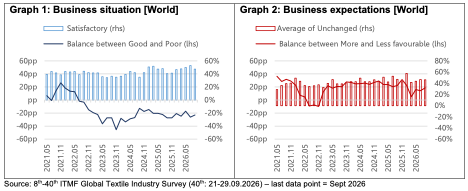 Business expectations for the next six months improved to +19pp, in sharp contrast to the current situation. However, 46% of participants expect no change, a sign that the optimism rests more on hope than on concrete signals. Africa (+59pp) is by far the most optimistic region, while East Asia (-20pp) and Southeast Asia (-6pp) remain pessimistic. Fibre producers (+67pp) are the most confident segment.
Order intake edged up to -24pp but remains weak, and South America has fallen to a record low of -69pp. Rising costs and inflation make a significant recovery in the coming months unlikely. The global order backlog shortened slightly to 2.3 months, within the range of 2 to 2.5 months it has held since mid-2023, as most companies work on confirmed orders only. Capacity utilisation rose to 71%, above the November 2023 record low of 68% but still well below the levels above 80% seen before late 2022.
Weak demand remains the main concern, cited by 56% of participants. Cost-related concerns are rising, led by high raw material (42%) and energy prices (41%), which have pushed inflation up again since the war in Iran. Concern about geopolitics has eased to 36%, from 46% in July. In response to US tariffs, companies are mainly diversifying into non-US markets (29%), investing in automation and efficiency (23%) or absorbing the higher costs (23%).
 Order cancellations remain low at around 2% on average, though they have risen among finishers in three consecutive surveys. Inventories remain lean in most regions, with Southeast Asia at a record low. The Americas are the exception: there, high inventories combined with weak order intake point to a build-up of unsold stock.
For more information, please see www.itmf.org
Posted: October 6, 2026
Source: The International Textile Manufacturers Federation (ITMF)