By James M. Borneman, Editor In Chief
Textiles are a mystery. Most people never consider how the basic products lining our closets, filling every room of our house, and touching our lives daily actually get made.
The process of transforming fiber into yarn, yarn into fabric — bleaching, dyeing, possibly printing — then cutting and sewing into finished goods is invisible, overlooked and never part of the conversation.
Ideas and concepts for new products, when they originate outside the circle of textile insiders, rarely break through that unseen curtain.
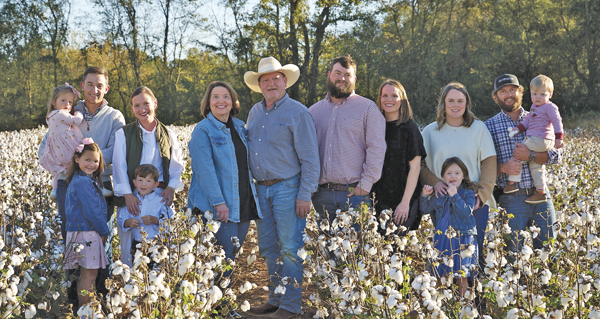
Red Land Cotton’s story is about how that barrier was broken by nothing more than the sheer force of will of a cotton farmer from Alabama and his daughter, who had a talent of her own.
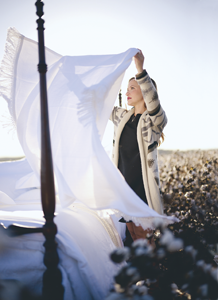
There are consumers today searching for the comfort and quality of years gone by. Imagine bed linens that bring home that feeling of something more — maybe reminiscent of a stay at a grandparents’ house or a country bed-and-breakfast.
It sounds like a flowery marketing story, but if you can deliver on that promise and tell the authentic story of quality bedding made in the United States that starts with cotton seed planted in farmland in Alabama, you may just make it work.
That story starts not with marketing but with a farmer.
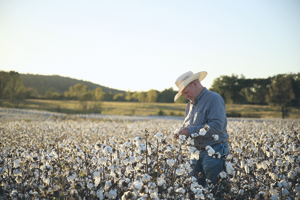
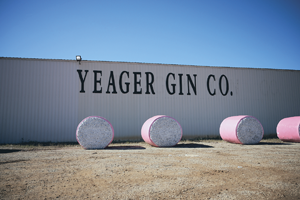
Mark Yeager didn’t set out to tell a story. He took over the family farm in 1983. Always looking to improve his business and the well-being of his family, in 1994 he took the next step and built his own cotton gin.
Just as farming cotton takes specialized skill and knowledge, ginning has its own complexities. It takes a crop from the field, cleans it, grades it and creates bales ready for market. In the process, Yeager gained more control over his crop and his seed, extending his business and the security of his family.
Inspiration
An idea struck in 2015 when Mark’s sister commented on one of his Instagram posts. She reacted to Mark’s photo of his cotton, saying she was proud of him but “… would love some sheets made out of [his] good North Alabama cotton.”
Mark, always looking to improve the security of his family and 3,000-acre cotton farm, thought it was a great idea: “Sheets use a lot of cotton.”
But not just sheets — heirloom sheets. Yeager brought his idea to his church group and asked for help finding an example of the bed linens his grandparents would have used. And from a friend, the sample was in hand.
In 2016, Mark Yeager and his daughter, Anna Yeager Brakefield, founded Red Land Cotton, focusing on creating premium cotton heirloom bedsheets.
More Than A Daughter
From the outside, you may see a TV commercial for Red Land Cotton and wonder: How can the story be true? Is this some slick marketing company conjuring up an image just to sell me something? Did an Alabama cotton farmer really do this on his own?
The quick answer: You’d have to actually meet the Yeagers to understand.
Mark has his own talents — an entrepreneurial spirit second to none, fiercely focused on America’s ability to make quality products starting in American soil, direct to consumer.
But Anna Yeager Brakefield, Mark’s daughter, has a story all her own.
After graduating from Auburn University with a degree in graphic design, she moved to New York to work in marketing, then continued her career in Nashville.
There she married Nick Brakefield, whom she’d met at Auburn while he studied pharmacy.
Getting Started
Yeager and Brakefield had done their homework. They had an early conversation with friends at Cotton Incorporated and showed them the sample of heirloom sheeting.
Cary, N.C.-based Cotton Incorporated is a nonprofit research and marketing company established in 1970. It functions as the primary engine behind U.S. cotton, funded by growers and importers to strengthen every link of the supply chain, from the field to the retail shelf.
“And after we got the green light on if we could make this, then it became, ‘How could we make it?’” said Brakefield.
From the very start, one thing was essential. “It was very important that it be made in the United States,” said Brakefield. “And over the course of doing this for 10 years, it has become even more evident that it is so important that the success of the American farmer is so directly related to the success of the textile industry in the United States — it goes hand in hand.
“So that’s why we wanted to build a supply chain out here — and connected with Jack Miller.”
Pulling Back The Curtain
Jack Miller has spent a lifetime in textiles. Growing up in South Carolina, he was at home with summer jobs at Alice Manufacturing Co. After graduating from Clemson University with a degree in administrative management in 1982, Spartanburg, S.C.-based Milliken & Company was a natural fit. Miller later returned to Alice Manufacturing, where he moved through a progression of responsibilities and eventually oversaw the day to day operations of four greige textile plants, along with other duties as time went on.
Miller lived his career in the wake of major changes in the industry — plant closings, consolidations — and watched links in the textile supply chain slowly being disassembled.
In 2009, Miller went out on his own, spending time in knitting, then forming SustainTex LLC, headquartered in Greenville, South Carolina.
“Organics — organic cotton — was getting bigger and bigger by the day,” said Miller. “I was obsessed with sustainability — recycled polyester had just come out.
“So our objective [at SustainTex] was to use that same domestic supply chain I knew and develop those fabrics here in the States.
“Pricing was always an issue — it’s a very small market for people who really care about that ‘Made in U.S.A.’ and that transparent supply chain.
“I was converting on my own — the classic 50-year-old textile guy with some relationships — converting cottons and things for guys that I worked with before … and it got me through.”
Connecting With Red Land
“When Red Land came in,” said Miller, “Alice was still open. And Mark called Apryll Smith at Alice and said something along the lines of, ‘We want to start making sheets. Can y’all help us?’ And Apryll said, ‘Call Jack Miller. He knows everything about sheets’ — and then Mark called me, and I still owe Apryll several beers!”
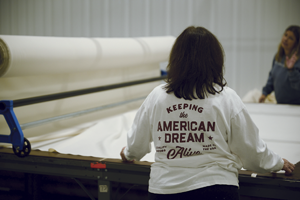
Miller had received calls like this many times and had always taken them seriously — but he has also seen reality play out when a new idea doesn’t cross the finish line.
Regarding their initial contact, Miller remarked, “You could tell that this was not going to be a hobby.
“You’ve got a cotton farmer. You’ve got a brilliant marketing person — both got guts. They’ve got money. They needed some clown to help them pull that together.”
Having seen projects driven by interests outside the textile industry before, Miller knew what to look for, and he saw it in Yeager and Brakefield. Red Land Cotton had the passion for the project — without a doubt — and that passion was coupled with the financial resources essential to get the project off the ground.
“It was perfect. Perfect timing for me, wherein I could help them build the supply chain that I’d already done — I’d already worked on twice before.
“I’d seen the supply chains built before, and I knew all the players. So it was a really good fit for me personally. I was extremely fortunate to get to help.”
Things progressed quickly for Red Land, with Yeager and Brakefield intent on making the plan come together.
“They just got in the car — they drove up here [Greenville, S.C.] and we hit the tour,” said Miller. “Because remember — the thing is — from Greenville you can hit a weaver, spinning and finishing, in a day or two.”
The tour was an eye opener for Red Land. “We got hooked up with Jack, and at that point, it started the winding road of the players,” said Brakefield.
The tour included spinning at Parkdale Mills and weaving at Hamrick Mills.
Assembling The Chain
“We met with Parkdale, and we went and visited that plant and talked to them about doing our spinning,” said Brakefield.
More than just a spinner, Gastonia, N.C.-based Parkdale Mills is known as the world’s largest independent yarn spinner, consuming roughly 60% of all cotton used domestically each year. Founded in 1916 and, under the leadership of Chairman and CEO Anderson Warlick, Parkdale remains privately held, supplying yarn to major home furnishings and apparel brands.
Miller later added, “Parkdale has been a phenomenal partner — phenomenally cooperative and helpful with Red Land.”
Yeager and Brakefield also visited weaving at Hamrick Mills.
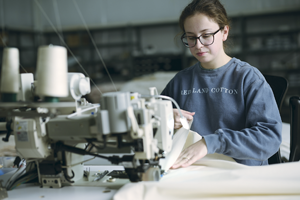
For finishing, Miller suggested Yates Bleachery. Though the plant has now closed, Miller commented, “I’ve worked with Brewster Yates my whole life, so I consider Yates a friend.”
Yates Bleachery was founded in 1920 by Arthur Edward Yates near the base of Lookout Mountain in Flintstone, Ga., and remained under family ownership for more than 100 years, most recently led by third-generation owner Brewster L. Yates Sr.
“He’s a good man and that plant is closed now, but all those folks became good relationships.
“Mark, Anna and Brewster Yates still have a great relationship.”
In building the relationships, both Brakefield and Miller spoke of attending the 2016 Techtextil North America show in Atlanta.
Techtextil North America 2016, held May 3-5 at the Georgia World Congress Center in Atlanta, Ga., brought together just under 10,000 visitors and hundreds of exhibitors across technical textiles, nonwovens, sewn products and equipment. Co-located with Texprocess Americas, the show floor and symposium sessions highlighted new materials, advanced manufacturing technologies and reshoring-focused supply chain discussions — the backdrop against which Red Land Cotton and Jack Miller met Parkdale Mills, Hamrick Mills and Yates Bleachery, beginning to stitch together their domestic supply chain.
“Parkdale was there. Jim Hopkins [Hamrick Mills] was there. Brewster Yates was there. You know, so all of a sudden, they’re in this big room full of textile people and realize, hey, here’s our supply chain right here,” said Miller.
“We all got in the same room at Techtextil in Atlanta, in 2016, and by October of that year we had our first product to sell,” recalled Brakefield.
Scaling Up
Miller also commented that part of the challenges were the run sizes and fragility of the supply chain. He knew that mills like Parkdale, Hamrick and Yates Bleachery are built for large commercial orders, so a new, unproven brand asking for a one-off first run is inherently a hard sell.
Hamrick’s Jim Hopkins, director of sales and marketing at Hamrick Mills, recalls, “I said, you know, I feel confident that this is going to work and it’s going to be a nice fabric and you’re going to like it.
“I said, but we can’t just do a little bit. And she [Anna Brakefield] said, ‘You know, I feel really good about this. I don’t think we have a problem giving you a good-sized order to get this off the ground and get it started.’ And so that’s when the order came through May 6 for 20,000 yards.
“I was amazed,” said Hopkins. “Yeah, but we had to get the yarn made. So we needed this fabric to weigh right at a pound of yarn a yard.
“We needed 20,000 pounds of yarn to get it started. And Parkdale — they got the Yeagers’ cotton in; they spun the yarn, put the warp packages together and the filling packages. They sent it to us and we were weaving by August.”
Timing matters here because Yeager and Brakefield had a plan. And that plan meant Red Land Cotton heirloom sheets would be ready to ship to meet the Christmas rush.
From Sheeting To Sheets
With sheeting fabric on the way, Red Land needed to move fast. The heirloom sample was from the 1920s and needed to be sewn and ready for Christmas. Red Land Cotton’s first vendor fell through and the company needed to act quickly.
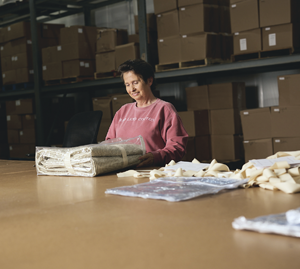
“I was selling this design with this stitching on it. And I needed to find somebody who could do that stitch.
“I found a lady who had sewn for some reputable home brands, but, I mean, literally, it was in her garage,” said Brakefield. “Essentially, it was her and three other ladies in North Bergen, New Jersey, but it wasn’t sustainable — it was too small.
“It just so happened that in our hometown, there was a group of ladies who had a cut and sew, and they were doing apparel — and there was an article in our local paper, talking about what we were doing, and they reached out to us about making shirts out of our fabric or something like that,” said Brakefield.
“We told them, we didn’t need shirts but we needed sheets — could they make sheets?
“And they started making our sheets. And every week we would go and get our inventory from the cut and sew in our hometown, drive five minutes back to my dad’s gin office, where I was doing the pick, pack and ship — and fulfilling orders on a weekly basis like that.”
Growing Quickly And Keeping Up
“We were able to grow with them for quite some time, and we hit a real growth spurt in 2019 and 2020. We realized we had to get more cut and sew production going, so we decided to start our own cut and sew plant in Tylertown, Mississippi,” said Brakefield.
“And you would probably ask yourself, ‘Why Tylertown, Mississippi?’
“Well, my dad did a lot of Googling — a lot of research — and that area has a ton of textile history.
“And there was a cut and sew manufacturing building that was up for rent. I mean, literally, the place had the cutting tables there, had machines there — just sitting. We worked with the town, we sourced a manager and got our cut and sew up and running in October, roughly, of 2020.”
Miller corroborated, saying, “Mark and I were on the phone one day and he says, ‘We’re going to Tylertown, Mississippi. They got a plant down there. We may open up a cut and sew.’ I’m like, ‘Wow, I’ll meet you down there.’ You know, again — it’s just, if they want to do something, they do it. They don’t overthink it. They just do it. It’s been very successful for them.”
The Finish Line
For Red Land Cotton, there never seems to be a finish line. The company seemingly did the impossible, from concept to Christmas, in a very short time.
“There was growth every year, but the real takeoff was in 2019, 2020. The bar graph is pretty steep,” said Brakefield.
“We had to grow to meet the requirements to be desirable as manufacturing partners — so that they would even pay attention to us or so that we could get product when we needed it. We had to have higher orders. So that was a real motivating factor …”
Brakefield still wonders about Red Land’s trajectory. “I mean, how we did it was kind of — placed the purchase order and said we’re going to figure it out.”
Ten Years Later
In July 2026, the TV lit up with a segment on Fox Broadcasting’s “Fox & Friends” morning show. Host Ainsley Earhardt was on location on the plant floor of Hamrick Mills in Gaffney, S.C. With her, Mark Yeager and Anna Yeager Brakefield were giving an inside look at Red Land Cotton sheets being made.
The segment captured what Red Land had said all along. Brakefield’s words were clear: “The beautiful thing about making a product in America is the way everybody came together to make this happen.”
When asked what was the best part, Brakefield answered, “When we ask our customers why they are purchasing from Red Land Cotton, it’s because it’s made in America.”
Earhardt also received a tour of Hamrick’s weaving operation with Cameron Hamrick explaining the basic steps of the process — even letting Earhardt start a weaving machine, saying, “I don’t know what customer will be fortunate enough to have Ainsley Earhardt make their fabric, but here she is making it!”
It was noteworthy TV to see Hamrick’s clean, modern weaving operation on display for the public to see — great for Red Land and great for U.S. textiles.
Relying On What You Know
Mark Yeager, a family-focused farmer and entrepreneur always trying to increase the value of what he grows, is straightforward in his value to Red Land Cotton. But how did Anna Brakefield add value?
“There is no telling the amount of benefit all the experience I collected over the first five years of my time outside of college that really benefited what Red Land Cotton is today,” said Brakefield.
“Just getting to work for really big brands and seeing how they handled their marketing. You know, I was able to do work for American Express, for BMW — I worked on the launch of Jay Z’s cologne — it’s just, there’s nothing that could replace that type of experience,” said Brakefield.
“For our senior thesis [at Auburn] we had to come up with a company. We had to write a business plan and then do all the branding, all the marketing, all the materials for it,” said Brakefield.
“And when I sat down to do Red Land Cotton, I pulled out that template and redid the whole thing — my whole senior thesis — but just for Red Land Cotton. You know, that’s a real testament to my education. I love Auburn. The fact that I can pull out my senior project and apply it to my business, I think, is really cool.”
Jack Miller summed it up nicely when asked how Red Land Cotton happened: “Everybody believed in them.”
2026 Quarterly Issue III