By John Brearley
For decades, the fashion industry has relied on skilled craftspeople, designers, product specialists, and developers whose work is informed by knowledge accumulated over years. This collective knowledge forms the backbone of fashion development, enabling brands to consistently translate creative vision into high-quality products. Today, that system is under strain.
As younger professionals continue to enter the fashion workforce, the traditional pathways for learning need to evolve. Emerging talent is expected to work faster and apply existing knowledge without adequate training. This creates a disconnect where shared understanding is rooted in assumptions rather than formal training.
Most brands aren’t struggling because they lack tools or creativity —they struggle because the pace and complexity of modern fashion operations have outgrown traditional ways of working. New hires are often expected to navigate fragmented systems, shifting consumer demand, supply-chain volatility, and data-driven decision-making from day one.
As timelines tighten and speed to market becomes a defining competitive advantage, the brands that will thrive are the ones using technology to better connect people, ideas, data and operations, while continuing to invest in human expertise and the next generation of talent.
The Growing Skills Shortage Within Design And Development Teams
Fashion development remains deeply dependent on specialized human experience. Patternmaking, fit, material usage and costing accuracy are skills refined through years of hands-on experience and contextual learning. These capabilities are highly nuanced and difficult to document, scale or replace.
As experienced professionals retire or move on, brands face a serious risk of knowledge loss. Critical decisions become inconsistent, execution varies across teams and younger employees are left without clear guidance on best practices. In many organizations, this results in an over-reliance on a few key individuals rather than resilient systems that support knowledge continuity.
At the same time, younger generations entering the fashion workforce have different expectations. They look for transparent career pathways, intuitive tools and environments where learning is embedded into daily work. Unfortunately, outdated workflows, fragmented systems and undocumented processes often fail to meet these expectations. When the tools feel disconnected from reality, adoption stalls and frustration grows.
Resistance to change is rarely about technology itself. More often, it stems from underestimated change management, unclear role evolution and insufficient training. Without a clear connection between new systems and real-world workflows, teams are left unsure of how technology supports their expertise rather than complicates it.
Bridging Talent Gaps With Technology
Technology alone will not solve the talent gap, but when applied intentionally, it can significantly amplify scarce expertise. The challenge is not whether to adopt technology, but how. Fashion companies must integrate digital tools in ways that are accessible to new employees while respecting the experience of existing teams. When systems reflect real workflows and decision logic, they act as a bridge between generations rather than a source of disruption. Structured, intuitive platforms allow junior and senior team members to collaborate more effectively, embedding best practices directly into the process instead of relying on an informal knowledge transfer.
This is evident in intelligent manufacturing, automation and robotics, which can reduce production time and improve consistency without eliminating the need for skilled professionals. Technology handles repetitive or data-heavy tasks, allowing human talent to focus on creativity, judgment and problem-solving.
The urgency of this balance is underscored by broader workforce trends. Research from McKinsey & Company and The Business of Fashion Insights, published in The State of Fashion 2026, indicates that by 2030, up to 40% of workers in developed economies may need to reskill or transition to new roles as technology advances. Fashion is no exception: roles are evolving, and the ability to support continuous learning is becoming a competitive differentiator.
AI As An Amplifier Of Human Expertise In Fashion Manufacturing
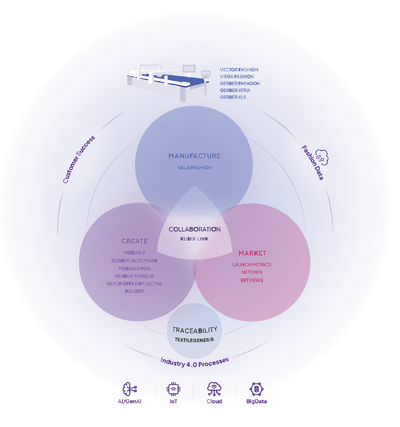
As fashion brands navigate increasing operational complexity, AI is emerging as a powerful catalyst for transforming human roles. This requires viewing AI not as a replacement for creative or technical expertise, but as an amplifier that enhances how that experience is applied.
AI-driven solutions can capture institutional knowledge, standardize best practices and provide real-time insights that support better decisions. By embedding intelligence into design, development and production workflows, brands can reduce dependency on individual memory while creating more consistent outcomes.
For example, AI can analyze historical data to guide material selection, optimize fit adjustments, or flag production risks earlier in the process. This allows teams, especially less experienced ones, to operate with greater confidence while learning from established practices. Senior professionals, in turn, are freed from repetitive tasks and can focus on innovation, mentorship and strategic direction.
AI also plays a role in modernizing training. Digitized workflows, guided processes and intelligent recommendations help transform learning from an informal afterthought into a continuous, embedded experience. These benefits are further reinforced by using AI in predictive maintenance and manufacturing optimization, enabling manufacturers to reduce downtime, improve operational efficiency and support performance commitments such as 98% equipment availability. In doing so, AI supports one of fashion’s most pressing needs: preserving knowledge while making it accessible to the next generation.
Long-Term Outlook: Investing In Skills To Secure the Future
The talent gap in fashion development is not a future concern; it is already here. Brands that ignore skill shortages risk becoming slower, less consistent, and more vulnerable in an increasingly competitive market.
Those that succeed will be the ones willing to invest in their people as much as their technology. This means supporting continuous learning, digitizing training and automating administrative tasks while using technology as an enabler of human expertise.
To survive in today’s fashion landscape, companies must commit to preserving, scaling and amplifying skills. In doing so, they ensure that craftsmanship, creativity and innovation continue to define fashion, even in the most technologically advanced era.
Editor’s Note: John Brearley is president, Americas, at Lectra.
2026 Quarterly Issue III