For U.S. manufacturers, technical demands and the strategic importance of filtration products are creating new opportunities.
Textile World Special Report
Like many technical textile applications, filtration technologies are often undervalued and overlooked by everyday consumers and professionals alike.
Wherever air has to be cleaned, water clarified, or process streams kept on spec, there is almost always a textile hidden in the system. As manufacturers, utilities and regulators have asked more of filtration — collecting finer particles, hotter gases, harsher chemistries — U.S. textile producers have shifted from basic textiles to engineered nonwovens and laminates designed around specific performance targets. Filtration has emerged as a significant technical outlet for U.S. textiles at a time when much commodity production has come under pressure. Industry analyses place the global nonwoven filter media market in the multibillion-dollar range, with one recent estimate valuing it at $6.55 billion in 2022 and projecting it to reach nearly $10 billion by 2030. INDA, Association of the Nonwoven Fabrics Industry, also identifies filtration as one of the key North American nonwovens end-use segments in its outlook work.
Meeting Basic Needs
In the early days of industrial filtration, textiles were used largely because they were available, not because they were engineered for the task. Woven cotton and wool fabrics — some felted — were pressed into service wherever a porous barrier was needed to keep solids out of water, air, or product. Municipal water plants relied on sand beds and simple filter cloths to hold back grit, while factories used cloth bags and basic screens to catch dust and fibers before they fouled machinery or finished goods.
As industrial processes intensified, those materials reached their limits. Higher throughputs and more aggressive chemistries exposed the weaknesses of traditional fibers, prompting broader adoption of synthetics such as polyester, polypropylene and nylon. Nonwoven technologies, meanwhile, made it possible to create thick, three-dimensional felts capable of trapping particles throughout the structure rather than only on the surface. In many operations, what had been a simple fabric became an engineered component.
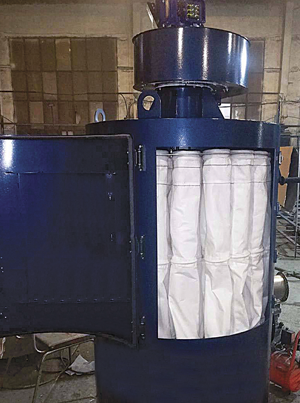
Environmental regulation accelerated that evolution. As air-quality standards tightened, fabric-filter baghouses became established in cement, metals, power generation and waste-to-energy operations. Those systems depend on textile filter bags that can withstand hot, dust-laden and chemically aggressive gas streams while maintaining acceptable pressure drop and service life. Producers responded with structures based on aramids, PTFE and glass, along with finishes tailored to specific dust loads and cleaning methods.
In-Plant Filtration
Filtration also became more important inside manufacturing plants. Dust, lint and airborne fibers were increasingly treated not just as housekeeping concerns but as occupational and product-quality issues. Textile operations installed dedicated air- and lint-filtration systems around weaving, knitting and finishing, while improved liquid filtration for process water, dyes, coatings and auxiliary chemicals helped reduce downtime and improve consistency.
Nonwoven technologies added another layer of capability. Spunbond and melt-blown processes gave producers new ways to tune fiber diameter, web structure and basis weight for particular air- and liquid-filtration duties. Multilayer constructions — for example, a spunbond backing carrying a fine melt-blown layer — delivered higher efficiency without sacrificing strength or processability. Melt-blown media in particular became important where very fine fibers and high surface area were needed, including high-efficiency air filtration and some liquid applications.
As commodity textiles came under pressure from offshore production, many U.S. plants leaned more heavily into technical products, including filtration. Industry observers have pointed to filtration textiles, along with other performance fabrics and nonwovens, as one route away from price-driven competition and toward application-specific business with higher value added.
A Variety Of Constructions
From a manufacturing standpoint, filtration textile development starts with a basic question: What does the application require? The answer usually determines fiber selection and whether a producer relies on woven, knitted, or nonwoven constructions, or combines several in a composite.
Polyester and polypropylene continue to account for a large share of air and liquid filtration where temperatures are moderate and a balance of cost and performance is acceptable. Where processes involve hotter gases or more aggressive chemistries, producers report greater use of aramids, PTFE and glass to prevent softening, shrinkage, or chemical attack. In that sense, fiber choice sets the operating window for a medium before fabric construction is even considered.
Engineered wovens remain important where dimensional stability and mechanical strength are central. By adjusting yarn size, monofilament or multifilament construction and weave design, manufacturers can target specific pore geometries and flow characteristics. Those fabrics are widely used in press cloths and belt filters in mining and chemical processing, where media must tolerate abrasion, pressure and mechanical cleaning.
Knitted structures play a narrower but still significant role. Warp-knit spacer fabrics and other knits serve as support or flow-management layers in spiral-wound membrane modules and some multilayer laminates. In those applications, the textile is there primarily to maintain channel spacing and support more fragile layers rather than deliver the main filtration performance.
Nonwovens have become central in many air- and a growing number of liquid-filtration applications. Needle-punched constructions are standard in dust-collection bags and industrial air filters, valued for their depth-filtration behavior and manageable pressure drop. Spunbond and melt-blown nonwovens, often used together, dominate many high-efficiency HVAC and cleanroom filters and are common in industrial cartridges. The ability to tune fiber diameter, porosity and thickness allows producers to balance efficiency, dirt-holding capacity and energy consumption in ways that differ from traditional wovens.
Air, Liquid And Process
In practice, textile-based filtration tends to appear in three broad categories: air, liquid and process. One INDA-based market analysis described the North American filtration market as about $21 billion in end-user sales in 2019 and projected it to approach $27 billion by 2024, illustrating the scale of the opportunity for media suppliers and converters. Textile World’s reporting on the North American nonwovens filter market, drawing on INDA data, described filtration as the most diversified of the nonwoven end-use categories, spanning more than 30 major market segments.
On the air side, nonwoven and composite constructions are common in industrial dust collectors and HVAC systems. Needle-punched fabrics provide depth filtration that captures dust through the thickness of the media, while surface treatments encourage the dust cake to release during cleaning rather than blind the pores. Higher-efficiency applications often rely on melt-blown layers and finer fibers to raise capture performance without pushing pressure drop beyond acceptable limits. The broader North American air filter market is also growing, with one forecast estimating an increase from $5.29 billion in 2025 to $7.21 billion by 2030.
The Largest Segment
In liquids, textiles are used wherever solids need to be separated from water, oils, or more complex fluids. Woven and nonwoven media appear in belt presses, filter presses, cartridge and bag filters. Mining and chemical plants rely on robust woven filter cloths to handle abrasion and pressure in dewatering duties, while food and beverage operations use nonwovens and engineered fabrics to keep products clear and consistent. Liquid filtration is also the largest segment of the broader industrial filtration market, accounting for 57.6 percent of global revenue in one 2024 market summary.
Process filtration cuts across both air and liquid. In power generation, cement and metals, high-temperature filter bags made from aramid, PTFE and glass-based felts are used to control particulate emissions. In transportation and industrial equipment, cartridge filters built with nonwoven media protect engines, hydraulic circuits and lubricating systems from wear-causing particles. Across these examples, the task is similar: matching fiber, structure and finishing to the demands of the stream.
Innovation In Fiber And Finish
Although the main constructions are well established, much of the recent innovation has occurred at the fiber and finish level. Finer fibers and bicomponent designs provide more surface area and more tightly controlled pore structures, which can be used to increase efficiency or reduce energy use. Multilayer structures let producers combine a robust backing with a delicate, high-performance surface layer tuned for a specific particle size or droplet behavior.
Finishing chemistry is another area of activity. Hydrophobic and oleophobic treatments are used to help shed water or oil in coalescing and separation applications. Antimicrobial treatments are being applied to nonwoven and technical textile media to inhibit microbial growth on filter surfaces, particularly in HVAC, appliance and some water applications. In industrial dust collection, specialized surface treatments can reduce blinding, improve cake release and extend the service life of filter bags between changeouts.
Energy consumption is also a growing focus. Every inch of pressure drop across a filter translates into fan or pump power. Media designed for lower resistance at a given efficiency, or that can be cleaned more effectively to maintain performance over time, contributes directly to plant-wide energy and emissions targets.
N95 — A Lifesaver
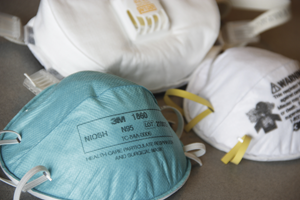
The COVID-19 pandemic underscored the need for reliable domestic filtration capacity as demand for respirators surged and supply chains came under strain (see “A Necessary Filter,” Textile World). In 2020, during the early months of the COVID-19 pandemic, Behnam Pourdeyhimi, then executive director of The Nonwovens Institute and associate dean for industry research and extension at NC State’s Wilson College of Textiles, explained that N95 respirators are generally built as a sandwich of spunbond nonwoven layers that give the mask shape and protect an inner melt-blown filtration layer that captures microscopic particles such as viruses and bacteria. One key differentiation is that polypropylene can be made into fine fibers through meltblown processes and electrostatically charged, and that charge can be made stable and durable by using a variety of additives. Other materials such as polyesters and nylons are not capable of producing fine fibers in the same way and their charge durability and charge density are limited. Therefore, traditional textiles cannot offer the enhanced filtration made possible by electrostatic charge. The pandemic highlighted how important it is for the United States to maintain this manufacturing capability.
Room To Grow
The demands placed on filtration textiles are unlikely to ease. Tighter air and water standards, greater attention to indoor air quality and continuing pressure to reduce energy and waste all point toward higher performance expectations for filters. Market researchers tracking nonwoven filter media place global revenues in the high single-digit billions of dollars today, forecasting continued growth through the next decade. The broader industrial filtration market is also expanding, with one recent forecast projecting growth from $37.1 billion in 2024 to $47.1 billion by 2029. INDA’s North American outlook work likewise points to continued importance for filtration within the nonwovens industry as producers adapt to changes in trade, sourcing and downstream demand.
At the same time, recent supply-chain disruptions have drawn more attention to the value of domestic capacity for critical technical materials. For U.S. manufacturers, that combination of technical challenge and strategic importance suggests continued opportunity. Plants that can combine expertise in fibers, constructions and finishing with specific application knowledge — and that are willing to work closely with equipment makers and end users — appear well positioned to compete. The same demand-driven evolution that carried filtration textiles from utility cloth to engineered media is still underway, as customers ask more of the systems that keep air clean, water clear and processes running.

FiltXPO™ Minneapolis
FiltXPO™ 2026, organized by Cary, N.C.-based INDA, Association of the Nonwoven Fabrics Industry, will take place Oct. 28-29, 2026, at the Minneapolis Convention Center in Minneapolis, Minn. Held every 18 months, the event brings together more than 1,200 filtration professionals and features more than 120 exhibitors showcasing technologies, equipment and solutions for air, liquid and industrial filtration applications.
Co-organized with the American Filtration and Separations Society, based in North Olmsted, Ohio, the Advances in Filtration Conference will highlight emerging technologies, including artificial intelligence, sustainability initiatives, PFAS mitigation and applications in e-mobility and data centers. The program will include technical presentations, panel discussions and research posters from industry experts, academics and students. A Filter Media Training Course is scheduled for Oct. 26-27.
“FiltXPO is where technologies, industry leaders and business opportunities converge,” said Tony Fragnito, president and CEO, INDA. “This is the leading filtration event for companies looking to grow their business and engage with decision-makers who are shaping the future of filtration.”
The event also will feature the FiltXPO Innovation Awards, recognizing advances in air filtration, liquid filtration and equipment. Winners will be announced live during the exhibition.
2026 Quarterly Issue III