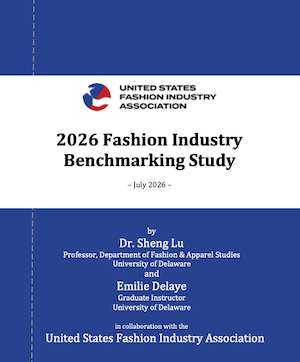
 NEWARK, DE — July 25, 2026 — In collaboration with the US Fashion Industry Association (USFIA), University of Delaware Professor Dr. Sheng Lu and Graduate Instructor Emilie Delaye, surveyed sourcing executives from 30 leading US fashion brands and retailers (80% with more than 1,000 employees) from April to June, 2026.
According to Sheng, the results, while there has been a slight increase in domestic sourcing and nearshoring as part of U.S. fashion companies’ sourcing diversification strategy, capacity building and a stable policy environment remain critical for continued sourcing expansion. Specifically:
- 76 percent of respondents sourced apparel from members of the Dominican Republic-Central America Free Trade Agreement (CAFTA-DR) this year, up from 64 percent in 2025, and 24 percent sourced more than 10 percent of their apparel from the region, concentrated among large companies typically using 2–3 members such as Guatemala, El Salvador, and Honduras.
- Respondents’ sourcing from members of the S.-Mexico-Canada Trade Agreement (USMCA), mainly from Mexico, held steady in 2026. However, respondents were hesitant to increase sourcing from the region due to concerns about the agreement’s uncertain future.
- Over the next 2–3 years, respondents plan to continue concentrating their apparel sourcing from the Western Hemisphere in a relatively narrow range of product categories, including T-shirts (67 percent), activewear and athleisure (33 percent), and bottoms (27 percent) from CAFTA-DR and T-shirts (47 percent) and bottoms (20 percent) from USMCA. This pattern was consistent with findings from previous surveys and suggested that limited product diversification remained a major constraint on the future growth of U.S. apparel sourcing from the Western Hemisphere.
- Most respondents (over 65 percent) further indicated that access to duty-free benefits was among the most important incentives for sourcing apparel from CAFTA-DR members and Mexico. This finding underscores that exempting CAFTA-DR and USMCA-qualified apparel products from additional tariffs imposed by the Trump administration and avoiding policy uncertainty will be essential to supporting U.S. fashion companies’ nearshoring efforts under the current business environment. Additionally, 100 percent of respondents support maintaining the USMCA as a trilateral agreement.
The newly published 2026 Fashion Industry Benchmarking Study, report is available at: https://www.usfashionindustry.com/resources/research-reports/usfia-fashion-industry-benchmarking-study
Posted: July 26, 2026
Source: Dr. Sheng Lu, Professor ,Department of Fashion & Apparel Studies, University of Delaware