 STOCKHOLM, Sweden — May 22, 2026 — Following the opening of its new showroom and test centre in Sweden, imogo will be introducing its groundbreaking new Dye-Max spray dyeing technology to Türkiye’s textile manufacturers at ITM 2026 in Istanbul from June 9-13.
The company is one of several members of TMAS – the Swedish textile machinery association – introducing new technologies combining advanced process control, intelligent automation and long-term industrial reliability to visitors at the Istanbul exhibition.

“Türkiye remains the bridge between Europe and Asia and one of the enduring strengths of its textiles and apparel sector is its deeply integrated value chain, spanning from fibre production through to garment manufacture within a tightly connected domestic ecosystem,” says TMAS General Secretary Therese Premler-Andersson.
“The industry also benefits from a skilled workforce, strong technical know-how and decades of export experience, alongside established capabilities in weaving, knitting and the dyeing and finishing of fabrics.”
Resource savings
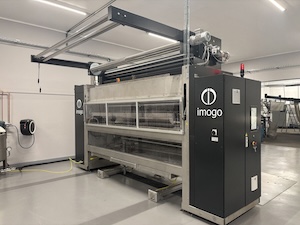
Having recently commissioned a Dye-Max for a key H&M supplier in Bangladesh, imogo – at stand 305 in Hall 3 at ITM – is confident Türkiye’s advanced dyeing and finishing specialists will quickly recognise its benefits.
Compared to conventional jet dyeing, the Dye-Max is achieving a 90% reduction in water consumption and energy savings of up to 90%, with considerably fewer chemicals and less dyestuffs also required.
“The savings in treatment water the Dye-Max achieves are due to the extremely low liquor ratio of 0.5 litres per kilo of fabric,” explains imogo executive partner and board member Christian Moore. “At the same time, the low liquor ratio and the spray process require considerably less auxiliary chemistry to start with, and all of it is used in the process, which also greatly reduces the production of wastewater, with only 20 litres being required for wash at changeovers. The low liquid content in the fabric meanwhile minimises the energy needed for fixation, while meeting industry quality standards and maintaining superior fabric performance.”
Automated quilting
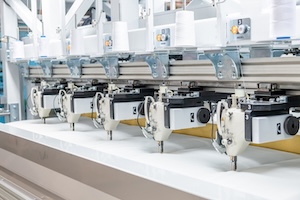
Also new is the Automatex P12-PB Automatic Lock Stitch Quilting Unit, engineered to deliver continuous, programmable quilting while reducing manual intervention in the stitching of bedding and padded home textiles.
Designed for high-volume manufacturers, the new P12-PB platform feeds fabric and filling directly into a quilting module equipped with twelve modified servo-driven lock stitch sewing heads. Arranged in two programmable banks of six, the heads allow producers to switch between straight line quilting and different shaped patterns without mechanical changeover, enabling flexible production runs while maintaining consistent stitch geometry.
At the core of the Automatex system is an automation architecture focused on maximising uptime. Each sewing head incorporates an automatic bobbin case changer supported by a retrieval system, allowing uninterrupted production during thread depletion. Thread break detectors further minimise defects, while servo indexing ensures accurate needle positioning across the working width. A colour touch screen interface simplifies pattern programming and machine operation and remote access capability enables troubleshooting and technical support without on-site intervention.
Operating at speeds of up to 12 metres per minute, the P12-PB is suitable for filling weights from 100-450gsm with stitch lengths between 3-4 mm. The machine produces various stitching patterns and straight lines at 21.7cm needle spacing, supporting a wide range of quilt constructions. It has been engineered for installation within standard industrial utility frameworks.
Technology assurances
Eltex of Sweden’s electronic yarn sensors and tension monitoring systems focus on early detection, identifying yarn breaks, end-outs or abnormal tension before they lead to waste, downtime or quality claims. From weaving and warping through to tufting, braiding, quilting and sewing, Eltex technology provides the assurance that modern automated processes depend on.
As production speeds increase and manual supervision is reduced, the ability to monitor yarn behaviour in real time becomes a key enabler of stable, high-quality output.
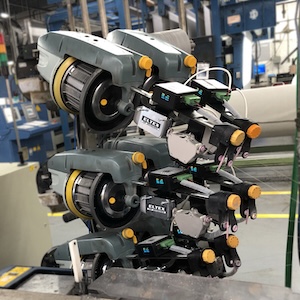
At ITM 2026 (Hall 7, stand 706a), Eltex will highlight its latest ACT-Multi system. It automatically ensures precise yarn tension across various textile processes, such as heat setting, through individual yarn monitoring and control based on a predefined reference tension. Each channel operates independently and the system also includes a machine stop function in the event of yarn breakage or if yarn tension operates outside preset limits.
Also showcased, will be the ACT-R system for rapier weaving machines which is highly effective in achieving constant weft yarn tension for yarns based on recycled fibres at one end of the scale, and for expensive technical yarns such as Kevlar at the other.
Tufting expertise
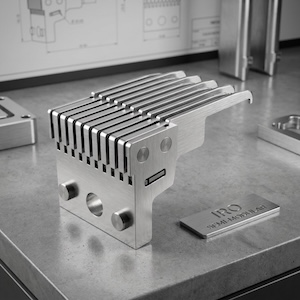
in Hall 7 at stand 710a, Vandewiele company IRO Gauge Parts will further present its latest gauge parts developments with a strong focus on semi-modules and high-quality single hooks for the tufting industry.
IRO’s semi-module concept combines modular efficiency with single-hook performance and has already been sold to several producers in Türkiye. It is designed to give manufacturers a flexible, reliable and competitive solution for future production needs.
IRO will also highlight its high-quality single hooks, developed for accuracy, durability and consistent performance. Backed by modern production, precise grinding, controlled hardening and robust inspection, these hooks reflect IRO’s continued focus on quality and reliability.
Following Vandewiele’s acquisition of Cobble, gauge parts manufacturing for the group moved to Sweden in 2020, creating a stronger and more modern platform for future growth.
With stronger production capabilities, improved accuracy and full traceability, IRO continues to invest in gauge parts that help customers achieve stable performance and long-term value.
Forward thinking
“Türkiye’s specific difficulties due to rising production costs and intensified competition in 2025 have been well documented,” concludes Therese Premler-Andersson. “Nevertheless, TMAS members have been encouraged by the readiness of forward-thinking companies to adopt the latest technologies in order to gain competitive advantages and we are looking forward to an extremely productive four days in Istanbul.”
Posted: May 26, 2026
Source: The Swedish textile machinery association (TMAS)