By Jordan Turner, SGS Beta
The global biobased textiles market was valued at US$5.80 billion in 2024 with projections indicating growth of 11.6% between 2025–2034.1 This growth is the result of improvements in global environmental regulations, increased demand from eco-conscious consumers favoring sustainable products and expansion of governmental initiatives.2 These industry developments favoring the use of eco-friendly materials necessitates a reliable method for manufacturers and distributors to ensure their textiles are produced using renewable biomass resources like plant fibers. ASTM D6866 biobased carbon content testing via carbon-14 analysis is an accurate, well-established third-party analytical tool that can be used to meet these industry goals and standards by validating the biobased content of a material or finished product.
Untangling the Definition of “Biobased”
The ASTM D6866 analytical standard defines the term “biobased” as “containing organic carbon of renewable origin like agricultural, plant, animal, fungi, microorganisms, marine, or forestry materials living in a natural environment in equilibrium with the atmosphere.”3 Biobased products are produced using renewable raw materials from marine, forestry, or agricultural sources. A biobased textile is fully or partially sourced from renewable biomass resources such as plants and animals. Biobased textiles serve as a renewable alternative to fossil-based synthetic fibers like polyester, which is currently the most prevalent fiber accounting for 57% of global fiber production.4 Despite this seemingly straightforward definition, there are some nuances within the textile industry when it comes to the three types of fibers that are typically referred to as biobased: natural, regenerated (or semi-synthetic), and synthetic biobased fibers.5
Natural fibers include cotton, wool, hemp, linen and silk. These are of biological origin, coming from plant or animal sources. Therefore, natural fibers clearly fall within the definition of biobased. These fibers are obtained via harvesting directly from the plant or animal before entering the production process. Natural textiles have been used for millenia. However, modern innovation within the industry has led to the development of two additional types of fiber that are considered to be biobased.
Regenerated or semi-synthetic fibers come from renewable biological resources like wood and plant fibers, pulp and cellulose. These include viscose from bamboo fiber (also known as rayon) and lyocell from wood pulp. Although they are derived from renewable biomass, thus fitting the definition of biobased, regenerated fibers are man-made. Their components must be extracted and chemically dissolved then reformed into fiber before being processed into textiles.
All of these types of fibers fit into the definition of “biobased” as they are obtained from renewable biomass. However, they differ when it comes to the level of processing required to produce the fibers. There is some flexibility in the interpretation of what it means for a product to be “biobased,” especially between the United States and the European Union.9 Therefore, it is important for textile producers and manufacturers globally to have a reliable method in their toolkit to ensure their textiles and fibers are authentic by verifying their exact biobased carbon content, according to internationally recognized standards like ASTM D6866 and EN 16640.
Measuring Up: Carbon-14 Biobased Testing
Biobased carbon content testing is performed using an Accelerator Mass Spectrometry (AMS) instrument to measure the amount of carbon-14, or radiocarbon, in a raw material (e.g. cotton) or finished product (e.g. linen garments). Carbon-14 is a radioactive isotope that is present in all living organisms. It is formed in the upper atmosphere and enters the global carbon cycle in the form of carbon dioxide which is then taken in by plants through photosynthesis and by animals when they eat plants. Upon the death of the organism, this exchange ceases and the amount of carbon-14 begins to decrease through the process of radioactive decay. The detection limit of carbon-14 analysis is 43,500 years before present (BP). This is a particularly valuable trait of the method because fossil-derived materials are significantly older than this detection limit, and they no longer contain any carbon-14. Therefore, only the portion of the sample that comes from recently-expired biomass will retain a measurable amount of carbon-14.
Biobased testing is applicable to liquids, solids, and gaseous samples, and is carried out according to internationally recognized analytical standards such as ASTM D6866 and EN 16640. The method accurately reveals the biobased carbon content of organic materials that were in direct equilibrium with atmospheric CO2 until respiration or metabolism ceased, either by the organism coming to the end of its natural life or by a crop being harvested.10 Carbon-14 analysis distinguishes between the amount of biomass-derived, biobased carbon as opposed to fossil-derived carbon in samples of both raw materials and end products. Measuring the carbon-14 isotope is ideal for verifying the amount of biobased content in a material. As this method directly measures the amount of biomass present, biobased testing via carbon-14 analysis is the most accurate analytical method for identifying the exact percentage of carbon that comes from renewable biomass sources.
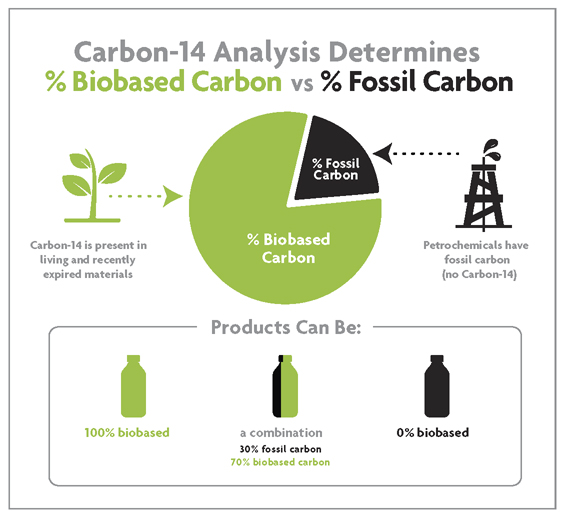
In addition to being highly accurate, biobased carbon content testing results are also easy to understand. Results are presented in the form of a percentage (%), a ratio representing the exact amount of biobased carbon versus the amount of fossil carbon, or absence of carbon-14 in a sample (Figure 1). This ratio, falling between 0% to 100%, clearly identifies the portion of the sample that comes from renewable biomass. A material that is fully fossil-derived has 0% biobased content while completely biomass-derived materials will have 100% biobased content. Any percentage in between is indicative of a mixture of fossil and renewable components.
Pinning Down the Applications of Biobased Testing
Biobased testing has a number of beneficial applications that biobased textile manufacturers and distributors can take advantage of to authenticate the composition of their fibers and finished products, and to support marketing claims. From research and development (R&D), to marketing, to certification programs, the data provided by biobased testing can help support business goals at every step. Obtaining accurate third-party analytical verification of biobased content is an excellent marketing tool that can be used to prove textiles and final products are made from renewable, biomass-sourced components instead of synthetic petroleum-derived fibers. Authentication of biobased content provides scientific back up to ensure products can withstand consumer scrutiny. These results are accurate enough to be used by R&D teams to verify the biobased content of end products and confirm that materials obtained from external suppliers are genuine.
Additionally, biobased testing results are required by some third-party programs in order for the applicant to meet the criteria for voluntary labels and certifications. These programs can be pursued to improve brand image and appeal to customers who are sustainability-conscious, while providing scientific evidence of marketing and label claims.
Stitching it all Together: Biobased Certifications & Eco-Labels
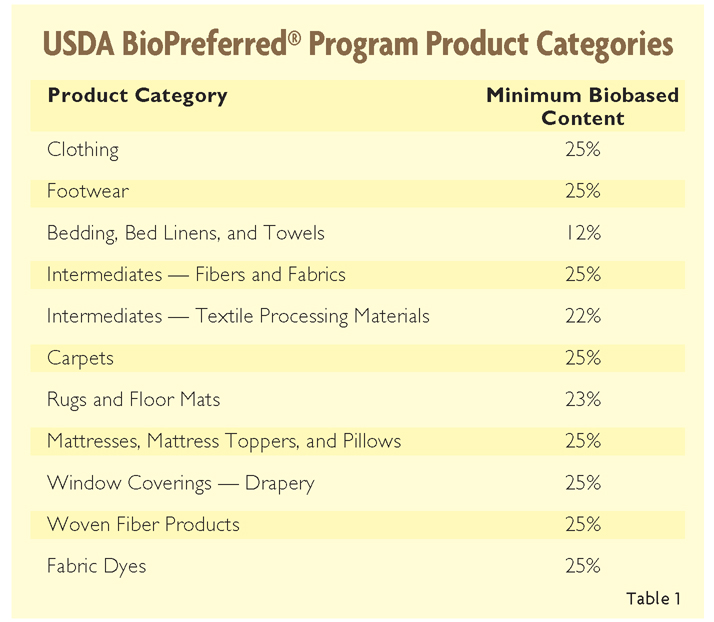
One certification program that has outlined criteria for the biobased textiles market is the USDA BioPreferred® Program. The program requires ASTM D6866 biobased testing to meet their certification requirements for biobased products.11 It recognizes 139 product categories, setting a minimum biobased content percentage for 14,000 products as of September 2025.12 Successful certification of a product under the BioPreferred® program allows manufacturers to use the USDA Certified Biobased Product label on their product packaging and marketing materials, clearly displaying information about the product’s biobased content to consumers. Additionally, BioPreferred® certified products gain an advantage when it comes to United States government procurement as federal agencies have mandatory purchasing requirements for certified biobased products.
In Europe, two eco-label programs that require biobased testing include Din Certco’s DIN-Geprüft Biobased Certification scheme and Nordic Swan. The DIN-Geprüft Biobased certification program accepts products that have a biobased content of 20% or more according to ASTM D6866 or ISO 16620.15 Products receive a label representing one of three quality levels depending on their biobased content: 20-50%, 50-85%, or >85%. Nordic Swan’s eco-label for textiles sets requirements for certifying natural and synthetic textiles, hides, and leather. The criteria requires biobased synthetic fibers to contain at least 90% biobased raw material that has been confirmed using ISO 16620, ASTM D6866, or equivalent testing such as carbon-14 biobased testing.16
Tying Off the Thread
Carbon-14 biobased carbon content testing is a key resource for companies seeking to ensure their label claims are supported and their products and materials are transparent under consumer scrutiny. Biobased testing verifies the exact amount of biobased carbon in a material or end product to prove it was sourced from sustainable biomass instead of fossil fuel sources. Further, a number of third-party certification programs including the USDA BioPreferred® Program require biobased testing results in order to apply for their certifications and eco-labels. The percentage of biobased content obtained through biobased testing also supports marketing and R&D goals, like improving brand image, validating label claims, and appealing to their sustainability-conscious customers. The accuracy and wide applicability of biobased testing make it a valuable option for sustainability-focused manufacturers to consider when seeking a solution for determining the authenticity of their biobased textiles.
References
1, 2. Polaris Market Research. (2025). Bio-Based Textiles Market Size, Share, Trends, & Industry Analysis Report By Source Material (Plant-Based, Animal-Based, Microbial/Bioengineered, and Others), By Application, and By Region – Market Forecast, 2025–2034. Polaris Market Research. https://www.polarismarketresearch.com/industry-analysis/bio-based-textiles-market
3. ASTM International. (2025). Standard Test Methods for Determining the Biobased Content of Solid, Liquid, and Gaseous Samples Using Radiocarbon Analysis. ASTM International. https://store.astm.org/d6866-24.html
4. Textile Exchange. (2024). Materials Market Report 2024. Textile Exchange. https://textileexchange.org/knowledge-center/reports/materials-market-report-2024/
5, 6. Chen J. (2023) Advances in Bio-Based Fibers. International Fiber Journal. https://www.fiberjournal.com/advancesin-bio-based-fibers/
7. Textile Exchange. (2022). The Sustainability of Biosynthetics. Textile Exchange. https://textileexchange.org/knowledge-center/reports/sustainability-of-biosynthetics/
8. Liu, F., Pan, L., Liu, Y., Zhai, G., Sha, Z., Zhang, X., Zhang, Z., Liu, Q., Yu, S., Zhu, L., Xiang, H., Zhou, Z., & Zhu, M. (2024). Biobased fibers from natural to synthetic: Processing, manufacturing, and application. Matter. 7(6),1977-2010. https://doi.org/10.1016/j.matt.2024.04.006
9. Willemse, M., & van der Zee, M. (2018). Communicating bio-based content of products in EU and US. [White paper]. Biobased Content. https://biobasedcontent.eu/white-paper-communicating-bio-based-content-of-products-in-eu-and-us/
10. ASTM International. (2018) ASTM D6866 – 18, Standard Test Methods for Determining the Biobased Content of Solid, Liquid, and Gaseous Samples Using Radiocarbon Analysis. ASTM International. https://store.astm.org/d6866-22.html
11. USDA BioPreferred® Program. (2025). What is the BioPreferred Program? [Fact Sheet]. USDA BioPreferred® Program. https://www.biopreferred.gov/BioPreferred/faces/pages/AboutBioPreferred.xhtml
12, 13. USDA BioPreferred® Program. (2025). Product Categories. USDA BioPreferred® Program. https://www.biopreferred.gov/BioPreferred/faces/pages/ProductCategories.xhtml
14. SGS. (2025). SGS Green Marks. SGS. https://www.sgs.com/en-us/services/sgs-green-marks
15. DIN CERTCO. (2025). Biobased products. DIN CERTCO. https://www.dincertco.de/din-certco/en/main-navigation/products-and-services/certification-of-products/environmental-field/biobased-products/
16. Nordic Swan Ecolabel. (2022). Nordic Ecolabelling for
Textiles, hides/skins, and leather. [Criteria Document]. Nordic Swan Ecolabel. https://www.nordic-swan-ecolabel.org/4a428f/contentassets/2a4b1e9ce1d04ad0a820553f8b716cd9/criteria-document_039_manufacturing-of-textiles-hidesskins-and-leather-039_english.pdf
2025 Quarterly Issue IV