March/April 2009

DuPont Specialty, Wilmington, Del., has unveiled its new website, located at
www.colorants.dupont.com. The site provides
information on DuPont’s range of custom services, applications, manufacturing capabilities; and the
markets and industries it serves.

Trevira GmbH, Germany, has redesigned its website, located at
www.trevira.com, to offer updated content, structure and
design, including product information in up to 15 languages. In other news, Trevira CS
flame-retardant fibers and yarns have been awarded the Swiss Council for Accident Prevention (bfu)
safety symbol.

Americhem, Cuyahoga Falls, Ohio, has launched a global website, located at
www.americhem.com, featuring content for customers in three
worldwide regions and five languages.


Online Textile Inc.
, Florida,  now offers textile translators for personal
computers, Macintosh, or iPhones. Abraham’s Interactive Textile Dictionary is available in an
English-Chinese version and in a European language version that translates terms in six languages.

The Germany-based
German Wool Research Institute has been renamed
DWI at RWTH Aachen University Inc.

Enfield, Conn.-based
Specialized Technology Resources Inc. has launched a website for its QA division,
located at
www.strquality.com.

F. Schumacher & Co., New York City, has introduced its Schumacher Terra™
eco-friendly fabrics and wall coverings, including the By Nature collection of organic cotton
fabrics. Schumacher will donate 2 percent of proceeds from sales of By Nature fabrics to WaterAid
America, New York City.

bbpattern
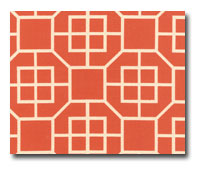
Organic cotton fabric from F. Schumacher & Co.’s By Nature collection

Bonjour/Schlossberg Switzerland, Clinton, N.J.,  has introduced Sensitive
Towels, a terry towel bath line that is manufactured in an eco-friendly manner and is suitable for
users with skin sensitivities. The line has received Cradle to Cradle™ certification from McDonough
Braungart Design Chemistry, Charlottesville, Va.

Research and Markets Ltd., Ireland, has released the report “China Apparel
Industry – New Opportunities for Growth.”

Kaeser Compressors Inc., Fredericksburg, Va., has released its Air Demand Analysis
program, a complete compressed air auditing system that uses data loggers and precision sensors to
create a detailed air usage profile for individual facilities.


bbbrochure


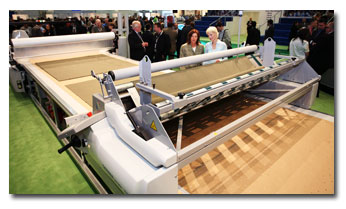
Wm. W. Meyer & Sons’ Pressure/Vacuum Blower brochure


Wm. W. Meyer & Sons Inc.
, Libertyville, Ill., has released a comprehensive
brochure detailing its pressure and vacuum blower packages.

March/April 2009

MSJ Associates Established

MSJ Associates LLC has opened for business in Greenville. Headed by Michael G. Smith, the
manufacturer’s representative and sales/marketing company supplies custom-designed creel racks and
powder coating capabilities, information systems, and carpet manufacturing systems solutions and
automation technology, among other products and services. MSJ also buys and sells used textile
machinery.

March/April 2009

Primer On Nonwoven Fabric Filtration


N
onwoven fabrics have seen impressive growth with penetration into a number of filtration
industry end-use market segments. Until nonwovens began to seriously access the market in the
1970s, woven textiles were the material of choice in many industry sectors. Nonwovens offered a
less expensive alternative and often a distinct technical advantage by the basic attributes of the
nonwoven construction. Today, the filtration industry worldwide is growing at 2 to 6 percent per
year above gross domestic product. Even so, the industry’s best years are ahead, with steady and
accelerated growth expected for the foreseeable future.
gefilters
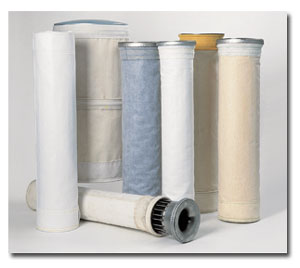
An assortment of nonwoven baghouse filters used on GE air filter systems


Filtration Market Size


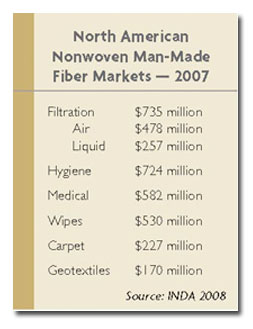
In terms of synthetic nonwoven fabric sales, filtration totaled $735 million in 2007,
according to the Association of the Nonwoven Fabrics Industry (INDA), which reported filtration as
the largest dollar end-use nonwovens market in North America. It is arguably the most profitable
segment. If one were to add in wetlaid cellulose filtration media, total nonwoven fabric filtration
media sales approach $1 billion for North America and $2.1 billion to $2.3 billion worldwide. The
only other filtration media of comparable volume are membranes, with $2 billion to $2.2 billion
worldwide roll good sales in 2007. Together, nonwoven fabric and membrane filtration media dominate
the filtration media market, with more than 90-percent combined market share in terms of roll goods
filtration media volume in comparison to all other material forms. Nonwovens and membranes never
compete with each other in a specific application, as each has its specific advantages, and they
often are combined to complement each other. Typically, nonwoven fabrics add backup support and/or
mechanical strength to comparatively weak membrane media, allowing membranes to function at peak
performance. 

Nonwoven fabric filtration media have dominated in applications such as coolant filtration,
baghouse filtration media, vacuum cleaner bags and many heating, ventilating and air conditioning
(HVAC) applications. In these and other applications, nonwovens are highly price-competitive. Yet,
a number of other end-use segments generate impressive profits, especially in liquid applications
when combined with membranes. 

Air applications consume approximately 65 to 70 percent of the nonwoven filtration media,
with liquid uses consuming the remaining 30 to 35 percent. Liquid application end-uses tend to
generate higher margins for the nonwovens producer because of the specialized constructions and
performance requirements, particularly in the medical, pharmaceutical and microelectronics
industries. In addition, there are rapidly expanding global needs for pure and potable water.
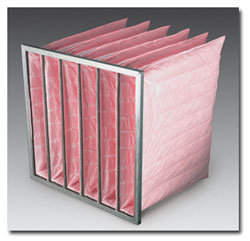
pocketfilter
This pocket air filter from Filtration Group is made of meltblown fabric.


Trends And Drivers 


Several factors are driving nonwoven fabric filtration media growth, but two megatrends
dominate. First, manufacturers worldwide are filtering with greater frequency at finer micron
levels to achieve higher product quality. Examples include chemical processing, “produced water,”
mining, food and beverage, including high-purity processes such as pharmaceutical and
semiconductor. Second, environmental thinking worldwide is expanding at an increasing rate in
virtually every segment of our economy. Federal, state and local regulators are enacting laws and
regulations specifically targeted at discharges and waste streams at an accelerating rate. Most
industry followers believe the new administration in Washington will support further initiatives
and regulations, with the filtration industry being a major beneficiary.


Where Nonwoven Fabrics Dominate


To understand nonwovens growth in filtration, one must understand the close relationship with
membrane filtration media. In many liquid applications, microporous and reverse osmosis membranes
are experiencing rapid growth. Most membrane applications are growing by 8 to 10 percent annually.
Those dealing with water and wastewater are growing up to 15 percent per year and more.  In
light of requirements for finer levels of filtration in many market segments, a number of industry
experts believe this or even higher levels of growth will be sustainable for many years. The major
beneficiary of membrane growth and market penetration continues to be nonwovens used in combination
with membranes in various configurations. For example, nonwoven wetlaid polyester substrates
support reverse osmosis membranes in spiral wrap modules in a $30 million worldwide nonwovens
market. The modules are found in systems predominantly located in arid regions where seawater is
converted to potable water. Spunbond fabrics are used as pleat supports and separators in virtually
every microporous membrane cartridge sold, accounting for nonwoven sales of approximately $35
million per year. 

Nonwoven meltblown and spunbond fabric along with nonwoven glass filtration media are the
principal air filtration media for HVAC – an 825 million- to 850 million-square-meter nonwoven
market in North America. High-efficiency particulate air (HEPA) wetlaid glass nonwoven filtration
media represent an additional 90 million to 100 million square meters. Air filters are found in
end-use markets from general dust filtration to high-efficiency filtration in many different
configurations. These filters are rated by a Minimum Efficiency Reporting Value (MERV) standard,
which rates filters from 1 to 20 in terms of their degree of efficiency. At the high end, MERV 17-
to 20-rated HEPA filters are typically used in situations that require absolute cleanliness for the
manufacture of microchips, liquid crystal display screens, pharmaceutical production and
microsurgery in hospital operating rooms. HEPA filters are primarily constructed from wetlaid glass
nonwoven filtration media, with a smaller portion of the market serviced by polytetrafluoroethylene
(PTFE) membranes laminated to a polyester base substrate for support. MERV 1-16, considered
HVAC-grade filters, are principally constructed of synthetic meltblown, spunbond or glass fabrics.
Overall, 75 percent of synthetic nonwoven media go into commercial markets, such as manufacturing
facilities, offices, theaters, hospitals, cruise ships, casinos and other such markets; with about
25 percent found in residential and general consumer air filters.

Nonwoven fabrics are also used as stand-alone filtration media in pleated cartridges. One
noteworthy example is cartridges, principally spunbond media, in the $30 million pool and spa
market. Other recognized cartridge applications include pleated cellulosic automotive engine
air-intake filters and oil filters on the family car, large semi-rigs and off-road vehicles; as
well as the smallest fuel filters on home lawnmowers, chain saws, power washers and other small
engines. Cellulosic media are relatively inexpensive, and are self-supporting when pleated, a key
factor along with the compatibility of construction materials with fluids and temperatures found
under the hood. 

Wetlaid cellulosic and spunbond polyester media that range from 200 to 300 grams per square
meter (g/m
2) are used in pleated dust collection cartridges. In North America, dust collection
media represents a 15 million-square-meter market that is growing at 5 percent per year, according
to INDA. Pleated cellulose- or polyester-based filters offer significantly greater surface area
than needlefelt filter bags for a given space as an alternative filter configuration in baghouse
applications. Typically, dust collection cartridges and baghouse filters are found in manufacturing
environments and facilities that process materials that generate large quantities of fine, airborne
particles or dust. The filters are used to reduce particulate exhaust and prevent spontaneous
explosion when large quantities of fine particles accumulate in factory air. 

Although pleated dust collection cartridges are an alternative to needlefelt baghouse
filters, needlefelt filter bags remain the clear industry leader in terms of dollars. Needlefelt
sales approach $120 million in North America and $530 million worldwide, with China being by far
the major driver of growth in recent years. Approximately 10 percent of the baghouse needlefelt
fabrics are laminated with a PTFE membrane providing for finer filtration and/or longer bag life.
Separately, the value of micron rated needlefelt fabrics constructed into liquid filter bags is
approximately $25 million to $30 million in North America and $65 million worldwide. For liquid
applications, nonwoven filter bags are used as final filters and in some cases as prefilters,
prolonging the life of final filters in heavily contaminated streams.
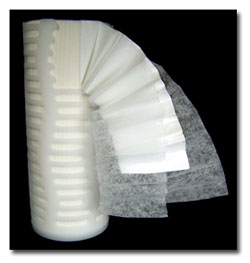
pleats
Pictured above is a cutaway of an Entegris Intercept® HSM 20 nm pleated cartridge filter.


Nanofibers In Filtration


Pleated dust collection and engine air-intake filters have a lightweight cover of synthetic
nanofibers over a base substrate of a wetlaid cellulosic or polyester nonwoven in a growing number
of applications. The nanofibers are as fine as 200 to 300 nanometers (nm) in diameter, with the
amount of nanofiber add-on being quite thin in cross-section and typically weighing less than 1 g/m
2 to 2 g/m
2. The nanofibers are laid down over what will become the upstream side of the substrate
using an electrospinning process, and in one case, an ultrafine meltblown process. These nanofibers
create a labyrinth of fibers with pores finer than particles in the incoming air stream.
Particulate deposits and resides on the surface of the fine nanofiber web, allowing the user to
clean the filter by shaking off loose particles from the surface or by using an automated clean-air
back-pulse system. The market is growing rapidly and is becoming an important market sector. All
major suppliers of air filters to the automotive and dust collection market have either internal
manufacturing processes in place or access to nanofiber media from outside suppliers.

By last count, more than 30 companies worldwide have electrospinning manufacturing processes,
but only a few have decent commercial volume. Many have the objective of producing a
heavier-weight, 15- to 90-g/m
2 stand-alone nanofiber web, without the cellulose or polyester base substrate. The
primary goal is to create filtration media to fill the micron rating gap between the finest
meltblown media and microporous membranes. Some manufacturers seek to mimic microporous membrane
micron ratings with higher flow rates. With regard to manufacturing costs, the relatively low
production speed of electrospinning is ideally suited for lightweight covers over substrates in the
dust collection and engine air-intake filters, as these applications require only a few grams of
fiber to cover the base substrate. Thus, heavier-weight electrospun webs have remained a challenge
because of low process throughput and high production cost compared to alternative filtration media
choices. However, there has been some headway by air filtration media producers who seek to replace
glass media in MERV 17-20 HEPA applications. Nanofiber nonwoven filtration media for applications
in the MERV 10-16 range and potentially for liquid applications clearly remains the largest
untapped potential. Should a lower-cost and/or alternative manufacturing process to electrospinning
be developed that can produce 15- to  60-g/m
2 nanofiber filtration media in the $3- to $5-per pound range, enormous opportunities
exist for the first successful producer.
p34


Conclusion


Nonwoven fabric contributions have been an important mainstay for the success of the
filtration industry for many years, and the future is very bright. As the industry grows, new
constructions will be the order of the day, as there are many unmet media end-use needs and growth
opportunities for an innovative nonwovens producer. The filtration market has a large number of
application niches in which customers are willing to pay for performance. Thus, the most profitable
nonwoven fabric producers offer proprietary materials in less than commodity run size for niche or
near-niche applications. Some of today’s mainstays are gradually fading as new nonwoven fabrics
come to market as differentiated constructions for customers seeking solutions to unmet industry
needs.


Editor’s Note: Edward C. Gregor is managing director of Edward C. Gregor & Associates LLC,
a Charlotte-based consultancy that brings new technologies to market and provides merger and
acquisition services in the fiber, technical textile, nonwoven fabric and filtration industries.

March/April 2009

Clemson, Milliken, Michelin Team For Lunar Wheel Project

Researchers at Clemson University, Clemson, S.C., and Milliken & Company, Spartanburg, are
working with Michelin North America Inc., Greenville, to improve tire tread materials that may be
used on National Aeronautics and Space Administration (NASA) Moon rovers.

Michelin is testing its new non-pneumatic Lunar Wheel, based on its Tweel non-pneumatic tire
technology, on the next generation of All-Terrain Hex-Legged Extra-Terrestrial Explorer (ATHLETE)
Moon rovers as part of a NASA Lunar Analogs testing and evaluation project. The ATHLETE rover is
able to navigate undulating as well as extremely rough or steep terrain such as is found on the
Moon’s surface; therefore, the tread and wheels must be tough yet flexible. The materials also must
endure extreme temperatures and be resistant to ultraviolet and cosmic radiation.

Clemson researchers are in the process of identifying the best tread materials. Fabric
possibilities include nonwoven felts, flat weaves, and cut- and loop-pile fabrics. Possible fibers
include polyaramids, polytetrafluoroethylenes, polyamides, polyimides and polyethylene
terephthalates. Researchers also are designing test equipment and developing computational models
to create tire-sand traction systems that eventually could result in improved tread material.

March/April 2009

Gentle Bleaching


T
he Gentle Power Bleach™ system is said to be the latest innovative pretreatment process
from Huntsman Textile Effects and Genencor. The enzyme-based peroxide bleaching process allows
low-temperature bleaching of textiles at a neutral pH range. By avoiding the use of harsh chemicals
and achieving its potential at low treatment temperatures, the process meets the goal for
environmentally friendly products and processes. This new system excels in its capability to
process textiles more sustainably than conventional bleaching systems while delivering textile
fabrics with enhanced quality.

Switzerland-based Huntsman Textile Effects is constantly developing new platforms to improve
fabric performance and reduce energy and water consumption in the textile industry. Palo Alto,
Calif.-based Genencor, a division of Denmark-based Danisco A/S, focuses on discovering, developing
and delivering highly innovative, eco-friendly, efficient enzyme technologies. Both companies see
this new process as a contribution to a more sustainable textile industry.


Perfect Preparation


The new gentle bleaching process is truly innovative. Traditional bleaching requires a high
water temperature, while the new gentle bleaching takes place at a low temperature of 65°C and
almost neutral pH conditions, making it especially suitable for all delicate fibers that are
temperature- and pH-sensitive. Even after bleaching under these gentler conditions, cotton is
perfectly prepared for dyeing all shades.

By applying the latest enzyme technology as a core component of the solution, it is now
possible under these mild conditions to prepare cotton with very good results for dyeing. On
regenerated cellulosic fibers, excellent full white levels can be obtained as well.  One
recipe is enough for all fibers sensitive to temperature and pH. A multitude of fibers can be
treated, including regenerated cellulosic fibers such as viscose, MicroModal®, lyocell, bamboo and
blends with cotton, elastane, acetate, acrylic, silk and wool. Similar bleaching recipes for all
fibers and blends result in simple recipe management and reduced sources of errors.

Although the technology is completely new, the process flow remains similar to the current
Smart Prep pretreatment system. The process is applicable on all closed discontinuous equipment
such as jets, jiggers, overflow and cheese dyeing machines. A liquid system is offered that is
suitable for automatic dosing systems.

p30
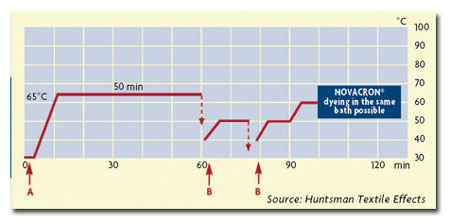
The Gentle Power Bleach™ enzyme-based peroxide bleaching process requires a water
temperature of only 65°C for bleaching and fewer rinsing cycles than traditional bleaching
systems.


Soft Hand


In the case of cotton, fabrics pretreated with the new bleaching technology are said to have
a superior hand compared to that of conventionally bleached goods. The main characteristics are:

•    very soft, bulky and natural hand;

•    fast and permanent effect;

•    excellent crease recovery properties;

•    improved needle resistance, or sewability, and stretch; and

•    very durable elastane properties.

The very mild process conditions also should ensure maximum strength of the textile material,
with the lowest degree of chemical damage on cotton compared to goods processed using traditional
bleaching methods.


Improved Color Yield


Optimal bleaching is a prerequisite for true colors. Compared with traditional bleaching
systems, the Gentle Power Bleach system brings the following advantages to the subsequent dyeing
process:

•    better color yield with more vivid and intense shades that have excellent
fastness properties;

•    brighter shades;

•    possible cost savings in the dyeing process; and

•    improved wash-, water- and rubbing-fastness properties.


Energy Savings …


Energy consumption savings by almost half are possible owing to the considerably lower
treatment and rinsing temperatures compared to conventional bleaching systems. No neutralization is
required, and at least one or two rinsing baths can be omitted, leading to a substantial reduction
in water usage.

When treating cotton, savings over traditional bleaching are attainable thanks to the fact
that the weight loss is reduced considerably. As the material remains naturally soft and bulky,
possible savings in softening may be obtained, and previously unattained softness levels may be
realized.

The new bleaching process further enables improvements in right-first-time production,
reducing costly re-works and second-quality products, and offering the following:

•    improved reproducibility in reactive dyeing by avoiding the risk of
excessive residual alkalinity at the beginning of the dyeing cycle;

•    reduced swelling of the natural fiber and avoidance of a channeling
effect in yarn cheese/package dyeing machines, leading to more uniform results; and

•    reduced risk of crease marking in piece-goods and garment processing.


… And Water Savings


Primarily, the reduced use of water and energy makes this process environmentally friendly.
By lowering the treatment temperature from boiling down to 65°C, the new bleaching technology is
said to be unique in the field of energy reduction. Even rinsing is conducted below this
temperature. Additionally, the effluent salt load is reduced by eliminating harsh chemicals such as
caustic soda. All auxiliaries used exhibit excellent bio-elimination, and are free of alkylphenol
ethoxylates and adsorbable organic halogen. In the case of cotton, the reduced weight loss leads to
a considerable reduction of both biochemical oxygen and chemical oxygen demand in the wastewater
stream. The enzyme-based peroxide bleaching technology is a way forward. It can help the textile
industry make better use of scarce natural resources and contribute to a more sustainable
environment – also for future generations.

March/April 2009

Get Ahead Of Power Costs


E
fficient power usage in the manufacturing environment is essential for containing and, in
some cases, reducing costs; improving productivity; and leveraging the latest available
technologies. Whether for lighting; air compressors; heating, ventilating and air conditioning
(HVAC); electric motors; or aspects of the production process – managing power usage is worth
serious consideration. Large facilities with deep plant engineering capabilities often build energy
efficiency into their planning as well as retrofit programs. Small to mid-sized companies, however,
often need help navigating such projects, particularly if a project is funded by a grant or is
eligible for tax credits.

utilitymen
Power suppliers may offer a wealth of resources to customers seeking to reduce costs by
improving the energy efficiency of their operations.


Where To Turn


Rich Philip, manufacturing market segment manager of Charlotte, N.C.-based Duke Energy
Corp., says help may lie in the hands of the very people who supply the facility’s power. “It is in
everyone’s best interest to make the businesses in the five states we serve as competitive as
possible,” Philip said. “Start with the resources available, like those tools offered on the Duke
website,
www.duke-energy.com. Larger accounts have the benefit of
an account manager, but smaller companies can also tap into the knowledge and experience of their
service provider.”

Duke Energy  provides 35,000 megawatts (mW) of generating capacity for an estimated 4
million US customers in a 47,000-square-mile area covering parts of North and South Carolina, Ohio,
Kentucky and Indiana. Duke Energy International generates approximately 4,000 mW of power,
primarily in Latin America.

In many smaller companies, it is often necessary to bridge the gap among plant management,
the plant engineering area and the company’s finance area to make a project successful, Philip
noted. He cited several areas of interest for textile manufacturers, including drying and curing
processes.

“When you save BTUs [British thermal units], you save money,” Philip said. “In some cases,
replacing some or all of a gas-fired process heating installation with the use of electric infrared
can make a measurable difference – not just in energy savings, but also in reductions of throughput
time. You might consider it for preheating or for the entire process.”


Lighting


Lighting is a common target for energy savings. “There is more to it than simple savings,”
Philip said. “The transition from sodium vapor to metal halide to the current technology available
with T5 lighting can save more than 100 watts per fixture per hour, but also can have a dramatic
effect on the work environment.”

T5 tubular fluorescent lighting technology – “T” stands for tubular and “5” for the number
of eighths of an inch in the bulb’s cross-section – entered the market in 1995 and presents
opportunities in that, in certain configurations, it is quick to light and can be dimmed. The light
quality is often thought to be more pleasing than sodium vapor or metal halide.

“We still deal with the issue of atmospheric versus process lighting,”  Philip
continued, “but T5 has broad diffusion and is very tunable. The quick-to-light aspect lets us save
additional money by installing motion sensors to light areas only when they are occupied. In a
traditional application, sodium vapor or metal halide would stay on the entire shift.”


Electric Motors


“High-efficiency motor programs can be very important in the textile industry just because
of the large quantity of electric motors in certain operations. High-efficiency motors tend to
operate 2- to 8-percent more efficiently than standard motors, and to qualify as a high-efficiency
motor, they must meet or exceed the efficiency levels specified by the National Electrical
Manufacturing Association’s MG-1 standard for motors and generators,” Philip said. “Installation
can pay back in as early as two years and have a positive impact on the long-term operating costs.”

Literature provided by Duke Energy states: “[M]otor systems consume approximately half of
the energy used in the commercial and industrial sectors. Improving the efficiency of motors, and
the systems they drive, can save substantial amounts of energy and reduce operating costs.
High-efficiency motors do cost more, but many models can offer a return on investment within two
years. The cost of operating a motor in the first year is often several times the purchase price.
Reducing operating costs through the purchase of higher-efficiency motors can offer a substantial
payback. For example, an energy-efficient, full-load 50 horsepower motor with 75-percent load
factor can save approximately 4,000 kWhs [kilowatt hours] per year over a standard model. At $.06
per kWh, that can lead to a savings of $240 per year.”

“Cost savings are a part of the decision of whether to replace an operating motor with a
high-efficiency model, replace a motor that has failed with a high-efficiency model or simply
rewind the current model,” Philip commented. “You might also consider adjustable variable speed
drives.”


Compressors And HVAC


“Certainly, motor efficiency applies to compressors as well, but there are other things to
consider,” Philip said. “Many times, new air compressors have been added over time as demand has
increased, and it is worth looking at combining capacity of multiple systems to increase
efficiency. Another area is variable speed technology and, finally, compressed air storage – which
can act as a buffer on demand.”

Technology and government standards also have driven improved efficiencies in HVAC systems.
“It often comes down to better chillers and control, putting conditioned air when and where you
need it,” Philip said. “It is certainly a big challenge of the textile industry, and some processes
are very sensitive to managing the manufacturing environment.”


Worth A Look


“We just completed a project in Indiana with a large manufacturer, and it was a process of
performing audits, ranking perspective projects, determining cost effectiveness and prioritizing
the implementation.” Philip said. “In the current financial state, cost savings go a long way in
improving the economic viability of some manufacturing facilities. We also need to keep an eye on
the various aspects of the economic stimulus package [passed by Congress in February 2009] that may
help with funding, as well as programs the United States Department of Agriculture offers that
assist rural locations. Grants and low-interest loans can increase the financial effectiveness of
these various projects. At Duke, the competitiveness of our customers is essential to the success
of our five-state territory, and a lot can be done to make sure we are manufacturing as efficiently
as possible.”

March/April 2009

Textile Processing For A Changing World


I
MB 2009 – World of Textile Processing will take place at Koelnmesse in Cologne, Germany,
Tuesday, April 21, through Friday, April 24. Organized by Koelnmesse GmbH with the German
Engineering Federation (VDMA) Garment and Leather Technology Association as conceptual sponsor, the
event will feature more than 600 exhibitors from 40 countries presenting process technologies
related to the production of apparel, home textiles and upholstered furniture, as well as for
leather processing. There will be a special focus on technologies for technical textiles and
materials as well as on ecology, resource conservation, product safety and socially responsible
apparel production. Some 25,000 trade visitors – including executives, technical directors,
engineers and buyers – from 120 countries are expected to attend the fair.

imb
IMB visitors examine Gerber Technology machinery on display  at the 2006
exhibition
.

The sector is experiencing what VDMA Garment and Leather Technology Association Managing
Director Elgar Straub calls “radical changes” with respect to the organization of production
locations. “Energy costs have risen and labor costs in some of the low-wage countries have also
increased noticeably. At the same time the sector is counting on more flexibility and productivity
within the whole production chain, from suppliers to distribution The trend toward
individualization is accompanied by an increased awareness of quality. Environmental protection,
resource conservation and social responsibility are further important topics for the whole sector,”
he said. “The sector is closely examining the steadily increasing transport and logistics costs in
relation to cheap products, particularly in regard to environmental protection.”

Exhibition offerings include: design, cutting and computer-aided design and manufacturing
(CAD/CAM), information technology, distribution logistics and material flow; quality control;
joining, sewing and embroidery; product preparation, textile finishing, material flow and knitting
technologies; technical textiles and materials; energy, air-conditioning, disposal and recycling;
research and development; leather processing including shoe manufacturing; and new potentials
including radio frequency identification, textile logistics, packaging and textile machinery.

IMB Forum 2009, “Technology for Shaping the Future – Opportunities through Progress,” will
open Tuesday afternoon with “Future Opportunities: Ecology and Sustainability,” moderated by Dr.
Andreas Stockert of Kühne & Nagel International AG. Wednesday and Thursday sessions will cover
CAD/CAM & Management Solutions, Material Flow/Logistics/Supply Chain Management, Processing of
Technical Materials and Product Development/ Apparel Technology.

On Wednesday evening, the 2nd IMB Innovation Awards, sponsored by the European Commission,
will be presented in three categories: Research & Development; IMB Exhibitor; and Students
& Young Professionals.

At the Speakers’ Corner, exhibitors may make presentations showcasing new solutions and
concepts.

Visitors who register online prior to IMB will be able to expedite entry to the exhibit
halls and also will be able to use Cologne’s transport systems free of charge to travel to the
fair. Visitors also may use IMB’s Internet-based Online Matchmaking service to set up appointments
with exhibitors.


For more information about IMB 2009, contact Ken Dickerson, US project manager IMB, Koelnmesse
Inc. +732-933-1117;
k.dickerson@koelnmessenafta.com; or Karen
Gebauer, Koelnmesse GmbH +49-221-821-3882;
k.gebauer@koelnmesse.de;
www.imb-cologne.com.

March/April 2009

Sales Down, Orders Short


T
he downward-spiraling economic conditions continued to negatively impact spinners in
early March. Orders were down for some spinners by 30 percent or more – and what business is coming
in is significantly shorter than usual.

“We’re still kicking, but everybody wants something cheap. We’re trying to run a full
schedule, but we stood for about a week’s equivalent last month,” said one Georgia spinner. “We’re
running okay right now, but it’s still to be determined how the rest of the month will go. All the
business is very short. Our customers are ordering just what they absolutely have to have and
nothing more.”

Said another spinner: “The pipeline is terrible and all of our orders are small. Our
customers call us and they want their product right now. We’re running all kinds of products just
to stay afloat.”

One North Carolina spinner reported similar business conditions.”Business isn’t what it was,
I can tell you that. We’ve had a rude awakening since about November,” he said. “We’ve had
significantly less forward business written, and we’ve had some major credit issues. Our customers
haven’t been able to pay us, which has put a tremendous amount of pressure on our cash flow. It’s
been a double whammy to have to manage curtailment and cash flow at the same time.”

“We’re running about 75 percent of the volume we had at the same time last year,” said
another Carolinas spinner. “We haven’t had to have any stoppages or furloughs, but we have
downsized. We’ve used a number of temporary employees in the past, and we’ve stopped using that
service.”

Part of the current difficulty can be attributed to waning product development by major
brands. “Normally, we would be seeing requests for new products as retailers look to refresh their
summer lines,” said one spinner. “The majority of our product development comes from the customer,
or the brand through the customer. I think you are seeing retailers becoming entrenched a little
bit as they wait for the economy to improve, so there is not a lot of development being initiated
at the brand level.”


Downward Pricing Pressures


Not only are orders in the tank for many spinners, but it also is becoming necessary to make
price concessions in order to move product.

“Our customers right now are taking a pretty hard line. They know if they can’t get it from
us at the price they want, they can probably get it somewhere else. So, we’ve had to do some hard
negotiating,” one spinner explained. “Some of our customers see the downward curve in cotton and
think the effect on yarn pricing should be immediate. But it doesn’t work that way.”

Another spinner agreed. “We are coming under more and more pressure to come down some. It’s
definitely a buyer’s market right now. Customers can pretty much dictate price up to a point,” he
said.


A Glimmer Of Hope?


Of interest to many spinners – and a source for limited optimism – was the announcement in
early March by big-box retailer Wal-Mart that same-store sales in February soared 5.1 percent, more
than double analysts’ predictions. Overall, in the retail segment, while sales continued to slump
in February, the decreases were not as deep as initial forecasts had indicated.

“The fact that Wal-Mart is showing some signs of improvement is encouraging,” said one
spinner. “But, I imagine a lot of that increase is in perishables – food items and such – and not
consumer goods. But, just the fact that people were spending a little more money in February gives
us hope that, once the weather improves and consumers start shopping for spring and summer
fashions, some movement will take place.”

Overall, spinners who originally were hoping for significant improvement by June are now
hoping there will be a significant uptick by the end of the third quarter.

“Judging by what I am reading and seeing on the news, it could be at least that long before
business improves,” said one spinner. “I just hope a lot of us are still around to see it.”

March/April 2009

Textile Makers Seek Government Help


W
ith the Obama administration and Congress working on ways to create and save jobs
throughout the economy, US textile manufacturers are seeking government help to stem the flow of
job losses. The Bureau of Labor Statistics says the textile industry has lost 102,000 jobs since
2005 and 39,000 last year alone. Textile manufacturers are looking to the government for help in a
number of areas, and they are encouraged that Washington appears to be making an effort to help
turn things around.


Buy American


Textile manufacturers are pressing the Obama administration to expand coverage of the Buy
American provisions in the American Recovery and Reinvestment Act of 2009 to cover a broader range

of government agencies. For several years, textile manufacturers and their supporters in
Congress tried unsuccessfully to expand to other government agencies the Buy American requirements

for Department of Defense (DoD) procurement of textile products under the so-called Berry
Amendment. When the Department of Homeland Security (DHS) was created, they saw a new opportunity,
but Congress balked at it, as government agencies have been opposed to those restrictions. However,
declining employment in the manufacturing segment of the economy and the ecnomic stimulus package
presented a new opportunity, and this time around, Congress enacted the Kissell Amendment, modeled
after the Berry Amendment.

The Kissell Amendment requires that uniforms purchased by the Transportation Security Agency
(TSA) be 100-percent US-made, and industry representatives believe it leaves the door open for
expansion to other DHS agencies such as the Federal Emergency Management Agency, Customs and Border
Protection, Secret Service, and Citizenship and Immigration Services. Textile industry
representatives say the DoD’s current purchases of $2.8 billion under the Berry Amendment support
some 35,000 US jobs, and they believe the TSA purchases under the Kissell Amendment could produce
another 20,000. Expansion of the Kissell Amendment beyond the TSA uniforms would be dependent upon
where it can be determined that Buy American would be in the interest of national security and the
Obama administration’s desire to expand coverage. Because the Kissell Amendment states it must be
applied in a manner “consistent with United States obligations under international agreements,” it
would be necessary for the administration to work with other governments to clear the way for any
expansion. Textile lobbyists will be asking President Barack Obama to use his authority to expand
coverage, or they could seek additional legislation if necessary.

Another provision in the new economic stimulus package says iron, steel and manufactured
products used in construction funded by the aid package must be made in the United States unless
they are not available or would increase the cost of the overall project by more than 25 percent.
Manufacturers of geotextiles see opportunities under the manufactured products category.

While several overseas countries and officials of the World Trade Organization (WTO) have
expressed their concern over protectionist measures, US manufacturers claim Kissell Amendment
requirements do not violate any international commitments, and they charge that many of the
complaining countries have laws of their own to protect domestic manufacturers.

Laura Jones, executive director of the United States Association of Importers of Textiles
and Apparel, whose organization historically has opposed Buy American, believes the new
measures  “are not right way to go,” saying that “this type of thinking can lead to other
areas of protectionism that are not healthy.”

Since the Buy American effort has the strong support of organized labor as well as many
manufacturing industries, it could fare well with the Obama administration and the Democratic
Congress.


China Trade Issues


Problems with Chinese trade, which accounts for more than half of the total US trade deficit
and more than half of apparel imports, remains on the radar scope of textiles and other
manufacturing industries. Both President Obama and the Democratic leadership of Congress have been
outspoken in citing the need for action to combat what they see as China’s illegal and unfair trade
practices.

In connection with this confirmation hearing before the Senate, Treasury Secretary Timothy
F. Geithner accused China of manipulating its currency and said the United States would move
aggressively to address the problem.

The International Trade Commission (ITC) has begun monitoring Chinese imports of 34 apparel
product categories that were released from quota controls last December 31. The action was
requested by the leadership of the House Ways and Means Committee, who are concerned there might be
a surge in imports from the “sensitive” product categories following removal of quotas. The ITC
report will trace historical patterns of trade and report to the committee every two weeks on
current developments. If a surge is detected, it would form the basis for the United States to
invoke its trade remedies such as countervailing duties or other actions.

On a broader scale, US textile manufacturers, organized labor and other industries continue
to press for action to counteract what they say is China’s currency manipulation, and before the
new administration took over, the US Trade Representative (USTR) filed a dispute settlement case
with the WTO against what it says are various illegal subsidies that China provides its industrial
sector. The USTR case charges that China is granting rewards for exporting, preferential loans for
exporters, research and development funding to develop new products for export, and payments to
lower the cost of export credit insurance. The USTR action was due in part to an investigation by
US textile trade associations that cited a wide range of subsidies China uses to promote its
exports.

While the Bush administration favored negotiations over harsher actions such as punitive
tariffs being pushed by a number of key members of Congress, the Obama administration is likely to
take a much stronger stance on a number of China trade issues.


CPSC Nets Funding, Expanded Authority


A newly constituted Consumer Product Safety Commission (CPSC) will have considerable impact
on a number of textile industry issues. Under the Bush administration, CPSC limped along with two
of three eligible commissioners and a lack of funds. But Congress has given CPSC new funding and
expanded authority stemming from the flap over lead in toys and other children’s products. The
Consumer Product Safety Improvement Act (CPSIA) has created a whole new ball game. It will require
all consumer products subject to existing regulations to comply with a testing and certifications
process. Manufacturers can determine how they want to go about testing, but they must certify that
their products meet safety standards. While CPSC’s first action under the new law applied to lead
and phthalate contents in children’s toys and products intended for children, it applies to all
other regulated products and could eventually be applied to upholstery fabric and bedding products
standards that are under development at CPSC.

CPSC created a fire-storm when it ruled, and a federal court concurred, that the testing and
certification apply retroactively. Recognizing that the retroactivity was causing major problems in
the marketplace, CPSC on February 6 granted a one-year stay for certain testing and certification
requirements. The commission stated that “until additional decisions are issued, all businesses …
must still be sure that their products conform to all safety standards and similar requirements,
including the lead and phthalates provisions of CPSIA.” In other words, manufacturers need not test
their products in any specific manner during the moratorium period, but their products nevertheless
must meet the requirements of the standard. That did not solve problems with retailers, who are
concerned that products they have on their shelves or on order could at some later date be deemed
not in compliance. The action was designed to give CPSC time to finalize rules that could relieve
certain

materials and products from testing. US textile manufacturers have made a strong case that
none of their products contain lead, and that is probably true with imports as well.

March/April 2009

Textiles: Challenging Times Yield Opportunity


T
he concept that tough times breed opportunity is true. In the midst of trying to survive,
making tough choices and dramatically changing your company, opportunity subtly avails itself.

In a marathon, running with the pack is comfortable – the pace is set, there is strategic
positioning in play, but no real change happens until a major physical challenge occurs. When the
pack hits the hill – sometimes known as the wall – all of a sudden, individuals get on the move.
The hill will claim its victims. Some will fall back and regroup, some will pull forward, and still
others will exit the race.

This is no time to be all hearts and flowers about US textiles. Global textile companies are
facing incredibly difficult business decisions. Those decisions are affecting the opportunity
landscape for those companies that can maintain during this period.

It might seem odd to suggest that this is a time of opportunity, but it truly is for those
companies positioned for a long view – yes, that might as well read companies that are
well-capitalized.

Take the example of a really interesting deal between Lubbock, Texas-based Plains Cotton
Cooperative Association (PCCA) and Guatemala-based Koramsa Corp. to establish a new company,

Denimatrix LP.

Koramsa, under the leadership of its well-known and revered President Carlos Arias,
developed a strong reputation for innovation and fashion in the jeans-manufacturing sector. The
recent economic environment took its toll on the company, but no one ever doubted the skill and
capability of the company or Arias.

Enter PCCA – and its American Cotton Growers (ACG) denim plant. PCCA has been a major denim
player for years and controls its process from cotton field through finished denim.

Why not extend that reach through the supply chain? You bet.

Hence, Denimatrix LP was established with PCCA’s purchase of key assets of Koramsa. PCCA
President and CEO Wally Darneille announced that Koramsa’s management team will stay in place, and
PCCA will keep producing denim at its Littlefield, Texas, plant.

It’s been reported that Denimatrix expects to offer retailers a 60- to 90-day advantage over
Asian and Middle Eastern supply chains and will be the first fully integrated vertical supply chain
in the Western Hemisphere – from cotton grown in Texas, to jeans manufactured and finished in
Guatemala City.

Arias announced he has orders in hand from two major brands and expects first units to go
out the door in early May.

Difficult times, yes – but if you’ve ever met or worked with the people associated with PCCA
or Koramsa, you have to cheer the gutsiness of this move. It gets back to collaboration,
partnership and innovation – only time will tell.

March/April 2009

Sponsors